Preparing the current spcent route.
The page shell is online. Shared content and route data are still being assembled.
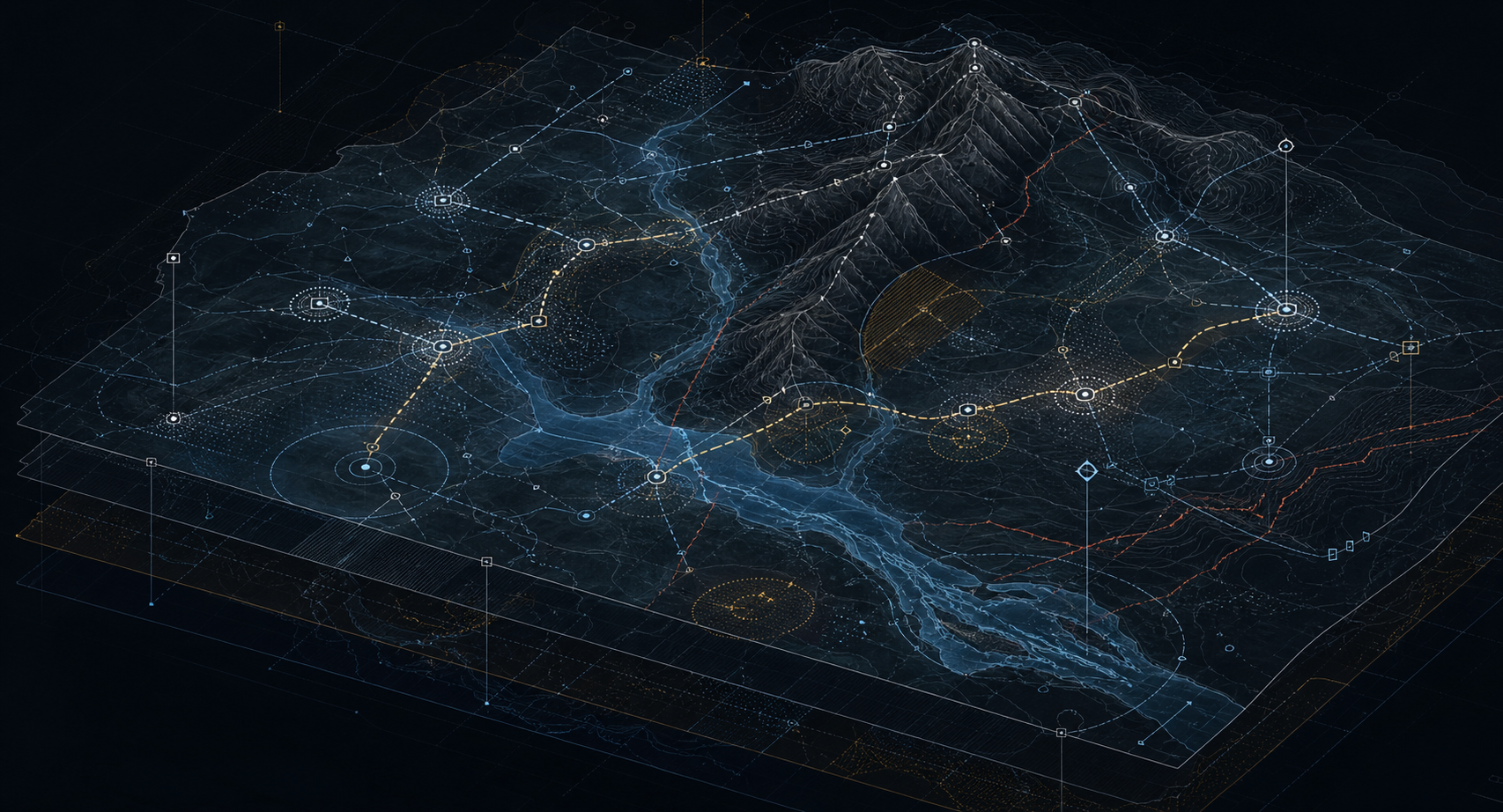
Spcent helps creators build worlds through world models, systems thinking, and spatial structure.
Structure over fragments. Logic over loose lore.
Worlds, Systems, Spatial, Studies, Guides, and Archive define the entry layer.
Frameworks, Models, Studies, and Glossary hold the reusable content underneath.
24 entries currently sit inside the strongest program branch.
50 entries currently anchor the dominant operating scale.
The present version already supports guided reading across multiple structural layers.
Each program hero now exposes a visual identity, live coverage count, and a recommended path so homepage browse can start from a durable editorial branch instead of only from modules or collections.
Explain how resources, goods, labor, information, and force circulate, stall, buffer, and break.
Start from the resource-flow loop, trace storage and throughput models, compare one logistics study, then run a flow audit worksheet.
Explain how legitimacy, coercion, administrative reach, frontier bargaining, and elite control are structured.
Start with the pressure map, locate legitimacy and capture mechanisms, validate against a frontier or state case, then run a governance stress test.
Explain what the world is materially built from before politics, balance, or style are discussed.
Start in Worlds, read the anchor framework, open one regional model, validate with a complete study, then finish with a world assembly guide pass.
Explain how technology, magic, infrastructure, communication, and transformation capacity rewrite baseline constraints.
Start with the operating regime, price the capability through diffusion or monopoly models, compare a regime-rewrite case, then run a capability sanity check.
The homepage now shows the next planned build-out for each program branch, so editorial expansion stays visible as part of the product surface.
Start in Worlds, read the anchor framework, open one regional model, validate with a complete study, then finish with a world assembly guide pass.
This branch currently has no planned backlog items in the generated queue.
Start from the resource-flow loop, trace storage and throughput models, compare one logistics study, then run a flow audit worksheet.
This branch currently has no planned backlog items in the generated queue.
Start with the pressure map, locate legitimacy and capture mechanisms, validate against a frontier or state case, then run a governance stress test.
This branch currently has no planned backlog items in the generated queue.
Start in Spatial, reduce the map into region graph and corridor logic, test topology under disruption, then return through a spatial design guide.
This branch currently has no planned backlog items in the generated queue.
Start with sustainment and projection models, identify the theater cycle, validate through an operational case, then run an operations stress test.
This branch currently has no planned backlog items in the generated queue.
Start with the urban logistics surface, step into gateway and throughput models, compare a port or capital study, then run a city-region worksheet.
This branch currently has no planned backlog items in the generated queue.
Start with the operating regime, price the capability through diffusion or monopoly models, compare a regime-rewrite case, then run a capability sanity check.
This branch currently has no planned backlog items in the generated queue.
Start with transformation and failure models, trace residue and recovery paths, compare a collapse or successor-order study, then run a failure-mode review.
This branch currently has no planned backlog items in the generated queue.
Start in Guides with the workflow framework, choose the role route, open the supporting program branches only as needed, and leave with a worksheet or review artifact.
This branch currently has no planned backlog items in the generated queue.
These shelves turn featured nodes into branch-level flagship reading, so the homepage exposes one editorial shelf per durable program instead of only a global mixed list.
Explain how resources, goods, labor, information, and force circulate, stall, buffer, and break.
Featured floor and mix are currently met for this branch.
Explain what the world is materially built from before politics, balance, or style are discussed.
Featured floor and mix are currently met for this branch.
Explain how technology, magic, infrastructure, communication, and transformation capacity rewrite baseline constraints.
Featured floor and mix are currently met for this branch.
Explain campaigns, sustainment, force projection, defensive depth, and operational windows as structural systems.
Featured floor and mix are currently met for this branch.
Explain transition, disturbance, collapse, recovery, and reassembly across eras and stress cycles.
Featured floor and mix are currently met for this branch.
Explain how legitimacy, coercion, administrative reach, frontier bargaining, and elite control are structured.
Featured floor and mix are currently met for this branch.
The homepage now surfaces five live lanes: material, ecology, mobility, advanced analysis, and case proof.
The newest Worlds expansion now connects material continuity, food-energy base, infrastructure burden, industrial conversion, and monopoly-forming capability into one visible route.
The newest spatial lane now connects multi-layer movement, borders, maritime chokepoints, map abstraction, and route-control studies into one visible reading path.
Ecology is no longer only a habitat layer. This lane brings disturbance, disease mobility, buffering landscapes, and recovery burden into direct view as structural worldbuilding tools.
The graph now includes an explicit advanced lane for transformation, cascading failure, infrastructure rewrite, successor assembly, and the new structural audit workflow.
M019 did not only add models. It added historical, fiction, and synthetic studies that prove substrate and capability analysis inside complete settings.
Open these when you want the platform logic explained visually, not just navigated.
Physical constraints, viable routes, and concentrated resources shape where settlement and civilization can plausibly emerge.
Combat, economy, and progression are not isolated mechanics. They reinforce, counterbalance, and redirect one another over time.
Topology, region graphs, and layered maps explain adjacency, bottlenecks, and territorial reach across a world.
Modules organize the public surface. Schemas and relations stay underneath.
Build complete world models across geography, civilization, ecology, resources, technology, and history.
SystemsDesign combat, economy, progression, power structures, and feedback loops.
SpatialModel topology, region graphs, map layers, AOI, slicing, and spatial networks.
StudiesAnalyze how existing fictional worlds and games actually work as systems.
GuidesLearn structured worldbuilding workflows, systems thinking, and self-consistency methods.
ArchiveBrowse the full index, glossary, and knowledge map of Spcent.
These tracks turn Worlds, Systems, and Spatial into clearer starting routes.
Start from terrain, settlement, surplus, and civilizational pressure so the world has structural coherence before detail expands.
Systems TrackTrace loops, surplus capture, institutional pressure, and disruption so the world behaves like a system rather than a list of mechanics.
Spatial TrackAbstract maps into nodes, corridors, and stress scenarios so movement and leverage become legible before visual polish.
This shelf points to complete settings where several world layers have to hold together at once.
An assembled example world showing how convoy seasons, relay ports, warehouse islands, and distributed sovereignty create a maritime commonwealth that is connective but fragile.
An assembled example world showing how irrigated granary cores, horse-frontier mobility, and fortified corridor towns create a political field of repeated expansion and recoil.
An assembled example world showing how deep water access, ritual infrastructure, and magical monopoly can produce a theocratic basin state that is rich in control but brittle at its hidden sources.
Open these when you want the editorial rules behind the routes.
Landforms, routes, barriers, gradients, and territorial shape.
Settlement logic, institutions, expansion pressure, and power centers.
Extraction, scarcity, logistics, dependency, and exchange patterns.
Region graphs, adjacency, chokepoints, corridors, and layered spaces.
Feedback loops, constraints, cascading effects, and equilibrium shifts.
How worlds change across time under pressure from structure and interaction.
Modules answer intent. Collections answer content type.
Explicit systems and dynamics that can be reused or adapted.
Applied analyses that show systems operating in context.
Canonical terms for discussing spatial and systemic design.
Use this for a quick coverage read.
These counts make the content system legible beyond route and collection alone.
Use this when you want a short editorial reading set.
A planning frame for mapping how geography, settlement, resources, and transit form a region's structural identity.
A model for how extraction, transport, storage, transformation, and redistribution create stability or fragility in a world system.
A sample systems study showing how basin agriculture, defensive ridges, and narrow passes produce a dense but brittle civilization pattern.
A framework for tracking expansion, consolidation, frontier friction, and institutional fatigue across a civilizational space.
These pages turn the graph into routes, audits, and worksheet outputs.
Use this guide when you need a first coherent pass through the world and want to avoid building decorative lore on top of weak physical or material structure.
Use this guide when the draft has lots of ingredients but no clear explanation of how they reinforce, balance, or destabilize one another.
Use this guide when you want one flagship operating path across Worlds, Systems, and Spatial before expanding into narrower branches or adding more case detail.
Use this guide when a capital, harbor, or relay city feels important in premise but still lacks visible buffering, dispatch geometry, and hinterland service logic.
Use this guide when force can move and fight in premise, but you still cannot explain whether it can stay effective, reopen pressure after disruption, or hold what it reaches.
Use this guide when a special capability is starting to reshape the setting, but you still cannot tell whether it is decorative, elite-limited, or truly structural.
Use this guide when the problem is no longer whether disruption happens, but how it propagates, when buffers fail, and what narrower order remains afterward.
Use this guide when you need an end-to-end order of operations that ties worlds, substrate continuity, systems, spatial logic, and studies into one repeatable process.
Use this guide when the setting is rich enough to feel convincing in fragments but not yet coherent as a whole.
Use this guide when your map is readable as artwork but not yet readable as structure, especially once decisive cities still feel like abstract points.
Use this guide when the world feels broad on the surface yet still lacks a clear repair target in constraints, flow, node hierarchy, or applied proof.
Use this guide when you need a concrete workflow for transformation boundary analysis, cascade propagation, inheritance auditing, and successor-system planning.
Use this guide when the draft has premise and atmosphere, but still needs one reliable structural pass through region, substrate, route, and applied proof.
Use this guide when the question is no longer what systems exist, but whether their loops, chokepoints, and collapse paths are legible enough to design against.
Use this guide when the job is no longer writing one page well, but keeping a larger world program coherent across teams, revisions, and escalating complexity.
Most worldbuilding platforms provide inspiration. Spcent provides structure for virtual worlds.
160 starter entries currently demonstrate the model.