Preparing the current spcent route.
The page shell is online. Shared content and route data are still being assembled.
A historical study of how maritime ports, inland corridors, quarantine filters, and dense urban nodes turned disease exposure into a system-wide commercial and political shock.
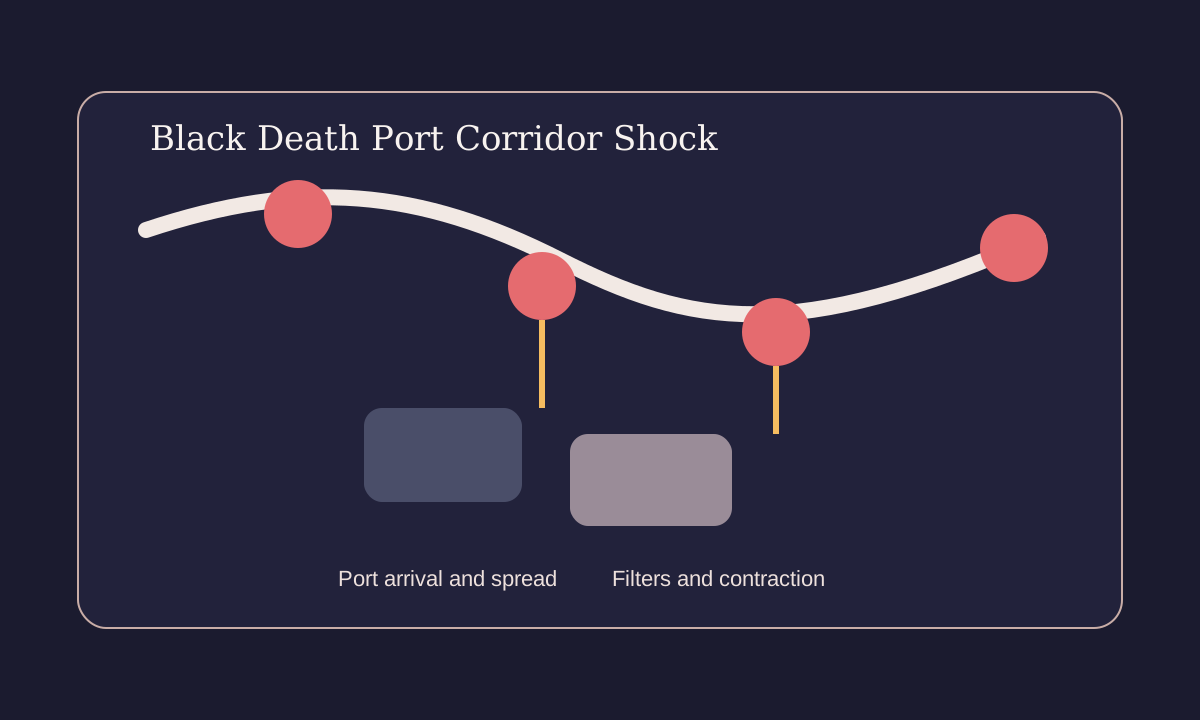
The Black Death is most useful here not as a medical chronology, but as a corridor shock. Maritime ports, caravan routes, market towns, barracks, and urban wards kept moving people, cargo, animals, and contaminated material through the same networks that ordinarily sustained commerce and governance.
That makes the case a strong ecology-shock study. Disease pressure did not float above the world system. It moved through port turnover, route density, and uneven local filters, then forced institutions to choose between closure and continuity.
Provides the core lens for understanding why movement systems repeatedly reintroduced exposure faster than cities could fully stabilize.
Wetland Buffer RegimeClarifies why marsh edges, quarantine islands, and port-adjacent water environments could both buffer traffic and intensify exposure risk.
Maritime Chokepoint NetworkExplains why a few dense sea-lane and port sequences mattered disproportionately for the wider spread and contraction pattern.
The decisive structural pattern is uneven closure. Ports could not simply stop being ports, and inland corridors could not fully disappear without major commercial loss. Instead, cities and polities introduced filters: quarantines, cordons, selective closures, ward restrictions, and staggered market behavior. Exposure kept moving, but under higher friction and deeper mistrust.
| Axis | Question | Signal |
|---|---|---|
| Maritime arrival | Why did exposure keep entering despite obvious danger? | Port turnover, ship crews, cargo handling, relay harbors, protected sea-lane dependence |
| Dense node amplification | Where did passing exposure become durable urban stress? | Market towns, ward density, labor quarters, barracks, storage districts, burial overload |
| Selective filtering | How did institutions try to slow spread without ending movement altogether? | Quarantine islands, ward gates, inspected cargo, port delay, road cordons, closed fairs |
| Commercial contraction | What wider pressures emerged once exposure changed movement behavior? | Crew shortage, credit strain, labor scarcity, route avoidance, market timing drift, legitimacy stress |
Use the toggle to see which layer matters most under routine turnover, selective quarantine, or wider labor shock.
Under ordinary conditions, the same dense nodes that sustain trade also create the exposure geometry that later makes filtering costly and incomplete.
The reusable lesson is that disease shock should be modeled as movement shock plus filtering burden. The Black Death is useful because it shows how exposure, corridor dependence, and selective closure can reorganize a whole system without ever reducing the world to full stoppage.
Read what should come before it, what relation role matters next, and where this page should hand you off after the local graph is clear.
Start with Disease Mobility Regime and then return here once the surrounding concept stack is clear.
These entries clarify the footing underneath the current node before you move outward again. Start with Disease Mobility Regime when you want the clearest next role.
Use Guides when the study should feed into a worksheet or structured revision sequence.
2 handoff nodes stay inside Evolution And Breakdown. 2 handoff nodes share Network.
Detail pages now expose the branch and scale of their surrounding graph before showing raw prerequisite and relation shelves, so continuation can stay taxonomy-led instead of adjacency-led.
Explain transition, disturbance, collapse, recovery, and reassembly across eras and stress cycles.
Start with transformation and failure models, trace residue and recovery paths, compare a collapse or successor-order study, then run a failure-mode review.
Explain how cities work as filters, gateways, relays, conversion surfaces, and regional control machines.
Start with the urban logistics surface, step into gateway and throughput models, compare a port or capital study, then run a city-region worksheet.
Explain how resources, goods, labor, information, and force circulate, stall, buffer, and break.
Start from the resource-flow loop, trace storage and throughput models, compare one logistics study, then run a flow audit worksheet.
Use this scale when routes, relays, buffers, and linked nodes matter more than territorial bulk.
Use this scale when the region is the main leverage unit for settlement, extraction, governance, or conflict.
Use this scale when the strongest explanation depends on several levels staying visible together.
Use this scale when internal city geometry or gateway-district filtering is the level that matters most.
Use prerequisites when you want the shortest path into the assumptions this page depends on.
A model for how corridors, ports, barracks, migration pulses, and immunity mismatch turn movement systems into repeating health pressure.
A model for reading straits, island chains, convoy arcs, and port ladders as one network where sea-lane leverage depends on sequencing as much as on any single port.
These groups explain why each neighboring node matters, whether it stabilizes the concept, operationalizes it, proves it, or pushes the lane further.
Use foundation relations when this node depends on a concept, term, or framing layer that should be explicit before you branch further.
A model for how corridors, ports, barracks, migration pulses, and immunity mismatch turn movement systems into repeating health pressure.
A model for reading straits, island chains, convoy arcs, and port ladders as one network where sea-lane leverage depends on sequencing as much as on any single port.
Use operationalizing relations when you want the current abstraction rendered as a cleaner model, loop, or structural device.
A model for how marshes, floodplains, reed belts, and seasonal wetlands absorb flood energy, disease pressure, nutrient renewal, and route friction at the same time.
Use extension relations when the next move is not prerequisite or proof, but a deeper neighboring step in the same graph lane.
A model for how walls, canals, customs lines, policing regimes, class barriers, and street hierarchy make some urban districts easy to cross and others selectively closed.
These entries still matter, but they currently rely on generic adjacency instead of typed continuation semantics.
An assembled example world showing how convoy seasons, relay ports, warehouse islands, and distributed sovereignty create a maritime commonwealth that is connective but fragile.
A structural study of how harbor clearance, district specialization, and regional servicing tied Hong Kong to a much larger hinterland than the city itself could physically contain.
Studies apply Spcent's lenses to complete cases. Read them to see whether geography, surplus, corridors, and pressure patterns still make sense when placed inside one setting.
The goal is not to retain setting trivia. The goal is to extract reusable patterns and structural habits you can reapply elsewhere.
Studies are strongest when you already know the frameworks and models underneath them, so you can recognize the structural moves being made.
After reading a study, identify which layer of your own draft needs work and go back there with one concrete change in mind.
Keep these collapsed until you want to turn the page into an active reading exercise.
What are the decisive regions, corridors, or chokepoints in this case?
What keeps the studied world stable, and what makes it brittle?
Which model or framework do I need next if I want to reproduce this pattern in my own project?
These routes are tuned to the kind of entry you are currently reading, so you can leave this page with one deliberate next move.
Use Guides when the study should feed into a worksheet or structured revision sequence.
Cross-layer moveReturn to the worlds module when the case highlights a weak worldbuilding layer in your own draft.
Cross-layer moveOpen models when the case reveals a mechanism you want to isolate and reuse directly.