Preparing the current spcent route.
The page shell is online. Shared content and route data are still being assembled.
A framework for reading movement as stacked road, river, sea, border, and administrative layers whose overlaps decide gateway leverage, rerouting options, and operating reach.
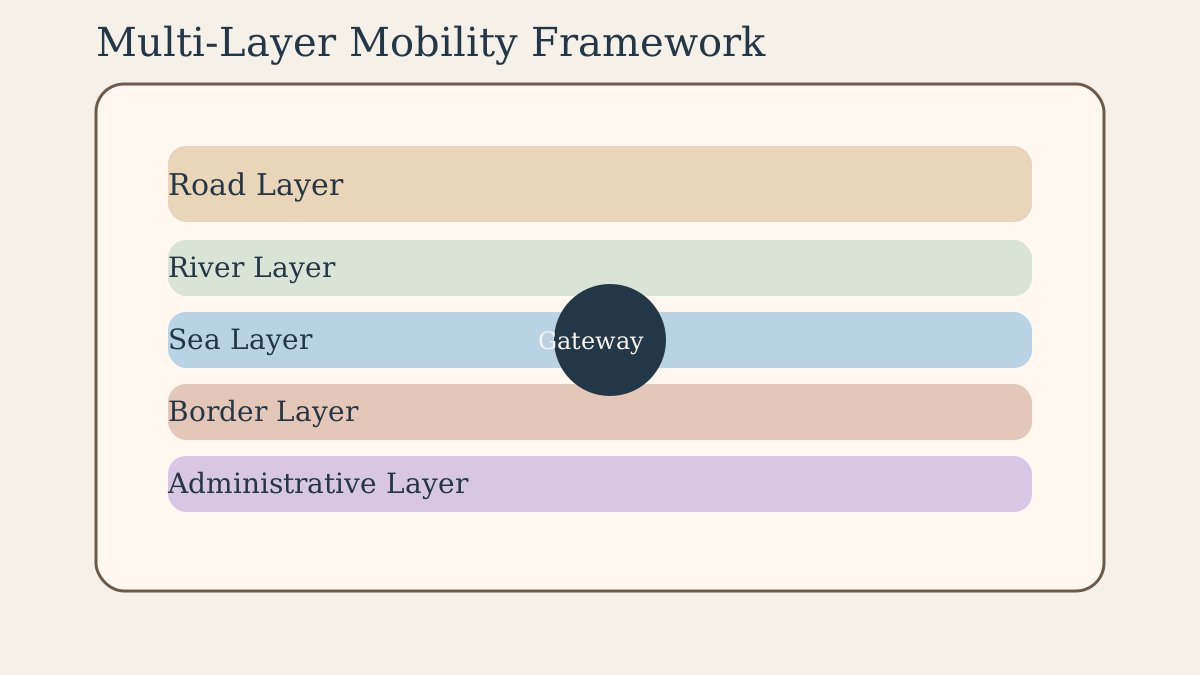
Mobility is rarely one network. A world usually moves through several stacked layers at once: roads, rivers, sea lanes, border crossings, and administrative corridors. Some layers move cargo cheaply. Others move authority, permits, escorts, or information.
The multi-layer mobility framework treats those layers as one coupled field. That makes it easier to explain why one gateway city becomes indispensable, why a border looks open for merchants but closed for armies, and why a sea lane can remain fast while still being politically slow.
| Axis | Question | Signal |
|---|---|---|
| Road layer | Where does regular land movement stay economical enough to repeat? | Caravan spines, military roads, wagon routes, relay towns, pass roads |
| River layer | Where does current-assisted bulk movement reshape regional hierarchy? | Canals, navigable rivers, lock points, portage cuts, floodplain depots |
| Sea layer | Which coasts and straits support long-distance throughput or naval reach? | Protected harbors, convoy arcs, island chains, straits, monsoon lanes |
| Border layer | Where does crossing cost change even if geography stays passable? | Customs mouths, fortified crossings, visa gates, tariff zones, patrol belts |
| Administrative layer | Which routes remain governable enough for permits, reserves, and repair to keep moving? | Tax districts, courier relays, depot chains, command corridors, regulated gateways |
A flat route map usually hides the real reason mobility feels easy or difficult. Cargo may move cheaply by river while information still travels slowly across the same region. Merchants may cross a frontier routinely while troops face customs delay, inspection, or escort burden. Sea lanes may connect two coasts quickly, yet inland transfer capacity may still make one harbor strategically shallow. The framework exists to keep those differences visible.
Once those layers are separated, gateway leverage becomes easier to explain. Important mobility nodes are rarely important because they are centrally located in geometric space. They matter because several movement and control layers converge there at once, allowing the same place to coordinate transport, taxation, permissions, reserve depth, or rerouting.
The strongest gateways are usually not those sitting on only one transport line. They matter because several layers converge there at once. A city can be ordinary as a road stop, but decisive once it also concentrates customs, naval staging, and inland redistribution.
This framework also helps explain asymmetric openness. The same border can be permeable to smuggling, expensive for grain convoys, and nearly sealed for reinforcement columns. Reading mobility as one flat route network hides those differences.
The fastest diagnostic move is to choose one actor and trace one concrete movement task through all five layers. Can grain move from river port to inland depot without customs delay? Can an army use the same corridor that merchants use? Can a courier outrun cargo congestion or is it trapped inside the same transfer queue? Questions like these reveal whether the draft has one coherent mobility field or several overlapping ones with different users and costs.
Use this when crossing cost and asymmetry are deciding who can really use a route.
Maritime Chokepoint NetworkOpen this when sea lanes, straits, and port chains dominate the movement stack.
Gateway CityUse the term when one urban node coordinates transfers across several mobility layers at once.
The reusable lesson is that mobility becomes legible when transport and control are read together. Use the framework whenever route leverage depends on transfer surfaces, border friction, or the overlap between movement and administration rather than on raw distance alone. That same lens also helps explain why one class of actor moves easily through a region that still feels slow or hostile to everyone else.
Read what should come before it, what relation role matters next, and where this page should hand you off after the local graph is clear.
Start with Region Graph and then return here once the surrounding concept stack is clear.
These entries clarify the footing underneath the current node before you move outward again. Start with Semantic Map Layering when you want the clearest next role.
Move into explicit mechanisms once this framework has clarified the structure you need to explain.
4 handoff nodes stay inside Spatial Structures. 2 handoff nodes share Cross Scale.
Detail pages now expose the branch and scale of their surrounding graph before showing raw prerequisite and relation shelves, so continuation can stay taxonomy-led instead of adjacency-led.
Explain how topology, region graphs, corridors, map abstraction, and scale determine movement and leverage.
Start in Spatial, reduce the map into region graph and corridor logic, test topology under disruption, then return through a spatial design guide.
Explain how legitimacy, coercion, administrative reach, frontier bargaining, and elite control are structured.
Start with the pressure map, locate legitimacy and capture mechanisms, validate against a frontier or state case, then run a governance stress test.
Explain how resources, goods, labor, information, and force circulate, stall, buffer, and break.
Start from the resource-flow loop, trace storage and throughput models, compare one logistics study, then run a flow audit worksheet.
Use this scale when routes, relays, buffers, and linked nodes matter more than territorial bulk.
Use this scale when the strongest explanation depends on several levels staying visible together.
Use this scale when the region is the main leverage unit for settlement, extraction, governance, or conflict.
Use this scale when city-scale transfer, concentration, or control is doing the main structural work.
Use prerequisites when you want the shortest path into the assumptions this page depends on.
A spatial abstraction that represents regions as connected nodes so adjacency, flow, and chokepoints can be reasoned about systematically.
A durable movement spine where terrain, settlement, exchange, and repeated transit align strongly enough to guide long-run circulation.
These groups explain why each neighboring node matters, whether it stabilizes the concept, operationalizes it, proves it, or pushes the lane further.
Use foundation relations when this node depends on a concept, term, or framing layer that should be explicit before you branch further.
A model for separating terrain, routes, ownership, throughput, and risk into deliberate visual layers so a map answers one structural question clearly.
Use operationalizing relations when you want the current abstraction rendered as a cleaner model, loop, or structural device.
A model for comparing how borders change crossing cost, asymmetry, inspection burden, and rerouting behavior for different actors and flows.
A model for reading straits, island chains, convoy arcs, and port ladders as one network where sea-lane leverage depends on sequencing as much as on any single port.
Use extension relations when the next move is not prerequisite or proof, but a deeper neighboring step in the same graph lane.
A framework for tracking which passes, ports, narrows, and crossings decide political leverage at the edge of a system.
These entries still matter, but they currently rely on generic adjacency instead of typed continuation semantics.
A model for reducing a full map into a small graph of meaningful nodes, edges, weights, and transfer surfaces without losing the questions that matter operationally.
A city whose importance comes from coordinating transfers between several movement layers rather than from local size alone.
Frameworks are broad structural lenses. Use them to decide what to compare, map, or diagnose before committing to a more explicit mechanism.
A framework tells you what variables and contrasts matter. It is less about behavior and more about what deserves structured attention.
Open a framework when a world or system still feels under-framed and you need a reusable way to inspect the problem space.
Once the pattern is visible, the next step is usually a model that explains the mechanism more explicitly.
Keep these collapsed until you want to turn the page into an active reading exercise.
What does this framework help me compare that I could not compare clearly before?
Which parts of my world or system become more legible when I use this lens?
What model or study should I read next once the frame is clear?
These routes are tuned to the kind of entry you are currently reading, so you can leave this page with one deliberate next move.
Move into explicit mechanisms once this framework has clarified the structure you need to explain.
Cross-layer moveReturn to the worlds module when this framework should be applied to a full worldbuilding layer.
Cross-layer moveUse Guides when you want this framework embedded in a workflow with outputs and checkpoints.