Preparing the current spcent route.
The page shell is online. Shared content and route data are still being assembled.
A model for how fires, floods, storms, pest waves, and disease pulses repeatedly reset ecological and settlement stability before recovery rebuilds density.
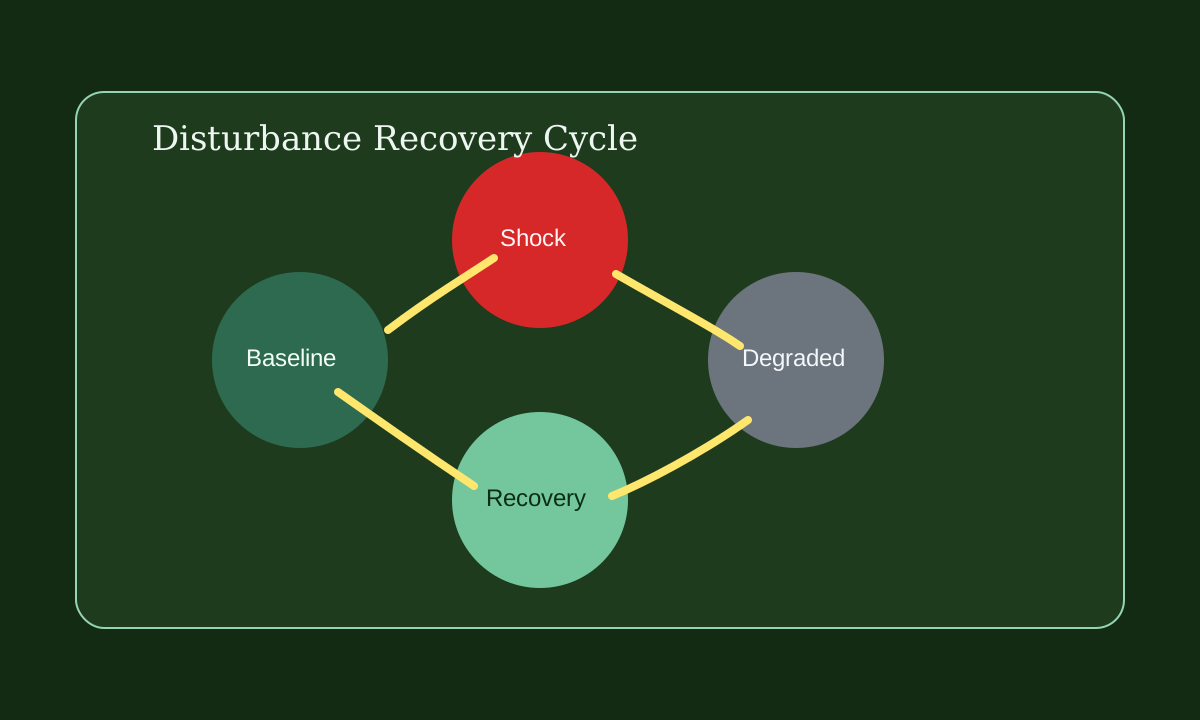
Worlds do not stay in one stable ecological condition. Fire seasons, flood pulses, pest waves, disease outbreaks, storm years, and overgrazing phases keep resetting what counts as normal. The disturbance recovery cycle turns those repeated resets into an operating pattern.
This model matters because many settings describe hazards as occasional drama rather than as recurrent forces that shape where settlement thickens, where buffers matter, and how long recovery actually takes. Disturbance is not only a hit. It is a cycle that changes habitat quality, labor allocation, and storage burden over time.
| Axis | Question | Signal |
|---|---|---|
| Baseline stability | What counts as ordinary ecological productivity before shock arrives? | Soil renewal, grazing balance, forest cover, reservoir confidence, ordinary disease load |
| Disturbance pulse | Which event or season resets the system sharply? | Flood crest, fire season, locust wave, epidemic pulse, storm damage, salinity burst |
| Degraded survival | What remains harder or thinner after the immediate event passes? | Seed loss, weakened herds, labor drain, contaminated water, exposed soils, buffer collapse |
| Recovery window | What must regenerate before density and circulation can return to ordinary levels? | Replanting, herd rebuild, dredging, wetland recovery, disease decline, storage replenishment |
After the visible shock ends, which layer remains slowest to recover: soil fertility, herd size, labor availability, water quality, or transport reliability? The answer usually matters more than the peak damage because it determines whether the next cycle arrives before the system is ready again.
Dust Bowl Migration Ecology is a strong use case because wind erosion, crop failure, and migration keep extending the recovery horizon after the immediate climatic shock. Mountain Basin Civilization is the contrast case where enclosure can protect recovery locally while making external adaptation harder.
The reusable lesson is that hazards become believable when they create recurring recovery states rather than isolated spectacle. Once the cycle is explicit, resilience, migration, and storage burden become much easier to justify.
Read what should come before it, what relation role matters next, and where this page should hand you off after the local graph is clear.
Start with Climate Rhythm Model and then return here once the surrounding concept stack is clear.
These entries clarify the footing underneath the current node before you move outward again. Start with Ecological Dependency Web when you want the clearest next role.
Return to broader lenses when this model is too specific for the question you are asking.
1 handoff nodes stay inside Evolution And Breakdown. 2 handoff nodes share Regional.
Detail pages now expose the branch and scale of their surrounding graph before showing raw prerequisite and relation shelves, so continuation can stay taxonomy-led instead of adjacency-led.
Explain what the world is materially built from before politics, balance, or style are discussed.
Start in Worlds, read the anchor framework, open one regional model, validate with a complete study, then finish with a world assembly guide pass.
Explain transition, disturbance, collapse, recovery, and reassembly across eras and stress cycles.
Start with transformation and failure models, trace residue and recovery paths, compare a collapse or successor-order study, then run a failure-mode review.
Explain how resources, goods, labor, information, and force circulate, stall, buffer, and break.
Start from the resource-flow loop, trace storage and throughput models, compare one logistics study, then run a flow audit worksheet.
Use this scale when routes, relays, buffers, and linked nodes matter more than territorial bulk.
Use this scale when the region is the main leverage unit for settlement, extraction, governance, or conflict.
Use this scale when the strongest explanation depends on several levels staying visible together.
Use this scale when the whole world model or planetary constraint pattern should stay visible at once.
Use prerequisites when you want the shortest path into the assumptions this page depends on.
A model for how repeating weather and seasonal windows structure labor, harvest timing, travel reliability, and crisis pacing across a world.
A model for tracing how food chains, pollination, disease buffering, draft power, and freshwater renewal link species and human settlement into one interdependent living system.
These groups explain why each neighboring node matters, whether it stabilizes the concept, operationalizes it, proves it, or pushes the lane further.
Use foundation relations when this node depends on a concept, term, or framing layer that should be explicit before you branch further.
A model for tracing how food chains, pollination, disease buffering, draft power, and freshwater renewal link species and human settlement into one interdependent living system.
A model for how repeating weather and seasonal windows structure labor, harvest timing, travel reliability, and crisis pacing across a world.
Use applied relations when the next useful move is to see the current pattern survive inside a study or assembled world.
A historical study of how soil loss, harvest collapse, debt pressure, and migration turned ecological disturbance into a long recovery problem rather than one bad season.
These entries still matter, but they currently rely on generic adjacency instead of typed continuation semantics.
A model for testing how a spatial layout behaves under congestion, disruption, seasonal shifts, and asymmetric pressure.
A model for how extraction, transport, storage, transformation, and redistribution create stability or fragility in a world system.
A sample systems study showing how basin agriculture, defensive ridges, and narrow passes produce a dense but brittle civilization pattern.
Models formalize behavior. Use them when you need a concrete chain, loop, stress scenario, or layered mechanism that can be tested and reused.
A model should explain how something behaves over time or under pressure, not just identify a broad topic area.
When a setting feels plausible at rest but still behaves vaguely, models provide the explicit structure needed to test it.
A strong workflow often moves from broad lens to formal model to applied case reading.
Keep these collapsed until you want to turn the page into an active reading exercise.
What mechanism is this model making explicit?
Where does this model break or become most interesting under stress?
Which study would verify whether this model survives in a complete setting?
These routes are tuned to the kind of entry you are currently reading, so you can leave this page with one deliberate next move.
Return to broader lenses when this model is too specific for the question you are asking.
Cross-layer moveMove through the systems module when you want to navigate models by design intent.
Cross-layer moveVerify the model inside applied cases where multiple structures interact at once.