Preparing the current spcent route.
The page shell is online. Shared content and route data are still being assembled.
Output that remains after immediate subsistence and maintenance needs are covered, making storage, exchange, taxation, or concentrated reinvestment possible.
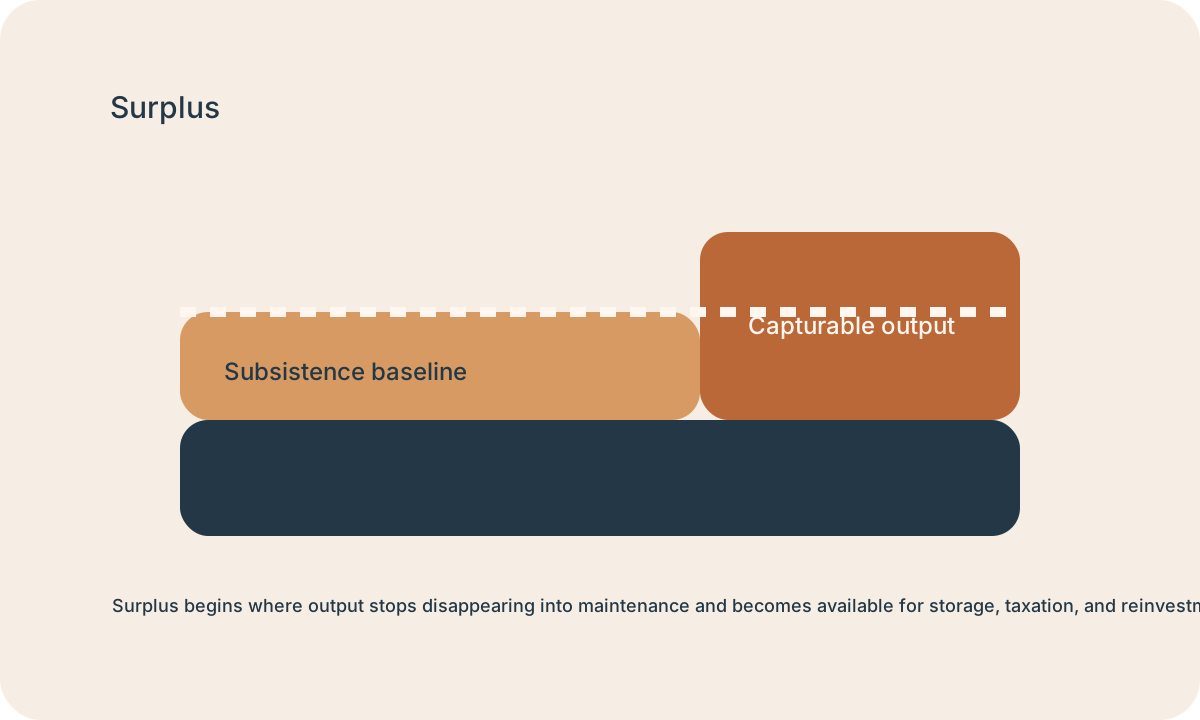
Surplus is the part of output that can be moved, stored, traded, taxed, or redirected after the system has met its immediate operating needs.
The critical point is not only that extra output exists. The critical point is that this extra output can now be captured and converted into future leverage.
Without surplus, institutions remain thin and local. With reliable surplus, actors can build warehouses, standing forces, public works, long-distance trade, and administrative depth.
Surplus does not mean simple abundance at harvest time, nor does it mean that a system feels prosperous in a single scene. Output counts as surplus only when it remains available after subsistence, maintenance, and replacement costs are paid. If one bad season, one convoy failure, or one political interruption wipes out all remaining slack, the system may have visible output without having durable surplus.
This distinction matters because many worlds confuse production spikes with structural capacity. Real surplus is output that can survive time and friction well enough to be stored, taxed, reinvested, or mobilized later.
If output falls slightly, does the system still have something left to store, tax, or reinvest after immediate maintenance and subsistence? If not, the apparent abundance is probably not true surplus yet.
Reliable storage, tax regularity, and specialized labor are usually the clearest signals. If a society can support granaries, workshops, administrators, soldiers, or long-distance traders without immediately starving its subsistence base, some form of surplus is present. If every shock forces the whole system back into immediate survival, surplus is still thin.
A fertile valley that feeds itself is not automatically surplus-rich. It becomes surplus-rich when it can store grain across seasons, release that store under stress, and support actors who are not themselves producing food every day. That is the threshold where economic output begins turning into political leverage.
Shows how surplus becomes progressively more governable through storage, taxation, and institutional conversion.
Resource Flow LoopPlaces surplus inside the wider chain of extraction, transport, storage, transformation, and redistribution.
Storage NodeIdentifies where surplus stops being diffuse and becomes concentrated enough to control.
Read what should come before it, what relation role matters next, and where this page should hand you off after the local graph is clear.
No prerequisite chain is currently required, which makes this page a valid graph entry point for the current topic.
Use Surplus Capture Ladder or the linked nodes below when you want to compare this page against neighboring parts of the graph.
Many glossary abstractions become richer when viewed inside the spatial module.
3 handoff nodes stay inside Flow And Logistics. 1 handoff nodes share Cross Scale.
Detail pages now expose the branch and scale of their surrounding graph before showing raw prerequisite and relation shelves, so continuation can stay taxonomy-led instead of adjacency-led.
Explain how resources, goods, labor, information, and force circulate, stall, buffer, and break.
Start from the resource-flow loop, trace storage and throughput models, compare one logistics study, then run a flow audit worksheet.
Use this scale when routes, relays, buffers, and linked nodes matter more than territorial bulk.
Use this scale when the strongest explanation depends on several levels staying visible together.
No prerequisite chain is currently required, so you can continue from here into relation paths or cross-layer handoff.
This page has no prerequisite chain yet. Treat it as a start node, then branch outward through typed relation paths or cross-layer handoff below.
This entry still relies on generic related links. That works as a fallback, but typed relation roles would make continuation clearer.
A model for how raw surplus becomes taxable, storable, and politically controllable through successive layers of capture.
A model for how extraction, transport, storage, transformation, and redistribution create stability or fragility in a world system.
A location where flow is buffered, accumulated, protected, measured, or redirected strongly enough to change who can control the wider system.
Glossary entries define Spcent's shared vocabulary. They are conceptual anchors designed to stabilize how an abstraction is used across pages and modules.
A glossary term should lock down what a phrase means so later reading is not burdened by ambiguity.
When you know the concept but not yet the best framework or model, start here and then move outward through related nodes.
A useful definition points toward the frameworks, models, and studies that actually use the term in context.
Keep these collapsed until you want to turn the page into an active reading exercise.
What question becomes easier once this term is precisely defined?
Which entries in the graph are using this abstraction operationally rather than only naming it?
Do I need a framework, model, or study next to see this concept in action?
These routes are tuned to the kind of entry you are currently reading, so you can leave this page with one deliberate next move.
Many glossary abstractions become richer when viewed inside the spatial module.
Cross-layer moveMove into frameworks when you want a planning lens built on top of the term.
Cross-layer moveSearch across the graph to find every place the concept currently appears.