Pulling this page together.
Preparing content, navigation, and supporting references for this route.
Preparing content, navigation, and supporting references for this route.
A framework for reading long-run structural change through continuity, rupture, inheritance, infrastructure rewrite, and post-shock reassembly rather than through event chronology alone.
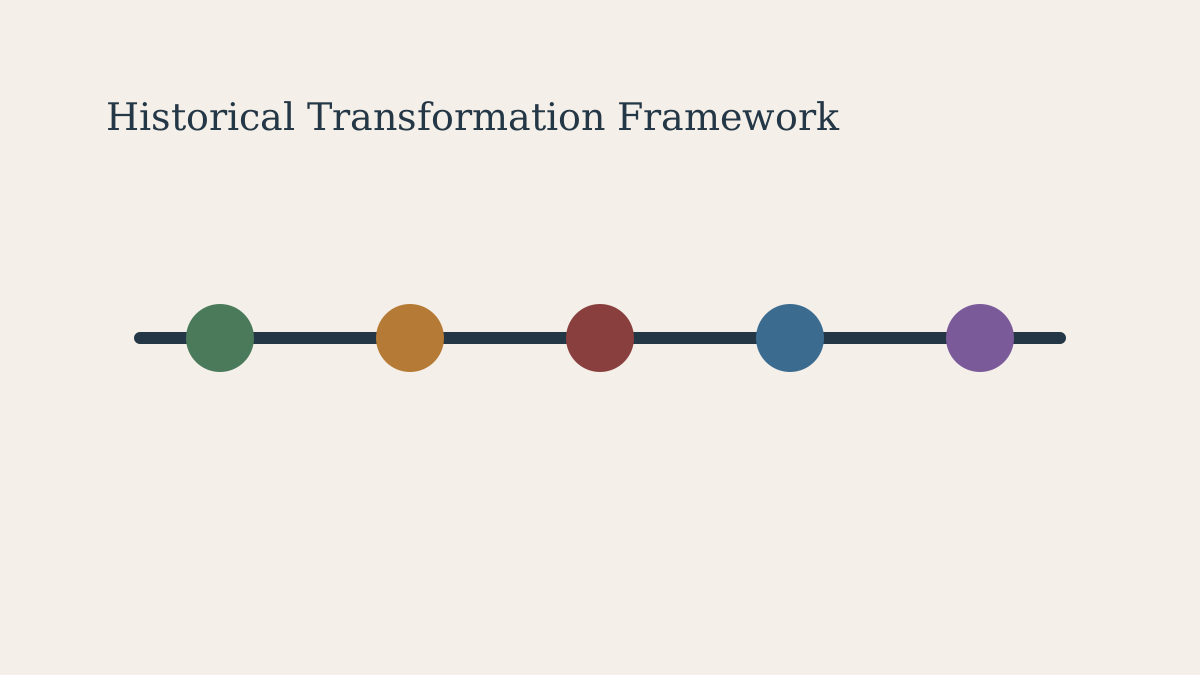
Pressure accumulation and transformation are not the same thing. Pressure describes a system straining inside its current logic. Transformation begins when that logic no longer reproduces itself reliably and a new order must inherit, discard, or rewrite the old structure.
The historical transformation framework organizes that change into five questions: what continues, what breaks, what survives, what gets rewritten, and what reassembles afterward. This keeps history structural instead of turning it into a list of events or dynasties.
| Axis | Question | Signal |
|---|---|---|
| Continuity | Which routes, institutions, and habits still reproduce the old order? | Stable granary chains, trusted legitimacy, durable corridor systems, intact tax logic |
| Rupture | What pressure or shock makes the old operating logic fail visibly? | Succession fracture, network loss, reserve exhaustion, military overreach, infrastructural break |
| Inheritance | What survives the rupture strongly enough to shape the next order? | Residual offices, sacred centers, surviving depots, courier habits, elite memory |
| Rewrite | Which core systems must be reorganized rather than merely repaired? | New route hierarchy, new extraction regime, altered communication stack, infrastructure replacement |
| Reassembly | How does the next system stabilize from the surviving fragments? | Regional reconsolidation, new reserve logic, polycentric governance, revived corridors, narrowed scope |
Ask whether the system is still reproducing itself under strain or whether the strain is already rewriting the next order's possibility space.
Identify what persists: corridor skeletons, local elites, reserve depots, institutional habits, symbolic legitimacy, or technical standards.
Determine whether the successor order recenters, fragments, narrows scope, rewrites infrastructure, or depends on new coordinating nodes.
Use the timeline to separate ordinary stress from the point where the old system stops reproducing itself and successor logic takes over.
Routes, institutions, and legitimacy are stressed, but they still keep reassembling the same operating logic after disruption.
Transformation begins when the old system can no longer reproduce its own logic at full scale, even if many of its symbols or institutions are still visible. Roads may remain, titles may survive, and tax habits may persist, but they now operate inside a narrower or altered assembly logic. That is the key distinction from ordinary crisis. A famine, invasion, or legitimacy shock can be severe and still remain an internal disturbance if the same order restores itself afterward. Transformation starts when restoration gives way to reassembly on different terms.
This is why the framework pays so much attention to residue. Surviving depots, local elites, legal habits, or infrastructure skeletons are not just leftovers. They are the material from which the next order is assembled. Formal historical writing becomes stronger when those inherited constraints are named directly instead of being hidden behind broad language about decline or rebirth.
One sign is scale narrowing. A state or world-system stops trying to govern its former full footprint and recenters around corridors, basins, or institutions it can still reproduce reliably. Another sign is infrastructural selectivity: maintenance concentrates on a reduced set of routes or nodes while former networks become residual rather than active. A third sign is legitimacy adaptation, where actors justify authority through new intermediaries, new standards, or new local bargains instead of through the previous order's universal claims.
When those signs align, the setting is no longer describing a damaged version of the same era. It is showing the threshold where the next era becomes more explanatory than the last one.
Use the framework when a history stops making sense as one continuous era but has not become simple ruin either. Start by naming the old system's reproduction logic as precisely as possible. Was the order held together by granary circuits, courier timing, imperial roads, tributary legitimacy, magic relay monopolies, or urban warehouse depth? If that baseline stays vague, every later claim about rupture or succession will drift into atmosphere.
Then identify what survives the break in a form strong enough to matter. This is where many histories flatten out. Writers often say the old order "fell" and then jump directly to the new era. The more useful question is what the next era was forced to inherit anyway: surviving bridgeheads, a tax archive, religious authority, port routines, old military roads, or a courier discipline that no one can afford to abandon. Those inherited pieces tell you what the next order can assemble cheaply and what it must rewrite at high cost.
Finally, ask what the successor order stops trying to restore. That decision is usually more revealing than the shock itself. A reassembled order may accept narrower territory, fewer guaranteed routes, a more polycentric elite bargain, or a different infrastructure stack. Once those accepted limits become stable, you are no longer reading restoration. You are reading transformation.
The most common mistake is treating every severe shock as transformation. A plague, invasion, dynastic war, or food crisis can be devastating and still remain internal to the same order if the old route hierarchy, legitimacy basis, and storage logic reassert themselves afterward. Transformation is not the size of the shock. It is the point where the old system stops reproducing itself on its former terms.
Another mistake is treating residue as sentimental flavor rather than operating constraint. Old capitals, surviving roads, inherited legal forms, and temple networks are not only visual remains. They are often the cheapest available scaffolding for the next system. If those inherited pieces are ignored, the successor order looks invented from nowhere. If they are overvalued, the new order looks like a copy of the old one. The framework matters because it forces both inheritance and rewrite to appear at the same time.
Imagine an empire that once controlled a full inland basin, two maritime exits, and a chain of mountain depots. A generation of civil war and flood damage does not erase the imperial title, but it does break the eastern canal grid and reduce confidence in the court's universal claims.
Under this framework, the transformation question is not simply "did the empire collapse?" The more useful reading is:
That example shows why transformation is best read as changed reproduction logic. The symbols may remain familiar, but the governing scale, route commitment, and administrative ambition have all been rewritten.
Use this when the decisive change is not who rules, but what transport, energy, or information substrate now organizes the world.
Post-Collapse Reassembly ModelOpen this when the main question is how a successor order forms from broken but surviving pieces.
Late Bronze Age Network FractureUse this when you want a case where interdependent exchange, elite coordination, and corridor failure rewrite what the next order can inherit.
Late Roman Fragmentation Network FailureApplies the framework to imperial fragmentation, institutional residue, and corridor loss across an advanced historical case.
The reusable lesson is that structural history should be read as a changing reproduction logic. Use this framework when you need to explain why one era stopped holding, what the next era inherited unevenly, and how new order emerged from surviving routes, institutions, and infrastructure. Its strongest use is comparative: it lets you distinguish a strained continuity, a terminal collapse, and a transformed successor order without reducing all three to the same dramatic language.