Pulling this page together.
Preparing content, navigation, and supporting references for this route.
Preparing content, navigation, and supporting references for this route.
A systems study of how extreme environmental scarcity, mono-resource dependence, and interstellar transport control turn Arrakis into a concentrated power machine.
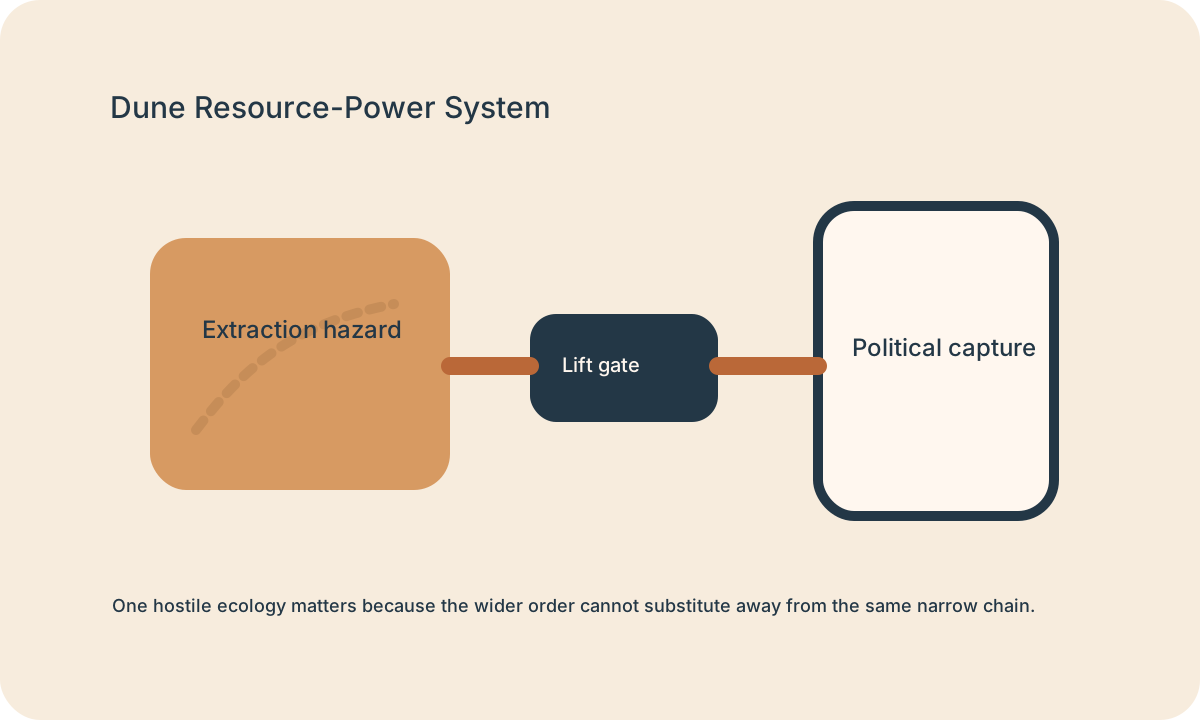
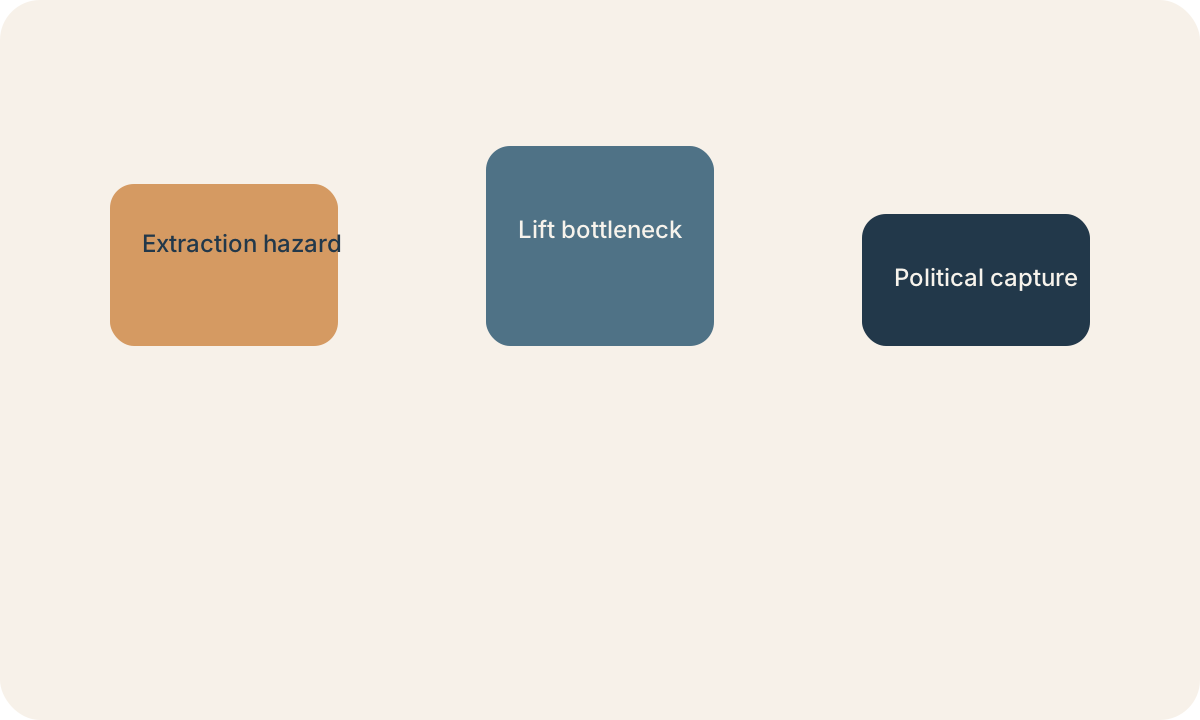
Dune is not merely a desert world with a valuable substance. It is a system in which one extreme environment produces a resource that the wider political order cannot route around.
This creates a textbook . Extraction, transport, protection, and imperial legitimacy all compress through one hazardous production zone.
Treat the desert environment as an operating regime that makes output expensive, fragile, and locally specialized.
Show where value becomes governable through lift, convoy timing, and transfer capacity.
Identify how extractors, brokers, imperial overseers, and local actors all compete to convert the same chain into authority.
Explains why spice matters as a full dependency chain rather than only a rare material at the point of origin.
Surplus Capture LadderShows how extraction becomes taxation, brokerage, and coercive leverage across multiple institutions.
Chokepoint RegimeProvides the cleanest conceptual frame for understanding why one world can decide the behavior of a much larger order.
Because the environment is so hostile, production cannot be separated from specialized local adaptation. Because the product is so decisive, outside powers cannot ignore local conditions even when they dominate militarily.
The result is a layered power struggle between extractors, transport enforcers, imperial overseers, and actors embedded in the local terrain. Control is never only military. It is logistical, ecological, and institutional at the same time.
| Axis | Question | Signal |
|---|---|---|
| Extraction hazard | Why is production expensive and fragile? | Hostile environment, narrow operating windows, specialized local knowledge, catastrophic interruption risk |
| Transport bottleneck | Where does value become governable? | Lift capacity, convoy timing, protected transfer points, off-world dependence |
| Political capture | Who converts material control into authority? | Imperial monopolies, feudal concessions, brokerage rights, coercive enforcement |
| Local asymmetry | Why can weak-looking actors still matter decisively? | Terrain fluency, disruption leverage, adaptation advantage, denial capacity |
Use the toggle to see how the same dependency chain behaves under stable extraction, transport disruption, or local denial.
When extraction schedules, convoy lift, and coercive oversight all align, the system looks governable. Outside powers can pretend the desert is only a dangerous production site rather than the true strategic center of the whole order.
Use the timeline to see how a specialized extraction ecology turns from manageable chain into visible imperial vulnerability.
The wider order accepts the desert as a costly but usable production ecology. As long as lift, brokerage, and coercion stay synchronized, dependence remains politically tolerable.
The structural force of the case comes from the fact that Arrakis is not merely remote. It is ecologically hostile in a way that refuses normal administrative smoothing. Extraction depends on timing, local adaptation, and exposure to catastrophic disruption, so outside powers cannot convert the desert into a routine industrial zone without also reshaping the wider political order around its special operating conditions.
That is what makes the world more rigorous than a generic rare-resource story. The desert is not background flavor attached to a valuable commodity. It is the condition that determines who can operate, who pays the maintenance burden, and how much of the chain can actually be governed from afar.
Formal imperial power repeatedly misreads where real leverage lives. It assumes control sits at the top of the hierarchy because titles, fleets, and concessions are visible there. In practice, leverage keeps returning to the points where ecology, timing, and movement can be denied. A system-wide dependency becomes politically unstable whenever the actors nearest the production edge can interrupt flow faster than the wider order can restore it.
This is why the case transfers so well to other settings with concentrated inputs. Whenever substitution is weak, operating knowledge is specialized, and transport remains narrow, formal superiority is less decisive than chain control. The empire may own the legal shell while the ecology owns the actual terms of governance.
The clean transferable lesson is that a resource becomes world-defining only when production, movement, and institutional capture stay chained tightly enough that disruption at one edge reshapes the whole order. That principle applies to magical fuel, rare isotopes, portal reagents, strategic waterways, or any other dependency that many actors cannot reroute around.
What does not transfer automatically is the exact Dune balance of environmental extremity, mono-resource dependence, and feudal-imperial structure. A setting with broad substitution, dense industrial redundancy, or many equivalent extraction zones would need a different model. The value of Dune is therefore diagnostic: it shows how extreme concentration behaves, not how every resource economy should be built.
The reusable lesson is that scarcity matters most when substitution is weak and transport is concentrated. A resource becomes politically world-defining when many institutions depend on the same fragile chain.
Dune works because it never lets resource value float free of terrain, logistics, and capture. Power follows the chain, not only the throne.