Pulling this page together.
Preparing content, navigation, and supporting references for this route.
Preparing content, navigation, and supporting references for this route.
A framework for reading how food, water, health, and maintenance cycles must keep reproducing beneath settlement, surplus, and political order.
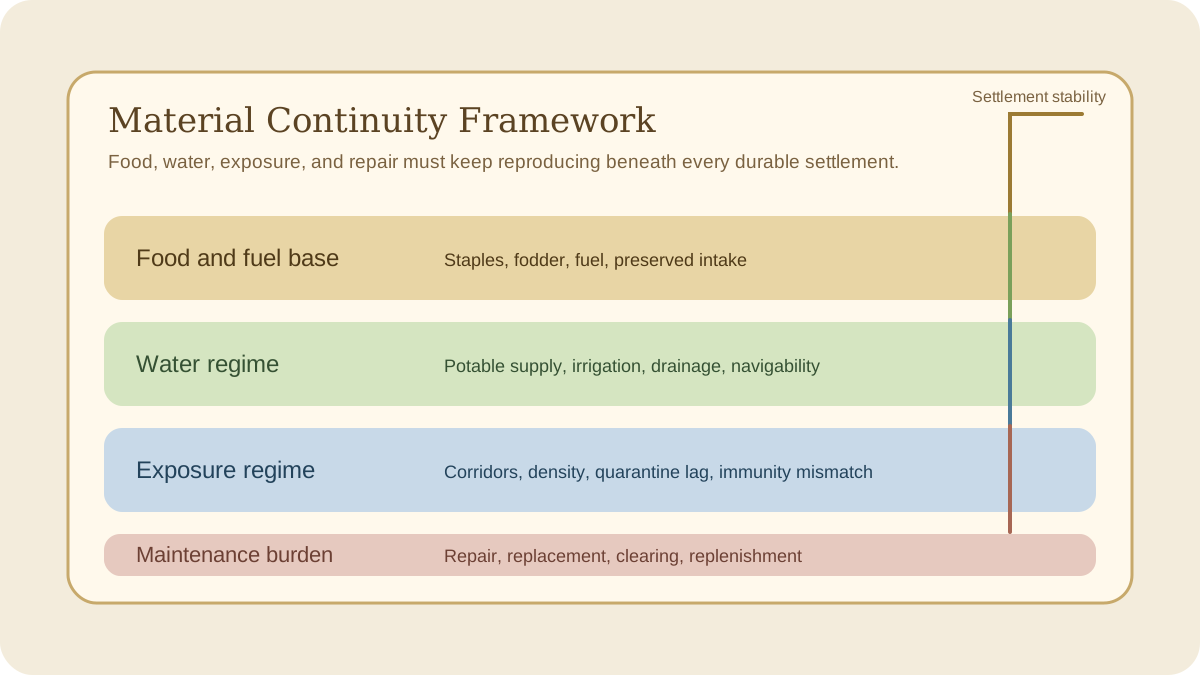
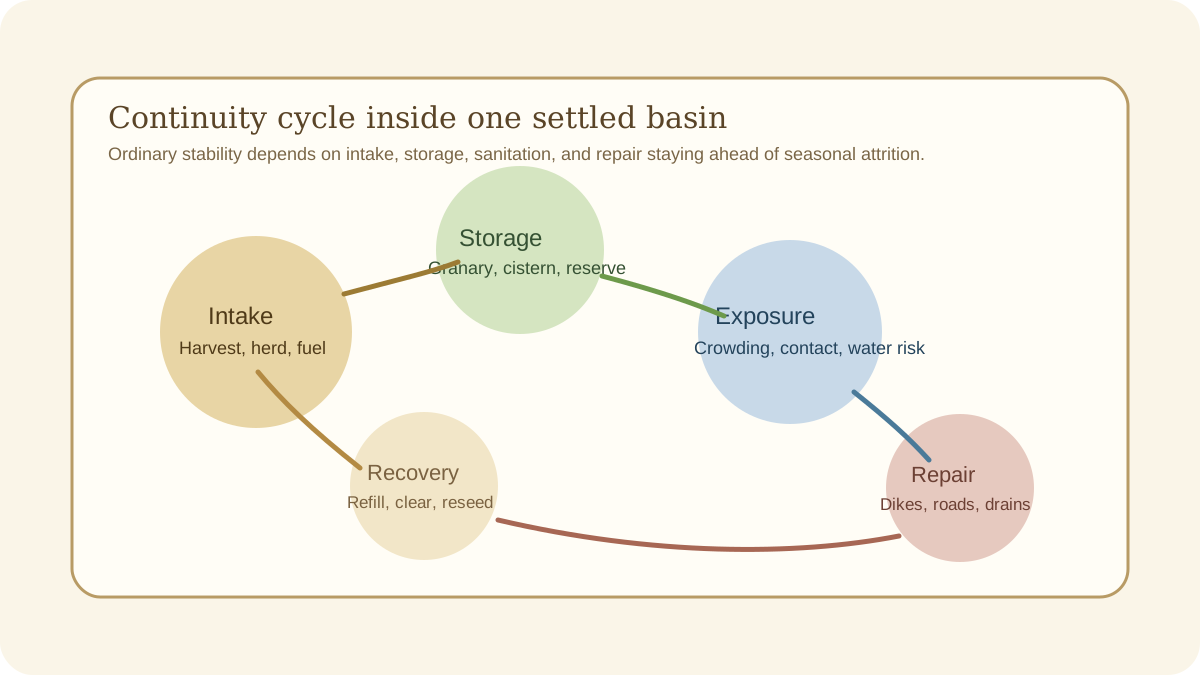
The world constraint stack explains inherited limits. Material continuity explains what must keep being renewed inside those limits if settlement is supposed to persist. A map can have fertile valleys, navigable rivers, and corridor leverage, yet still fail structurally because calories, potable water, disease buffering, or maintenance labor do not reproduce at the same pace as density.
This framework is useful when a setting can explain where people gather but not how they keep eating, drinking, repairing, and surviving repeated exposure. The question is not whether a world once had abundance. The question is what must be replaced every cycle before higher-order systems can remain stable.
| Axis | Question | Signal |
|---|---|---|
| Food and fuel base | What recurring intake keeps laboring populations fed and basic heat, cooking, or transport powered? | Staple grain, fisheries, herd cycles, charcoal belts, fodder zones, preserved calories |
| Water regime | How does potable, irrigable, or navigable water remain available through seasonal stress and contamination risk? | Flood timing, reservoirs, aquifers, cistern rotation, canal upkeep, salinity control |
| Exposure regime | Which movement and density patterns keep turning health pressure into chronic structural risk? | Port crowding, caravan relays, marsh fever, winter enclosure, quarantine lag, immunity mismatch |
| Maintenance burden | What physical systems decay faster than the society can repair them under ordinary load? | Dike repair, road washout, granary rot, tool replacement, irrigation silt, urban drainage failure |
Constraints describe what the world permits. Continuity describes what the world must keep paying for. A cold frontier may be habitable in theory, but if fodder, fuel, and repair demand outrun local reproduction, that frontier is only temporarily occupied. A river basin may be fertile, but if silt, disease load, and dike repair accumulate faster than coordination, the same fertility becomes a maintenance trap.
When a world's institutions feel detached from daily reality, trace the continuity problem first.
Identify what has to arrive or regenerate every cycle before labor remains possible at current density.
Material continuity is easy to ignore because successful renewal looks ordinary. Food arrives, drains clear, tools get repaired, fuel is replaced, and seasonal illness is managed before it becomes a dramatic event. As a result, many settings describe higher-order politics, trade, and conflict convincingly while leaving the everyday replacement cycle implicit.
The framework turns that hidden layer into an explicit design surface. It asks what has to keep happening before the world can afford administration, specialization, warfare, or long-distance exchange at all. Once those renewal costs are named, settlement density and political durability stop looking effortless.
Use the framework when a world has cities that never seem to run short of staples, rivers that carry traffic without sanitation or dredging cost, or harsh disease environments that never alter route design and labor deployment. Those worlds usually describe concentration while skipping renewal.
The fastest stress question is: if one ordinary cycle arrived late or understrength, what breaks first? A convincing answer should name a food base, a water dependency, an exposure surface, or a repair backlog before it jumps straight to ideology or leadership failure.
The framework prevents two opposite mistakes. One is decorative harshness, where the world looks demanding but everyday continuity somehow never constrains what cities, armies, or empires can do. The other is static abundance, where food, water, and maintenance are so easy that the setting loses any explanation for bottlenecks, reserve systems, or seasonal vulnerability. Continuity gives the middle ground: worlds that can persist, but only by paying recurring costs.
Open this when the world needs a concrete staple, fuel, labor, and storage logic instead of generic abundance.
Hydrology Settlement CouplingUse this when rivers, reservoirs, floodplains, or aquifers are shaping density more strongly than the draft currently shows.
Disease Mobility RegimeRead this when route density, quarantine, and immunity mismatch should be reshaping movement and institutional burden.
The reusable lesson is that convincing worlds do not only inherit structure from terrain and climate. They also inherit fragility from whatever must be replenished repeatedly. Once that renewal problem is explicit, settlements, armies, ports, and administrations stop looking self-sustaining by accident.