Preparing the current spcent route.
The page shell is online. Shared content and route data are still being assembled.
A systems study of how orbital gateways, transport dependency, delayed relief, and asymmetric political control make The Expanse's core-periphery order structurally unstable.
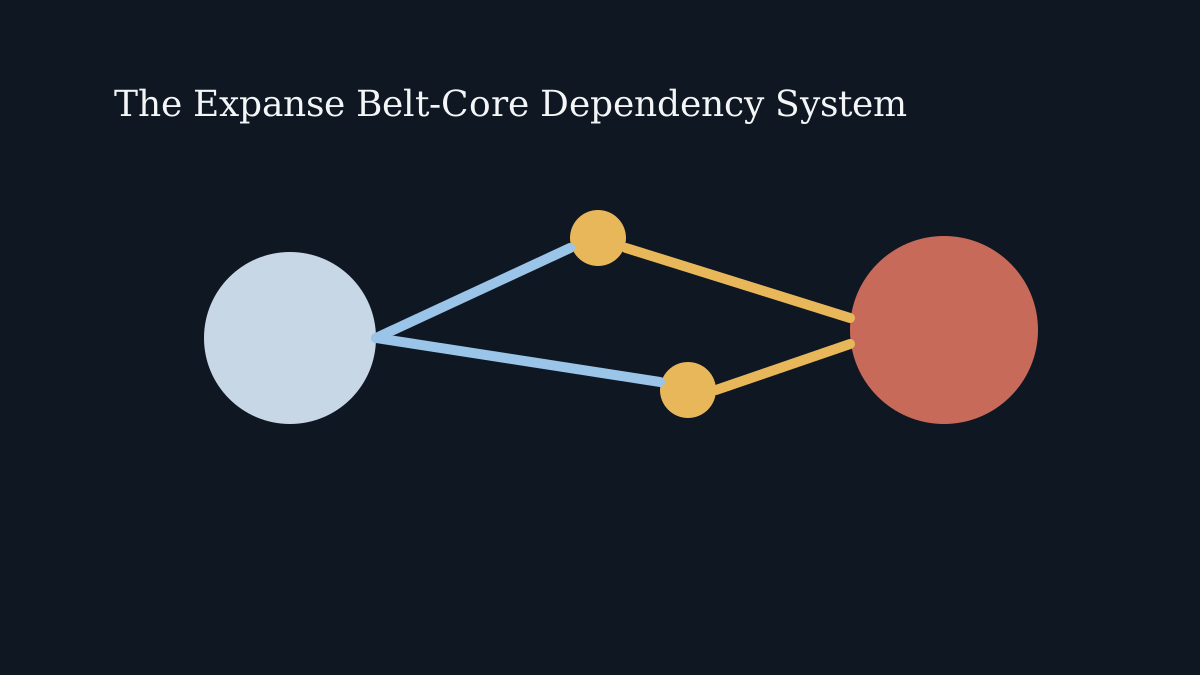
The Expanse is a core-periphery system in which peripheral life support remains materially dependent on transport and gateway control that peripheral actors do not fully govern. That dependency keeps the network tense even when open war is absent.
The useful comparison lens is not only colonial power. It is delayed relief. A peripheral station can appear connected while still remaining structurally exposed if food, water, air components, or coercive response arrive slower than local crisis.
Clarifies why orbital hubs and stations matter as transfer points across several movement and control layers at once.
Communication Latency RegimeExplains why response, verification, and political authority remain uneven across the same network.
Recovery-Collapse LoopShows how delayed relief can turn one local disruption into wider political rupture.
Compared with a stable trade corridor, The Expanse has thinner autonomy at the periphery. Stations hold local function, but key reserves and replacement flows remain tied to upstream centers, transport schedules, and security decisions elsewhere.
| Axis | Question | Signal |
|---|---|---|
| Gateway dependence | Which stations convert circulation without fully controlling it? | Docking hubs, orbital relays, refueling nodes, customs checkpoints |
| Reserve dependence | Where does survival depend on upstream relief or maintained stock? | Air processors, food shipments, water reserves, repair parts, convoy windows |
| Political asymmetry | Who can delay, deny, or price access to the same network? | Inspection power, military escort, recognition, trade access, emergency release |
The dependency pattern becomes clearer when the same orbital system is viewed under calm trade, delayed relief, and acute confrontation.
When freight and information keep moving, peripheral dependence may feel normal even though bargaining power remains unequal.
The setting is structurally unstable because the same network carries life support, freight, emergency response, and political authority together. Peripheral actors are not only poorer or weaker. They are more delay-exposed. That means every technical lag can become a sovereignty question once local populations realize that nominal inclusion still leaves them materially vulnerable.
The model is useful because it shows how hard autonomy becomes when reserves, replacement parts, and gateway rights remain upstream. Local improvisation can reduce immediate vulnerability, but it cannot erase the route geometry that keeps critical survival functions dependent on distant control. That is why bargaining in the setting stays charged even during routine trade.
The setting stays politically volatile because material dependence keeps outrunning formal inclusion. In other words, the political problem is not only injustice in the abstract. It is the repeated experience that survival still depends on actors located elsewhere in the network.
The reusable lesson is that peripheries become unstable when life-support dependency, delayed relief, and political asymmetry all travel through the same route system. The Expanse works structurally because those layers stay tightly coupled. It is a strong case for any setting where infrastructure dependence is experienced as politics every day. The grievance is material before it becomes ideological. People radicalize because the network keeps teaching them who controls survival. The politics harden because every delay is also a lesson about power. Relief lag becomes a constant public argument about who counts, who waits, and who can safely be sacrificed at system scale.
Read what should come before it, what relation role matters next, and where this page should hand you off after the local graph is clear.
Start with Resource Flow Loop and then return here once the surrounding concept stack is clear.
These entries clarify the footing underneath the current node before you move outward again. Start with Gateway City when you want the clearest next role.
Use Guides when the study should feed into a worksheet or structured revision sequence.
1 handoff nodes stay inside Governance And Power. 2 handoff nodes share Cross Scale.
Detail pages now expose the branch and scale of their surrounding graph before showing raw prerequisite and relation shelves, so continuation can stay taxonomy-led instead of adjacency-led.
Explain how resources, goods, labor, information, and force circulate, stall, buffer, and break.
Start from the resource-flow loop, trace storage and throughput models, compare one logistics study, then run a flow audit worksheet.
Explain how technology, magic, infrastructure, communication, and transformation capacity rewrite baseline constraints.
Start with the operating regime, price the capability through diffusion or monopoly models, compare a regime-rewrite case, then run a capability sanity check.
Explain transition, disturbance, collapse, recovery, and reassembly across eras and stress cycles.
Start with transformation and failure models, trace residue and recovery paths, compare a collapse or successor-order study, then run a failure-mode review.
Use this scale when routes, relays, buffers, and linked nodes matter more than territorial bulk.
Use this scale when the strongest explanation depends on several levels staying visible together.
Use this scale when city-scale transfer, concentration, or control is doing the main structural work.
Use prerequisites when you want the shortest path into the assumptions this page depends on.
A model for how extraction, transport, storage, transformation, and redistribution create stability or fragility in a world system.
The practical distance and depth over which an actor can reliably enforce compliance through force, threat, escort, or punitive response.
These groups explain why each neighboring node matters, whether it stabilizes the concept, operationalizes it, proves it, or pushes the lane further.
Use foundation relations when this node depends on a concept, term, or framing layer that should be explicit before you branch further.
A city whose importance comes from coordinating transfers between several movement layers rather than from local size alone.
A model for explaining how courier time, relay density, verification delay, and command visibility reshape coordination, legitimacy, and operational response.
Use operationalizing relations when you want the current abstraction rendered as a cleaner model, loop, or structural device.
A model for tracing whether disruption pushes a system toward repair, brittle stagnation, or self-amplifying collapse after reserves, coordination, and repair capacity are tested.
These entries still matter, but they currently rely on generic adjacency instead of typed continuation semantics.
A model for reading straits, island chains, convoy arcs, and port ladders as one network where sea-lane leverage depends on sequencing as much as on any single port.
A model for locating where reserves are stored, who can release them, and how fast they can stabilize the wider system under delay, shock, or surge.
Studies apply Spcent's lenses to complete cases. Read them to see whether geography, surplus, corridors, and pressure patterns still make sense when placed inside one setting.
The goal is not to retain setting trivia. The goal is to extract reusable patterns and structural habits you can reapply elsewhere.
Studies are strongest when you already know the frameworks and models underneath them, so you can recognize the structural moves being made.
After reading a study, identify which layer of your own draft needs work and go back there with one concrete change in mind.
Keep these collapsed until you want to turn the page into an active reading exercise.
What are the decisive regions, corridors, or chokepoints in this case?
What keeps the studied world stable, and what makes it brittle?
Which model or framework do I need next if I want to reproduce this pattern in my own project?
These routes are tuned to the kind of entry you are currently reading, so you can leave this page with one deliberate next move.
Use Guides when the study should feed into a worksheet or structured revision sequence.
Cross-layer moveReturn to the worlds module when the case highlights a weak worldbuilding layer in your own draft.
Cross-layer moveOpen models when the case reveals a mechanism you want to isolate and reuse directly.