Preparing the current spcent route.
The page shell is online. Shared content and route data are still being assembled.
An assembled example world showing how deep water access, ritual infrastructure, and magical monopoly can produce a theocratic basin state that is rich in control but brittle at its hidden sources.
This example world is built around concealed aquifers in a dry rift basin. Water access is not open geography. It is measured, ritualized, and politically guarded through temple complexes that also regulate magical extraction and storage.
That makes the state look mystical from the outside, but its real power is infrastructural. Ritual matters because it controls access to pumping sites, reservoir timing, and the legitimacy of rationing.
Explains why magical power in this world behaves as a licensed operating layer tied to ritual windows and controlled sites.
Storage NodeShows why cisterns, aquifer mouths, and sealed reservoirs become the real political centers of the basin state.
Control Surface MatrixClarifies how temples, guards, caravan brokers, and irrigators each control different layers of the same water system.
The strongest pattern is hidden concentration. Surface settlement looks scattered, but political reality is organized around a few invisible water nodes and the institutions that mediate them.
That creates a rich but fragile order. If ritual trust breaks, a pumping complex fails, or caravans lose confidence in temple arbitration, the whole theocracy can fragment faster than an outside observer expects.
| Axis | Question | Signal |
|---|---|---|
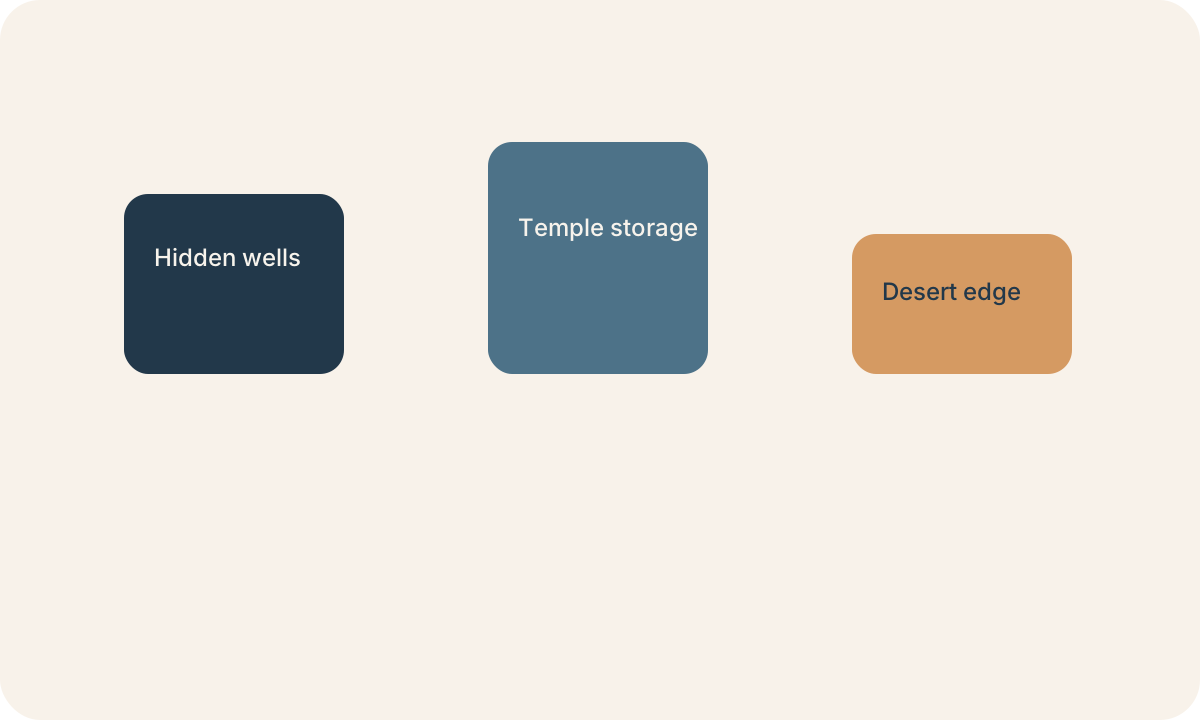
| Hidden source | Where does real capacity originate? | Deep wells, aquifer shafts, ritual pumping chambers, guarded maintenance crews |
| Visible order | How is that capacity turned into legitimate rule? | Temple calendars, ration law, canal schedules, pilgrimage duties, sacred storage rites |
| Desert edge | Where does control become expensive and politically exposed? | Caravan wells, raider belts, salinity drift, reservoir sabotage, frontier dependency |
The reusable lesson is that an example world can integrate ecology, resources, institutions, and magic most cleanly when one hidden infrastructure base binds them all together.
This setting works because ritual authority, hydraulic storage, and survival pressure are all expressions of the same underlying bottleneck.
Read what should come before it, what relation role matters next, and where this page should hand you off after the local graph is clear.
Start with Magic Operating Regime and then return here once the surrounding concept stack is clear.
Use Magic Operating Regime or the linked nodes below when you want to compare this page against neighboring parts of the graph.
Use Guides when the study should feed into a worksheet or structured revision sequence.
No handoff nodes currently stay inside Governance And Power. 2 handoff nodes share Regional.
Detail pages now expose the branch and scale of their surrounding graph before showing raw prerequisite and relation shelves, so continuation can stay taxonomy-led instead of adjacency-led.
Explain how technology, magic, infrastructure, communication, and transformation capacity rewrite baseline constraints.
Start with the operating regime, price the capability through diffusion or monopoly models, compare a regime-rewrite case, then run a capability sanity check.
Explain campaigns, sustainment, force projection, defensive depth, and operational windows as structural systems.
Start with sustainment and projection models, identify the theater cycle, validate through an operational case, then run an operations stress test.
Explain how resources, goods, labor, information, and force circulate, stall, buffer, and break.
Start from the resource-flow loop, trace storage and throughput models, compare one logistics study, then run a flow audit worksheet.
Use this scale when the region is the main leverage unit for settlement, extraction, governance, or conflict.
Use this scale when the strongest explanation depends on several levels staying visible together.
Use this scale when routes, relays, buffers, and linked nodes matter more than territorial bulk.
Use prerequisites when you want the shortest path into the assumptions this page depends on.
A model for how magical capability is sourced, gated, trained, costed, and monopolized so it behaves like a real operating layer instead of selective plot permission.
A location where flow is buffered, accumulated, protected, measured, or redirected strongly enough to change who can control the wider system.
This entry still relies on generic related links. That works as a fallback, but typed relation roles would make continuation clearer.
A model for how magical capability is sourced, gated, trained, costed, and monopolized so it behaves like a real operating layer instead of selective plot permission.
A location where flow is buffered, accumulated, protected, measured, or redirected strongly enough to change who can control the wider system.
A model for mapping how water, temperature, soil renewal, shelter, and disturbance tolerance create uneven ecological carrying capacity across a world.
A model for comparing what different factions actually control across territory, movement, institutions, storage, and legitimacy rather than by abstract power labels.
Studies apply Spcent's lenses to complete cases. Read them to see whether geography, surplus, corridors, and pressure patterns still make sense when placed inside one setting.
The goal is not to retain setting trivia. The goal is to extract reusable patterns and structural habits you can reapply elsewhere.
Studies are strongest when you already know the frameworks and models underneath them, so you can recognize the structural moves being made.
After reading a study, identify which layer of your own draft needs work and go back there with one concrete change in mind.
Keep these collapsed until you want to turn the page into an active reading exercise.
What are the decisive regions, corridors, or chokepoints in this case?
What keeps the studied world stable, and what makes it brittle?
Which model or framework do I need next if I want to reproduce this pattern in my own project?
These routes are tuned to the kind of entry you are currently reading, so you can leave this page with one deliberate next move.
Use Guides when the study should feed into a worksheet or structured revision sequence.
Cross-layer moveReturn to the worlds module when the case highlights a weak worldbuilding layer in your own draft.
Cross-layer moveOpen models when the case reveals a mechanism you want to isolate and reuse directly.