Preparing the current spcent route.
The page shell is online. Shared content and route data are still being assembled.
A model for tracing how staples, fuel, fodder, labor conversion, and storage create the recurring intake that makes density and surplus possible.
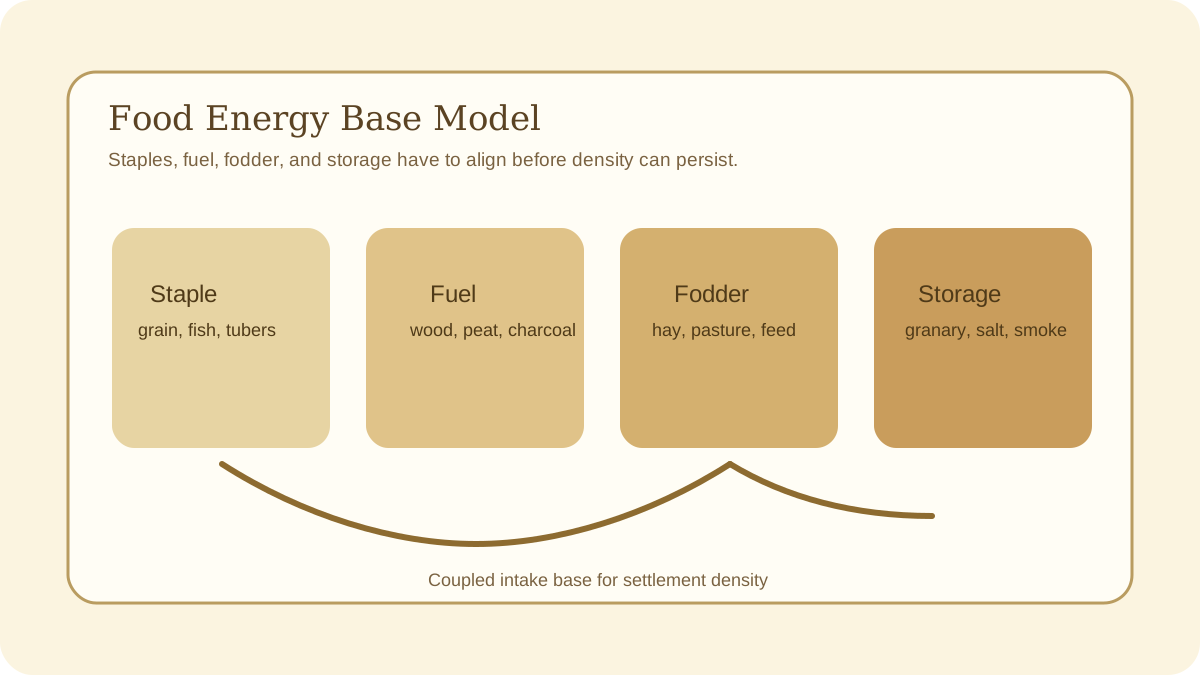
Every dense society sits on a conversion system that turns land, water, animals, fuel, and labor into repeat calories and usable energy. The food energy base model makes that conversion visible before the world jumps to markets, taxation, or armies.
The model matters because abundance is not one category. Grain, fish, fodder, draft power, and cooking fuel do not peak in the same place or season. A region can look rich while still lacking the intake reliability needed for cities, garrisons, or long campaigning.
| Axis | Question | Signal |
|---|---|---|
| Staple stream | What recurrent calorie source feeds the largest share of the population? | Cereal grain, tubers, fish runs, herd products, orchard belts, preserved legumes |
| Fuel stream | What powers cooking, heat, smelting, drying, or transport at ordinary scale? | Woodlots, charcoal belts, dung fuel, peat, whale oil, imported coal |
| Fodder and traction | What keeps draft animals, carts, river tow, or mounted elites operational? | Hay meadows, grain diversion, pasture cycles, stable infrastructure, winter feed reserves |
| Storage buffer | Which preserved reserves bridge the gap between production and lean season? | Granaries, smokehouses, salting, dried fish, ice pits, ration depots |
If one harvest, herd cycle, or fuel season underperforms, who loses usable intake first: cities, armies, winter households, draft animals, or trade caravans? The answer reveals whether the world really has a common food base or only several disconnected abundance stories.
This model is especially useful for agrarian basins, steppe-edge grain systems, cold survival settings, and port economies that depend on imported staples. In Steppe Granary Marches, the real question is not only how grain moves, but how border defense and horse maintenance keep competing for the same intake base. In Frostpunk Thermal Governance System, fuel is inseparable from survival, so food and heat become one political rationing problem.
The reusable lesson is that intake should be modeled as a coupled base rather than as food alone. Once calories, fuel, fodder, and storage are tied together, settlement density, mobilization capacity, and scarcity politics all become easier to justify.
Read what should come before it, what relation role matters next, and where this page should hand you off after the local graph is clear.
Start with Habitat Carrying Gradient and then return here once the surrounding concept stack is clear.
These entries clarify the footing underneath the current node before you move outward again. Start with Material Continuity Framework when you want the clearest next role.
Return to broader lenses when this model is too specific for the question you are asking.
2 handoff nodes stay inside World Foundations. 2 handoff nodes share Regional.
Detail pages now expose the branch and scale of their surrounding graph before showing raw prerequisite and relation shelves, so continuation can stay taxonomy-led instead of adjacency-led.
Explain how resources, goods, labor, information, and force circulate, stall, buffer, and break.
Start from the resource-flow loop, trace storage and throughput models, compare one logistics study, then run a flow audit worksheet.
Explain what the world is materially built from before politics, balance, or style are discussed.
Start in Worlds, read the anchor framework, open one regional model, validate with a complete study, then finish with a world assembly guide pass.
Explain how technology, magic, infrastructure, communication, and transformation capacity rewrite baseline constraints.
Start with the operating regime, price the capability through diffusion or monopoly models, compare a regime-rewrite case, then run a capability sanity check.
Use this scale when the strongest explanation depends on several levels staying visible together.
Use this scale when the region is the main leverage unit for settlement, extraction, governance, or conflict.
Use this scale when routes, relays, buffers, and linked nodes matter more than territorial bulk.
Use this scale when city-scale transfer, concentration, or control is doing the main structural work.
Use prerequisites when you want the shortest path into the assumptions this page depends on.
A model for mapping how water, temperature, soil renewal, shelter, and disturbance tolerance create uneven ecological carrying capacity across a world.
A model for how extraction, transport, storage, transformation, and redistribution create stability or fragility in a world system.
These groups explain why each neighboring node matters, whether it stabilizes the concept, operationalizes it, proves it, or pushes the lane further.
Use foundation relations when this node depends on a concept, term, or framing layer that should be explicit before you branch further.
A framework for reading how food, water, health, and maintenance cycles must keep reproducing beneath settlement, surplus, and political order.
Use applied relations when the next useful move is to see the current pattern survive inside a study or assembled world.
An assembled example world showing how irrigated granary cores, horse-frontier mobility, and fortified corridor towns create a political field of repeated expansion and recoil.
Use extension relations when the next move is not prerequisite or proof, but a deeper neighboring step in the same graph lane.
A model for how extraction, transport, storage, transformation, and redistribution create stability or fragility in a world system.
These entries still matter, but they currently rely on generic adjacency instead of typed continuation semantics.
A model for mapping how water, temperature, soil renewal, shelter, and disturbance tolerance create uneven ecological carrying capacity across a world.
A model for how raw surplus becomes taxable, storable, and politically controllable through successive layers of capture.
A game study of how heat radius, labor sacrifice, storage timing, and moral policy turn Frostpunk into a compact model of survival governance under extreme climatic pressure.
Models formalize behavior. Use them when you need a concrete chain, loop, stress scenario, or layered mechanism that can be tested and reused.
A model should explain how something behaves over time or under pressure, not just identify a broad topic area.
When a setting feels plausible at rest but still behaves vaguely, models provide the explicit structure needed to test it.
A strong workflow often moves from broad lens to formal model to applied case reading.
Keep these collapsed until you want to turn the page into an active reading exercise.
What mechanism is this model making explicit?
Where does this model break or become most interesting under stress?
Which study would verify whether this model survives in a complete setting?
These routes are tuned to the kind of entry you are currently reading, so you can leave this page with one deliberate next move.
Return to broader lenses when this model is too specific for the question you are asking.
Cross-layer moveMove through the systems module when you want to navigate models by design intent.
Cross-layer moveVerify the model inside applied cases where multiple structures interact at once.