Preparing the current spcent route.
The page shell is online. Shared content and route data are still being assembled.
An assembled example world showing how irrigated granary cores, horse-frontier mobility, and fortified corridor towns create a political field of repeated expansion and recoil.
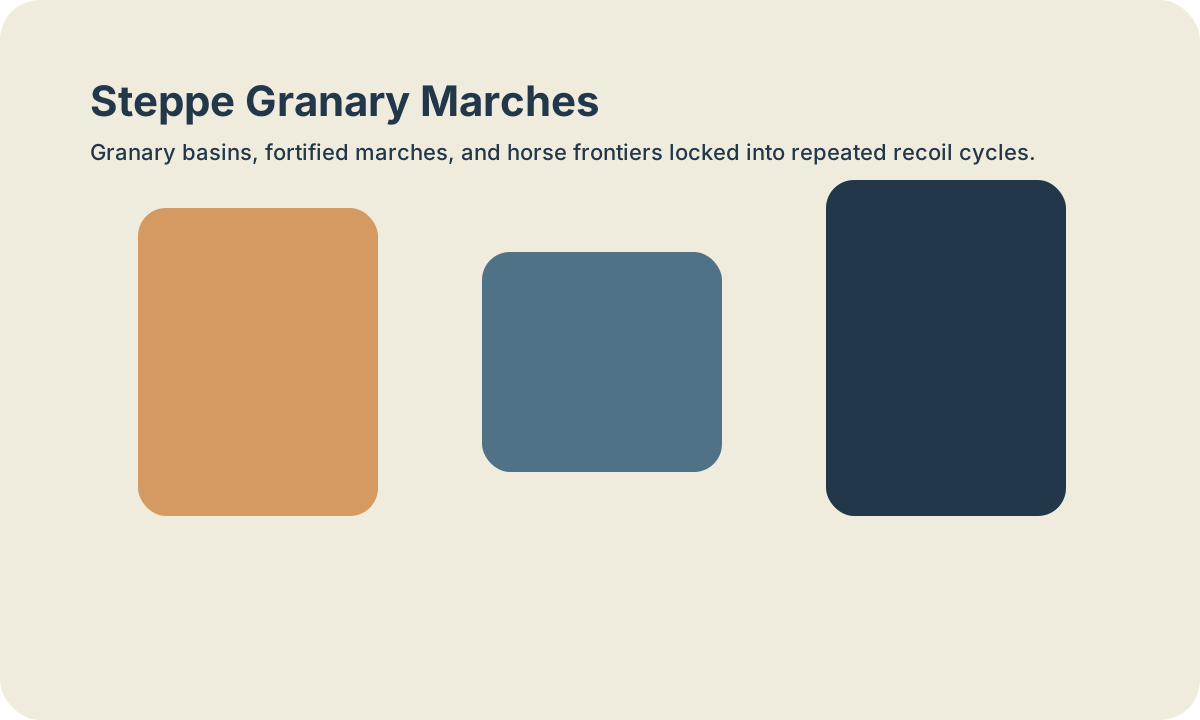
This example world is assembled around a hard ecological contrast: irrigated grain basins can sustain administrative depth, while adjacent steppe belts sustain speed, raiding, and seasonal coalition power.
That contrast produces marches instead of stable borders. Fortified towns, canal depots, and cavalry must all cooperate across a frontier that is never cheap to close.
Explains why dense agrarian cores and low-density horse frontiers produce different forms of survival and concentration.
Force Projection WindowShows why cavalry reach, supply drag, and fortified basin depth create recurring but limited expansion cycles.
Era Pressure TransitionClarifies how the same world can oscillate between expansion, fragmentation, and renewed frontier militarization.
The decisive structure is asymmetry between food depth and movement speed. Basin states can hold archives, granaries, and tax officials. Steppe confederations can move faster, concentrate force quickly, and punish overextended fronts.
That keeps the marches alive as a political system. No actor can permanently erase the other without first changing the underlying habitat and logistics balance.
| Axis | Question | Signal |
|---|---|---|
| Granary core | Where is durable administrative capacity generated? | Canal-fed agriculture, fortified storehouses, river tolls, cadastral taxation |
| March corridor | Where does the state spend most of its coercive budget? | Watchtowers, escort roads, frontier market towns, military farms |
| Horse frontier | Where does speed outrun fixed control? | Seasonal camps, dispersed grazing, mobile alliances, raid windows, shifting tributaries |
The world is compelling because neither side can easily erase the ecological basis of the other. Granary cores can outstore and out-administer the frontier, but they cannot simply become fast-moving steppe coalitions. Steppe powers can outmaneuver fixed marches, but they cannot effortlessly replace the food depth and bureaucratic density of the basin states. The asymmetry therefore regenerates the frontier over time.
The case transfers well because it ties politics to enduring habitat contrast rather than to generic hostility. Frontier raids, garrison reform, canal maintenance, and shifting tributary bargains all make sense once grain depth and movement speed are recognized as separate structural strengths that keep colliding at the same corridor belt.
It also shows why frontier reform so often disappoints. A basin state can improve one march, rebuild one chain of forts, or buy a few seasons of calmer bargaining, but it cannot abolish the steppe advantage in mobility without changing the deeper substrate. The pattern therefore renews itself unless one side fundamentally rewrites the ecological terms of the contest.
The reusable lesson is that example worlds become memorable when their political instability comes from enduring ecological and logistical asymmetry rather than from generic faction noise.
This world works because settlement depth, mobility, and frontier cost all come from the same assembled map. That shared source of pressure is what keeps frontier politics from dissolving into disconnected episodes of war, reform, and revolt. It gives every campaign and reform program the same structural backdrop. The world stays coherent because every actor is reacting to the same habitat divide.
Read what should come before it, what relation role matters next, and where this page should hand you off after the local graph is clear.
Start with Habitat Carrying Gradient and then return here once the surrounding concept stack is clear.
Use Habitat Carrying Gradient or the linked nodes below when you want to compare this page against neighboring parts of the graph.
Use Guides when the study should feed into a worksheet or structured revision sequence.
1 handoff nodes stay inside Governance And Power. 2 handoff nodes share Regional.
Detail pages now expose the branch and scale of their surrounding graph before showing raw prerequisite and relation shelves, so continuation can stay taxonomy-led instead of adjacency-led.
Explain campaigns, sustainment, force projection, defensive depth, and operational windows as structural systems.
Start with sustainment and projection models, identify the theater cycle, validate through an operational case, then run an operations stress test.
Explain transition, disturbance, collapse, recovery, and reassembly across eras and stress cycles.
Start with transformation and failure models, trace residue and recovery paths, compare a collapse or successor-order study, then run a failure-mode review.
Explain how legitimacy, coercion, administrative reach, frontier bargaining, and elite control are structured.
Start with the pressure map, locate legitimacy and capture mechanisms, validate against a frontier or state case, then run a governance stress test.
Use this scale when the strongest explanation depends on several levels staying visible together.
Use this scale when the region is the main leverage unit for settlement, extraction, governance, or conflict.
Use prerequisites when you want the shortest path into the assumptions this page depends on.
A model for mapping how water, temperature, soil renewal, shelter, and disturbance tolerance create uneven ecological carrying capacity across a world.
A model for how far and how long force can be projected effectively before supply, delay, terrain, and recovery costs collapse performance.
This entry still relies on generic related links. That works as a fallback, but typed relation roles would make continuation clearer.
A model for mapping how water, temperature, soil renewal, shelter, and disturbance tolerance create uneven ecological carrying capacity across a world.
A model for how far and how long force can be projected effectively before supply, delay, terrain, and recovery costs collapse performance.
A framework for tracking expansion, consolidation, frontier friction, and institutional fatigue across a civilizational space.
A model for identifying when accumulated pressure crosses a threshold and turns one historical operating regime into another.
Studies apply Spcent's lenses to complete cases. Read them to see whether geography, surplus, corridors, and pressure patterns still make sense when placed inside one setting.
The goal is not to retain setting trivia. The goal is to extract reusable patterns and structural habits you can reapply elsewhere.
Studies are strongest when you already know the frameworks and models underneath them, so you can recognize the structural moves being made.
After reading a study, identify which layer of your own draft needs work and go back there with one concrete change in mind.
Keep these collapsed until you want to turn the page into an active reading exercise.
What are the decisive regions, corridors, or chokepoints in this case?
What keeps the studied world stable, and what makes it brittle?
Which model or framework do I need next if I want to reproduce this pattern in my own project?
These routes are tuned to the kind of entry you are currently reading, so you can leave this page with one deliberate next move.
Use Guides when the study should feed into a worksheet or structured revision sequence.
Cross-layer moveReturn to the worlds module when the case highlights a weak worldbuilding layer in your own draft.
Cross-layer moveOpen models when the case reveals a mechanism you want to isolate and reuse directly.