Preparing the current spcent route.
The page shell is online. Shared content and route data are still being assembled.
A model for how orders, temples, state bureaus, or chartered houses monopolize magical capability through licensing, site control, doctrine, and rationed access.
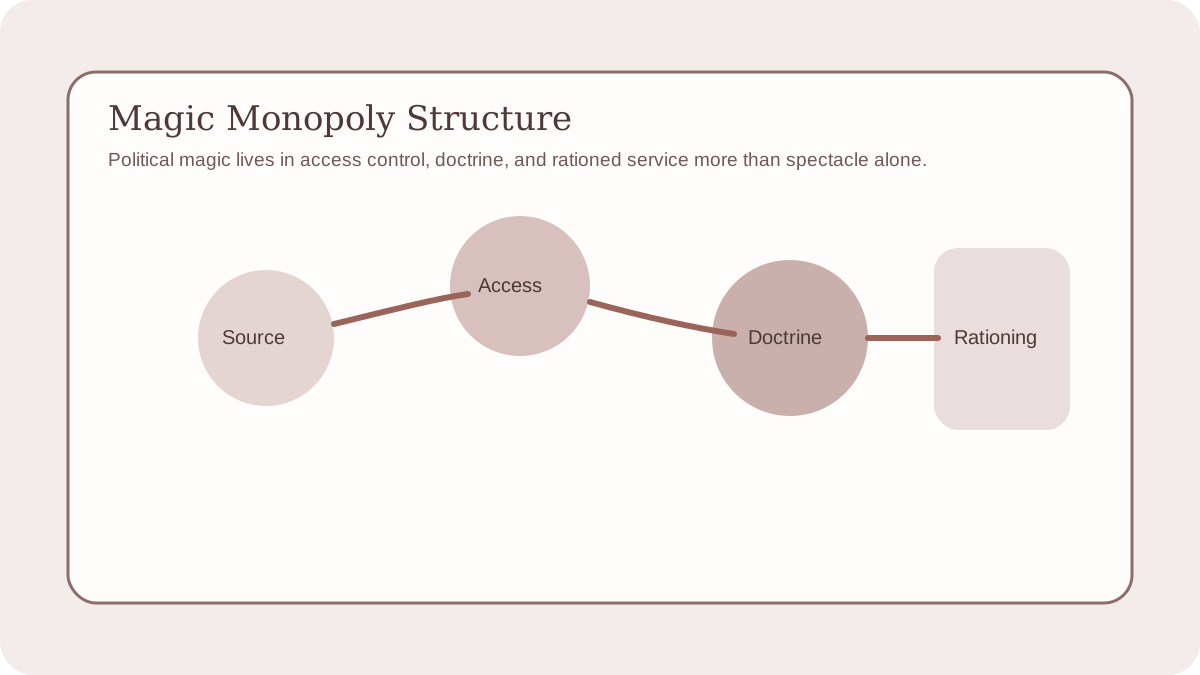
The magic operating regime explains the source, cost, and scope of capability. Magic monopoly structure asks who gets to gate that capability once it becomes politically valuable. Orders, temples, academies, chartered houses, and state bureaus can all convert magical access into a durable monopoly.
This model matters because many settings have rare power without showing the institution that keeps it rare. If training, doctrine, site access, reagent supply, or legal recognition can be controlled, magic becomes a monopolized operating layer with rents, black markets, and legitimacy consequences.
| Axis | Question | Signal |
|---|---|---|
| Source control | Which sites, materials, bloodlines, or ritual windows can the monopoly restrict directly? | Sacred wells, reagent vaults, ley nodes, initiation lines, seasonal sanctuaries, licensed shrines |
| Access gate | How are users filtered, trained, or legally recognized? | Ordination, guild charter, state exam, bonded apprenticeship, permits, hereditary orders |
| Doctrine lock | Which interpretation of safe or lawful use keeps alternative practice delegitimized? | Canonical rituals, taboo law, sealed texts, certification tests, sanctioned liturgy, inspection bureaus |
| Deployment rationing | Who receives magical service first when capacity is scarce? | Court privilege, military priority, merchant contract, sacred duty, frontier neglect, black-market leakage |
If magical access widens suddenly through smuggling, imitation, reform, or frontier autonomy, which monopoly lever breaks first: source control, licensing, doctrine, or deployment priority? The answer reveals whether the institution is governing magic or merely claiming to.
Rift Aquifer Theocracy is a direct reference because control over hidden water and sanctioned access makes doctrine inseparable from material survival. Dune Resource Power System offers the non-fantasy analogue: monopoly, restricted training, and strategic scarcity create concentrated bargaining power even before outright coercion appears.
The reusable lesson is that magical hierarchy should be modeled as an access monopoly, not only as a list of powerful users. Once the monopoly levers are explicit, reform pressure, black markets, client states, and doctrinal conflict become structurally legible.
Read what should come before it, what relation role matters next, and where this page should hand you off after the local graph is clear.
Start with Magic Operating Regime and then return here once the surrounding concept stack is clear.
These entries make the current idea more explicit and more reusable. Start with Legitimacy-Capture Coupling when you want the clearest next role.
Return to broader lenses when this model is too specific for the question you are asking.
1 handoff nodes stay inside Capability Regimes. 3 handoff nodes share Cross Scale.
Detail pages now expose the branch and scale of their surrounding graph before showing raw prerequisite and relation shelves, so continuation can stay taxonomy-led instead of adjacency-led.
Explain how legitimacy, coercion, administrative reach, frontier bargaining, and elite control are structured.
Start with the pressure map, locate legitimacy and capture mechanisms, validate against a frontier or state case, then run a governance stress test.
Explain how technology, magic, infrastructure, communication, and transformation capacity rewrite baseline constraints.
Start with the operating regime, price the capability through diffusion or monopoly models, compare a regime-rewrite case, then run a capability sanity check.
Explain campaigns, sustainment, force projection, defensive depth, and operational windows as structural systems.
Start with sustainment and projection models, identify the theater cycle, validate through an operational case, then run an operations stress test.
Use this scale when the strongest explanation depends on several levels staying visible together.
Use this scale when the region is the main leverage unit for settlement, extraction, governance, or conflict.
Use this scale when the whole world model or planetary constraint pattern should stay visible at once.
Use prerequisites when you want the shortest path into the assumptions this page depends on.
A model for how magical capability is sourced, gated, trained, costed, and monopolized so it behaves like a real operating layer instead of selective plot permission.
A model for comparing what different factions actually control across territory, movement, institutions, storage, and legitimacy rather than by abstract power labels.
These groups explain why each neighboring node matters, whether it stabilizes the concept, operationalizes it, proves it, or pushes the lane further.
Use operationalizing relations when you want the current abstraction rendered as a cleaner model, loop, or structural device.
A model for how material capture becomes durable rule only when extraction, justification, and visible order remain coupled strongly enough to be tolerated.
Use applied relations when the next useful move is to see the current pattern survive inside a study or assembled world.
An assembled example world showing how deep water access, ritual infrastructure, and magical monopoly can produce a theocratic basin state that is rich in control but brittle at its hidden sources.
Use extension relations when the next move is not prerequisite or proof, but a deeper neighboring step in the same graph lane.
A model for how magical capability is sourced, gated, trained, costed, and monopolized so it behaves like a real operating layer instead of selective plot permission.
These entries still matter, but they currently rely on generic adjacency instead of typed continuation semantics.
A model for comparing what different factions actually control across territory, movement, institutions, storage, and legitimacy rather than by abstract power labels.
A systems study of how extreme environmental scarcity, mono-resource dependence, and interstellar transport control turn Arrakis into a concentrated power machine.
An advanced science-fiction study of how infrastructure advantage, communication compression, and selective peripheral integration can stabilize rule at long distance without evenly occupying every region.
Models formalize behavior. Use them when you need a concrete chain, loop, stress scenario, or layered mechanism that can be tested and reused.
A model should explain how something behaves over time or under pressure, not just identify a broad topic area.
When a setting feels plausible at rest but still behaves vaguely, models provide the explicit structure needed to test it.
A strong workflow often moves from broad lens to formal model to applied case reading.
Keep these collapsed until you want to turn the page into an active reading exercise.
What mechanism is this model making explicit?
Where does this model break or become most interesting under stress?
Which study would verify whether this model survives in a complete setting?
These routes are tuned to the kind of entry you are currently reading, so you can leave this page with one deliberate next move.
Return to broader lenses when this model is too specific for the question you are asking.
Cross-layer moveMove through the systems module when you want to navigate models by design intent.
Cross-layer moveVerify the model inside applied cases where multiple structures interact at once.