Preparing the current spcent route.
The page shell is online. Shared content and route data are still being assembled.
A model for how marshes, floodplains, reed belts, and seasonal wetlands absorb flood energy, disease pressure, nutrient renewal, and route friction at the same time.
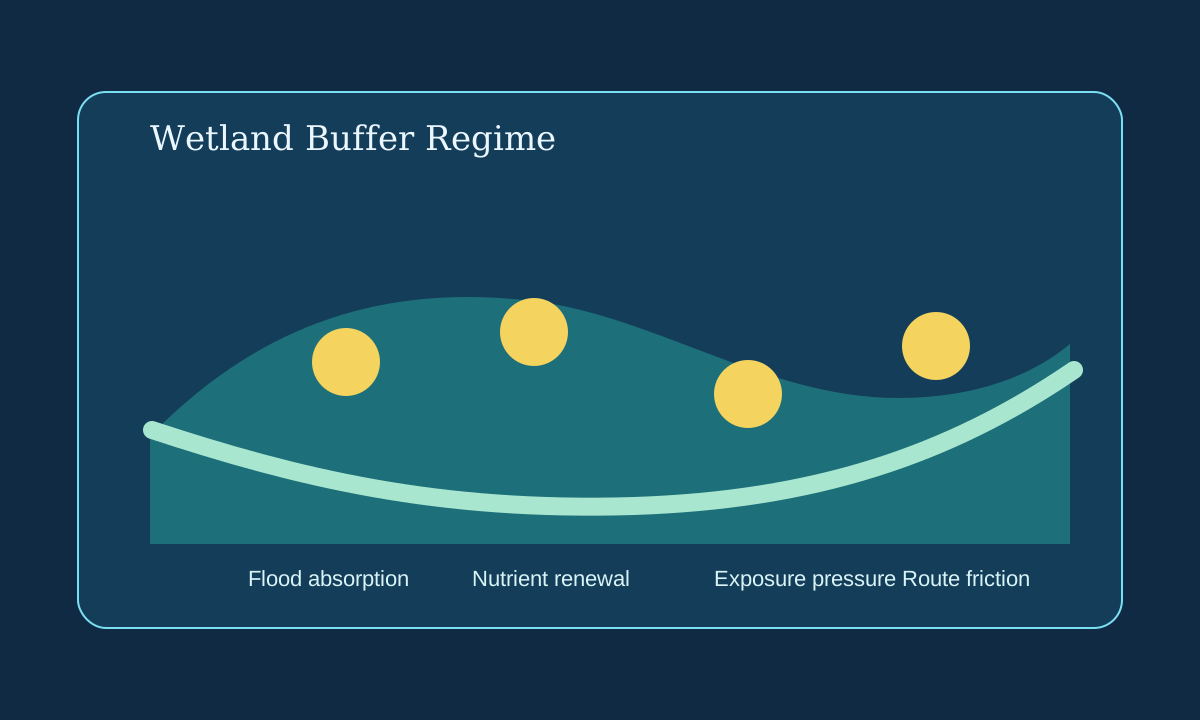
Wetlands are not empty margins. They are buffer regimes. Marshes, reed belts, floodplains, deltas, and seasonal swamps can absorb flood energy, trap nutrients, filter water, delay armies, shelter biodiversity, and intensify vector-borne disease in the same landscape.
This model matters because worlds often treat wetlands as one-note obstacles or one-note fertile deltas. In practice, the same wet zone can be protective, productive, and dangerous depending on season, maintenance, and settlement form.
| Axis | Question | Signal |
|---|---|---|
| Flood absorption | How does the wet zone dissipate or redirect water energy? | Overflow marsh, reed belts, spill channels, saturated flats, sediment traps |
| Nutrient renewal | What productive value does periodic inundation create? | Silt deposition, fish nurseries, grazing flush, reed harvest, fertile retreat soils |
| Exposure pressure | How does the same environment alter disease and health risk? | Standing water, vector habitat, foul channels, quarantine islands, seasonal fever zones |
| Route friction | What movement becomes harder, slower, or more selective across the wet zone? | Causeway dependence, shallow draft routes, tow paths, bridge choke points, dry-season corridors |
If the wet zone is drained, silted up, or left unmanaged, which function disappears first: flood absorption, fertility renewal, disease filtering, or route stability? The answer shows whether the surrounding settlements depended on the wetland more than they admitted.
Nile Flood Basin State is the positive contrast where flood regimes are disciplined into a productive corridor. Black Death Port Corridor Shock is useful at the opposite edge because marshy and port-adjacent environments can intensify exposure while still remaining commercially indispensable.
The reusable lesson is that wet landscapes should be modeled as multi-function buffers rather than as empty terrain. Once their flood, nutrient, exposure, and route roles are explicit, delta and marsh worlds become much more coherent.
Read what should come before it, what relation role matters next, and where this page should hand you off after the local graph is clear.
Start with Hydrology Settlement Coupling and then return here once the surrounding concept stack is clear.
These entries clarify the footing underneath the current node before you move outward again. Start with Hydrology Settlement Coupling when you want the clearest next role.
Return to broader lenses when this model is too specific for the question you are asking.
2 handoff nodes stay inside Evolution And Breakdown. 3 handoff nodes share Regional.
Detail pages now expose the branch and scale of their surrounding graph before showing raw prerequisite and relation shelves, so continuation can stay taxonomy-led instead of adjacency-led.
Explain what the world is materially built from before politics, balance, or style are discussed.
Start in Worlds, read the anchor framework, open one regional model, validate with a complete study, then finish with a world assembly guide pass.
Explain transition, disturbance, collapse, recovery, and reassembly across eras and stress cycles.
Start with transformation and failure models, trace residue and recovery paths, compare a collapse or successor-order study, then run a failure-mode review.
Use this scale when routes, relays, buffers, and linked nodes matter more than territorial bulk.
Use this scale when the region is the main leverage unit for settlement, extraction, governance, or conflict.
Use prerequisites when you want the shortest path into the assumptions this page depends on.
A model for how potable water, irrigation, flood control, drainage, and navigability bind settlement density to water management burden.
A model for tracing how food chains, pollination, disease buffering, draft power, and freshwater renewal link species and human settlement into one interdependent living system.
These groups explain why each neighboring node matters, whether it stabilizes the concept, operationalizes it, proves it, or pushes the lane further.
Use foundation relations when this node depends on a concept, term, or framing layer that should be explicit before you branch further.
A model for how potable water, irrigation, flood control, drainage, and navigability bind settlement density to water management burden.
Use operationalizing relations when you want the current abstraction rendered as a cleaner model, loop, or structural device.
A model for how corridors, ports, barracks, migration pulses, and immunity mismatch turn movement systems into repeating health pressure.
Use applied relations when the next useful move is to see the current pattern survive inside a study or assembled world.
A historical study of how flood timing, basin irrigation, grain storage, and hydraulic maintenance let a river civilization turn annual renewal into durable state capacity.
Use extension relations when the next move is not prerequisite or proof, but a deeper neighboring step in the same graph lane.
A model for tracing how food chains, pollination, disease buffering, draft power, and freshwater renewal link species and human settlement into one interdependent living system.
These entries still matter, but they currently rely on generic adjacency instead of typed continuation semantics.
A model for mapping how water, temperature, soil renewal, shelter, and disturbance tolerance create uneven ecological carrying capacity across a world.
A historical study of how maritime ports, inland corridors, quarantine filters, and dense urban nodes turned disease exposure into a system-wide commercial and political shock.
Models formalize behavior. Use them when you need a concrete chain, loop, stress scenario, or layered mechanism that can be tested and reused.
A model should explain how something behaves over time or under pressure, not just identify a broad topic area.
When a setting feels plausible at rest but still behaves vaguely, models provide the explicit structure needed to test it.
A strong workflow often moves from broad lens to formal model to applied case reading.
Keep these collapsed until you want to turn the page into an active reading exercise.
What mechanism is this model making explicit?
Where does this model break or become most interesting under stress?
Which study would verify whether this model survives in a complete setting?
These routes are tuned to the kind of entry you are currently reading, so you can leave this page with one deliberate next move.
Return to broader lenses when this model is too specific for the question you are asking.
Cross-layer moveMove through the systems module when you want to navigate models by design intent.
Cross-layer moveVerify the model inside applied cases where multiple structures interact at once.