Pulling this page together.
Preparing content, navigation, and supporting references for this route.
Preparing content, navigation, and supporting references for this route.
A sample systems study showing how basin agriculture, defensive ridges, and narrow passes produce a dense but brittle civilization pattern.
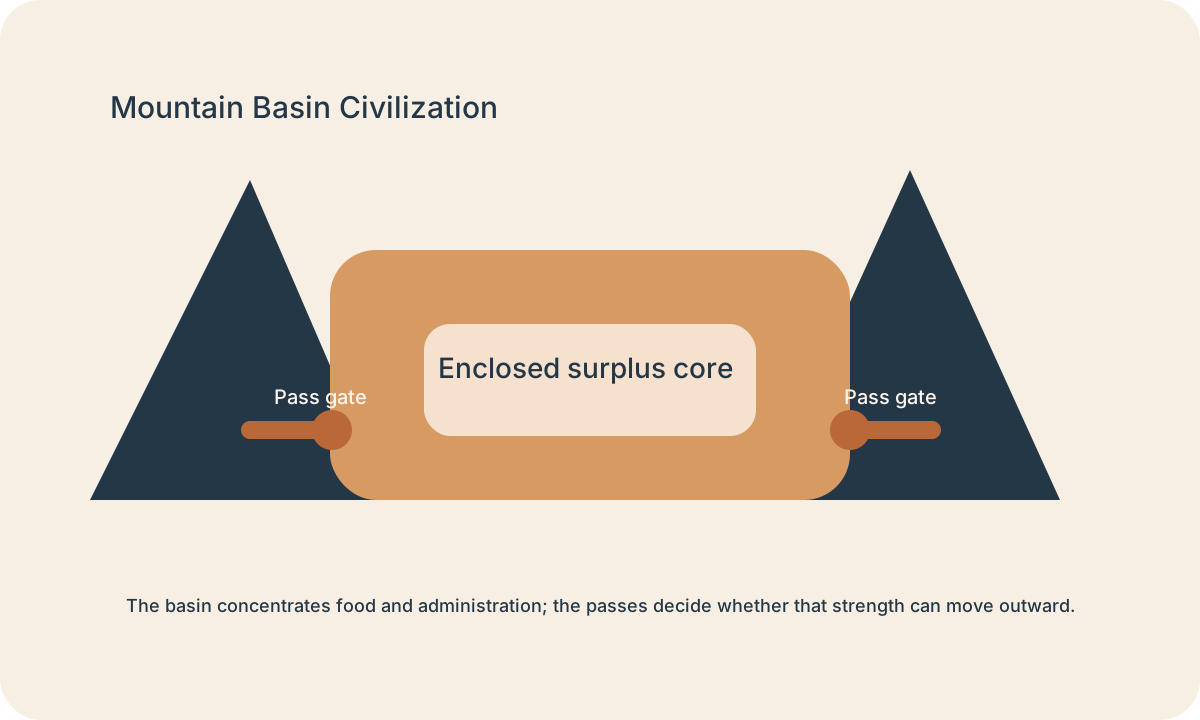
A ring of mountains creates fertile basins but restricts outward movement to a few passes.
This produces strong internal coherence, concentrated food production, and high vulnerability at corridor thresholds.
Start with the basin where agriculture, storage, and administration can reinforce one another under mountain protection.
Map the few crossings that convert internal wealth into long-distance trade, military reach, and diplomatic leverage.
Ask how quickly blockade, snow closure, or hostile ridge control can turn a rich basin into a brittle enclosed system.
Provides the macro-pressure lens for understanding how basin systems strain at their edges.
Resource Flow LoopExplains why storage and pass control become central institutions in enclosed basins.
Settlement Corridor StackClarifies how narrow passes harden into strategic corridors and political leverage points.
Political power consolidates around storage and pass control, while long-distance trade remains profitable but easy to interrupt.
The resulting civilization is rich in core zones yet strategically anxious at its edge.
That pattern produces a characteristic political style. Basin elites often invest heavily in fortifying gateways, counting stored grain, and bargaining with corridor governors because the margin for logistical error is narrow. A bad harvest, blocked pass, or rebellious ridge community can quickly turn a concentrated surplus system into a trapped one.
Switch the scenario to see how the same enclosed geography behaves very differently when the pass network is stable, stressed, or cut.
Harvests move into storage, passes remain open, and the basin converts internal density into trade and political confidence. Under these conditions enclosure feels like coherence rather than trap.
Use the axis switch to compare what the surplus core, pass regime, ridge edge, and outer corridor each contribute to the whole civilization.
Protected food and storage density make this the political and demographic center of gravity.
The core concentrates administration because counting, storage, and redistribution are cheapest here.
A small number of crossings decide whether enclosed strength can be projected outward.
The pass regime concentrates bargaining power because a few actors can delay or release the whole basin.
Broken outer slopes impose surveillance cost and make local disorder hard to standardize away.
The ridge edge attracts patrols, fortification, and negotiated loyalties rather than routine bureaucratic depth.
The line beyond the pass where basin wealth becomes trade, diplomacy, and military timing.
The outer corridor determines whether the basin looks inward like a fortress or outward like a trading state.
Enclosure does more than protect agriculture. It compresses strategic attention. Because only a few passes connect the basin to the wider world, disputes over storage, transit, and gateway authority become politically heavier than they would in a more open region. The same geography that makes administration coherent also makes mismanagement harder to hide.
This is why basin civilizations often feel simultaneously secure and anxious. The core is protected enough to accumulate surplus and hierarchy, but everyone knows that a small number of corridor failures can turn internal strength into trapped abundance. Politics therefore gravitates toward reserve timing, pass discipline, and the question of who can speak for the gateways.
The basin is not weak because it is enclosed. It is weak when it mistakes protected density for strategic freedom. If elites assume that internal wealth alone guarantees leverage, they can overinvest in core grandeur while underinvesting in relief roads, pass fortification, and relations with ridge communities. At that point the basin becomes richer than it is mobile.
That is the clean diagnostic the case offers. Ask whether the civilization can still turn interior storage into outward action after one bad season or one blocked connector. If not, the basin is running on the illusion of strength rather than on true corridor resilience.
Use this study when a world needs to explain why enclosed geography creates both coherence and fragility. Mountain-basin systems are useful examples of how protected density can still depend on a tiny number of outward connectors.
The portable lesson is that enclosure does not remove politics. It relocates politics onto storage timing, pass control, and the institutions that decide whether internal wealth can actually leave the basin under pressure.