Preparing the current spcent route.
The page shell is online. Shared content and route data are still being assembled.
A synthetic study of how fortress belts, granary release, garrison rotation, and corridor choke points turn frontier warfare into a reserve and timing problem.
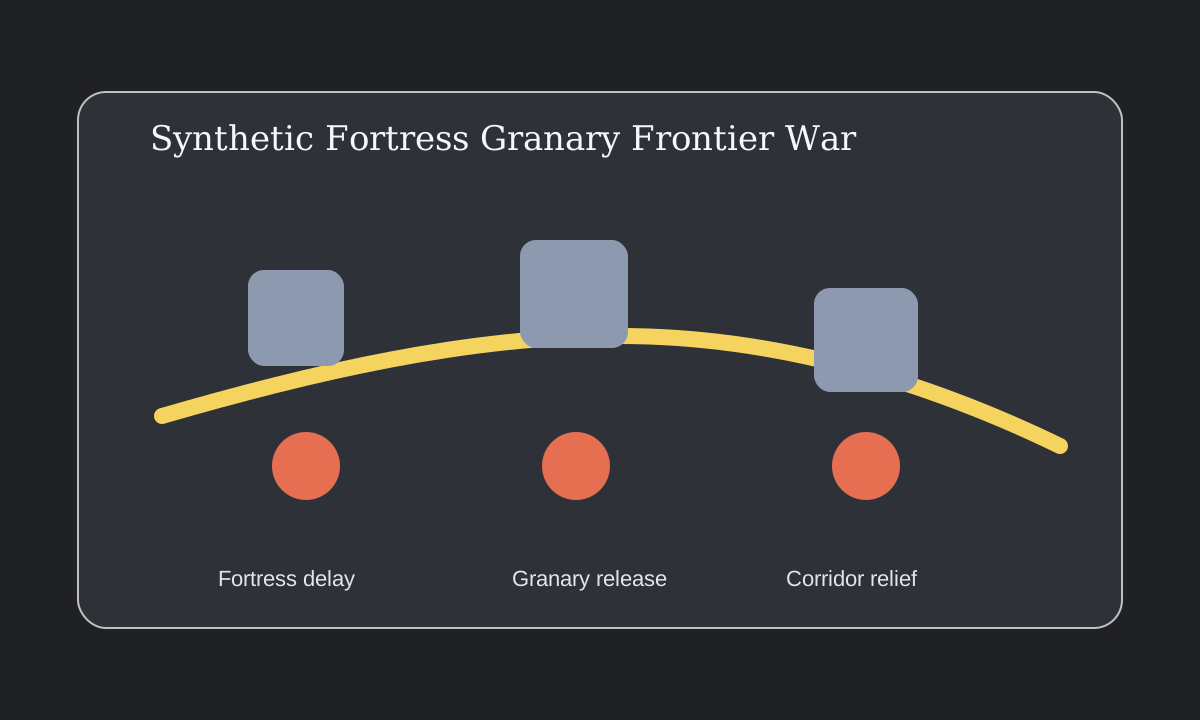
This synthetic case treats frontier war as a granary-and-fortress problem. Fortified lines do not hold by stone alone. They hold when garrisons rotate, granaries release at the right time, relief columns can still cross decisive corridors, and local strongpoints do not become isolated consumers of reserves.
That makes the case useful because it proves the slower side of combat logic. Not every campaign is won by speed. Some are won by whether fortified depth, stored stability, and corridor control stay synchronized longer than the attacker can sustain pressure.
Provides the base lens for reading the frontier as a recurring cycle of supply, garrison fatigue, relief, and delayed recovery rather than as isolated sieges.
Strategic Reserve NetworkClarifies how stored grain, munitions, and replacement manpower matter only if release authority and routes remain intact under pressure.
Frontier Chokepoint LedgerShows why a few passes, ferries, or ridge roads decide whether the defensive system behaves like depth or like scattered strongholds.
The frontier war turns on four reserve pressures. Fortress belts delay penetration. Granaries convert stored abundance into staying power. Garrison rotation prevents static exhaustion. Relief corridors determine whether reserves actually arrive before an isolated node becomes politically and militarily irrelevant.
| Axis | Question | Signal |
|---|---|---|
| Fortress delay | What makes an attacking force spend time and material instead of passing straight through? | Wall depth, ditch systems, artillery platforms, fallback forts, overlapping fire zones |
| Granary release | When does stored stability become usable defense rather than static stockpile? | Depot timing, ration schedules, reserve escort, release authority, spoilage control |
| Garrison rotation | How does the defense avoid becoming a fixed, exhausted line? | Relief units, manpower cycling, repair crews, local militia integration, fatigue discipline |
| Corridor relief | Which routes decide whether a threatened fortress can still be reconnected to the wider system? | Pass roads, ferry chains, ridge paths, winter access, convoy protection, siege bypass routes |
The decisive question is rarely whether the wall exists. It is whether the wider system can keep feeding and rotating the wall before the pressure compounds.
The defense survives early pressure because attackers cannot pass cleanly through the first layer of forts without spending time and supplies.
The case is useful because it treats forts as reserve claims rather than as self-sufficient walls. A fortress buys time, but time only matters if grain, munitions, relief columns, and replacement crews can all arrive before the defender's local endurance collapses. This pushes the analysis away from architecture alone and back toward synchronization across the whole defensive field.
That is why granaries matter so much. Stored abundance is not automatically defensive strength. It becomes strength only when release authority, route protection, and garrison rotation all line up early enough to keep one threatened point inside the wider frontier system. Otherwise stockpiles remain static while forts become isolated consumers.
The portable lesson is that frontier defense should be modeled as a reserve-and-corridor problem even when walls and strongholds dominate the visual surface. This applies to medieval marches, orbital bastion chains, magical ward belts, and any other defense-in-depth system where delay is useful only if the wider logistics machine can exploit it.
The reusable lesson is that frontier war should be modeled as synchronized delay, reserves, and corridor relief. This case is useful because it shows how fortresses matter only when the wider reserve system can keep them alive. The visual wall matters less than the timing discipline behind it. That is what turns stone into strategy. Otherwise the stronghold is only a timed expense. The defense survives through schedule, not masonry alone.
Read what should come before it, what relation role matters next, and where this page should hand you off after the local graph is clear.
Start with Combat Sustainment Loop and then return here once the surrounding concept stack is clear.
These entries clarify the footing underneath the current node before you move outward again. Start with Combat Sustainment Loop when you want the clearest next role.
Use Guides when the study should feed into a worksheet or structured revision sequence.
3 handoff nodes stay inside Conflict And Operations. 4 handoff nodes share Regional.
Detail pages now expose the branch and scale of their surrounding graph before showing raw prerequisite and relation shelves, so continuation can stay taxonomy-led instead of adjacency-led.
Explain campaigns, sustainment, force projection, defensive depth, and operational windows as structural systems.
Start with sustainment and projection models, identify the theater cycle, validate through an operational case, then run an operations stress test.
Explain how resources, goods, labor, information, and force circulate, stall, buffer, and break.
Start from the resource-flow loop, trace storage and throughput models, compare one logistics study, then run a flow audit worksheet.
Explain how legitimacy, coercion, administrative reach, frontier bargaining, and elite control are structured.
Start with the pressure map, locate legitimacy and capture mechanisms, validate against a frontier or state case, then run a governance stress test.
Use this scale when the region is the main leverage unit for settlement, extraction, governance, or conflict.
Use this scale when the strongest explanation depends on several levels staying visible together.
Use this scale when routes, relays, buffers, and linked nodes matter more than territorial bulk.
Use prerequisites when you want the shortest path into the assumptions this page depends on.
A model for how supply, reserve depth, reinforcement timing, route security, and recovery windows determine whether force projection remains real or collapses after contact.
A model for locating where reserves are stored, who can release them, and how fast they can stabilize the wider system under delay, shock, or surge.
These groups explain why each neighboring node matters, whether it stabilizes the concept, operationalizes it, proves it, or pushes the lane further.
Use foundation relations when this node depends on a concept, term, or framing layer that should be explicit before you branch further.
A model for how supply, reserve depth, reinforcement timing, route security, and recovery windows determine whether force projection remains real or collapses after contact.
A framework for tracking which passes, ports, narrows, and crossings decide political leverage at the edge of a system.
Use operationalizing relations when you want the current abstraction rendered as a cleaner model, loop, or structural device.
A model for locating where reserves are stored, who can release them, and how fast they can stabilize the wider system under delay, shock, or surge.
Use contrast relations when the difference between two nodes is more useful than simple adjacency or agreement.
A historical study of how remount depth, reconnaissance reach, dispersed foraging, and command tempo turned Mongol warfare into a campaign system rather than a sequence of isolated battles.
These entries still matter, but they currently rely on generic adjacency instead of typed continuation semantics.
A model for how far and how long force can be projected effectively before supply, delay, terrain, and recovery costs collapse performance.
A model for tracing the two-way dependence between a city and its surrounding production, service, labor, and reserve network instead of treating the city as a self-contained center.
Studies apply Spcent's lenses to complete cases. Read them to see whether geography, surplus, corridors, and pressure patterns still make sense when placed inside one setting.
The goal is not to retain setting trivia. The goal is to extract reusable patterns and structural habits you can reapply elsewhere.
Studies are strongest when you already know the frameworks and models underneath them, so you can recognize the structural moves being made.
After reading a study, identify which layer of your own draft needs work and go back there with one concrete change in mind.
Keep these collapsed until you want to turn the page into an active reading exercise.
What are the decisive regions, corridors, or chokepoints in this case?
What keeps the studied world stable, and what makes it brittle?
Which model or framework do I need next if I want to reproduce this pattern in my own project?
These routes are tuned to the kind of entry you are currently reading, so you can leave this page with one deliberate next move.
Use Guides when the study should feed into a worksheet or structured revision sequence.
Cross-layer moveReturn to the worlds module when the case highlights a weak worldbuilding layer in your own draft.
Cross-layer moveOpen models when the case reveals a mechanism you want to isolate and reuse directly.