Pulling this page together.
Preparing content, navigation, and supporting references for this route.
Preparing content, navigation, and supporting references for this route.
An overarching framework for assembling worlds from substrate, circulation, institutions, capability, and historical residue so complete settings can be compared through the same structural layers.
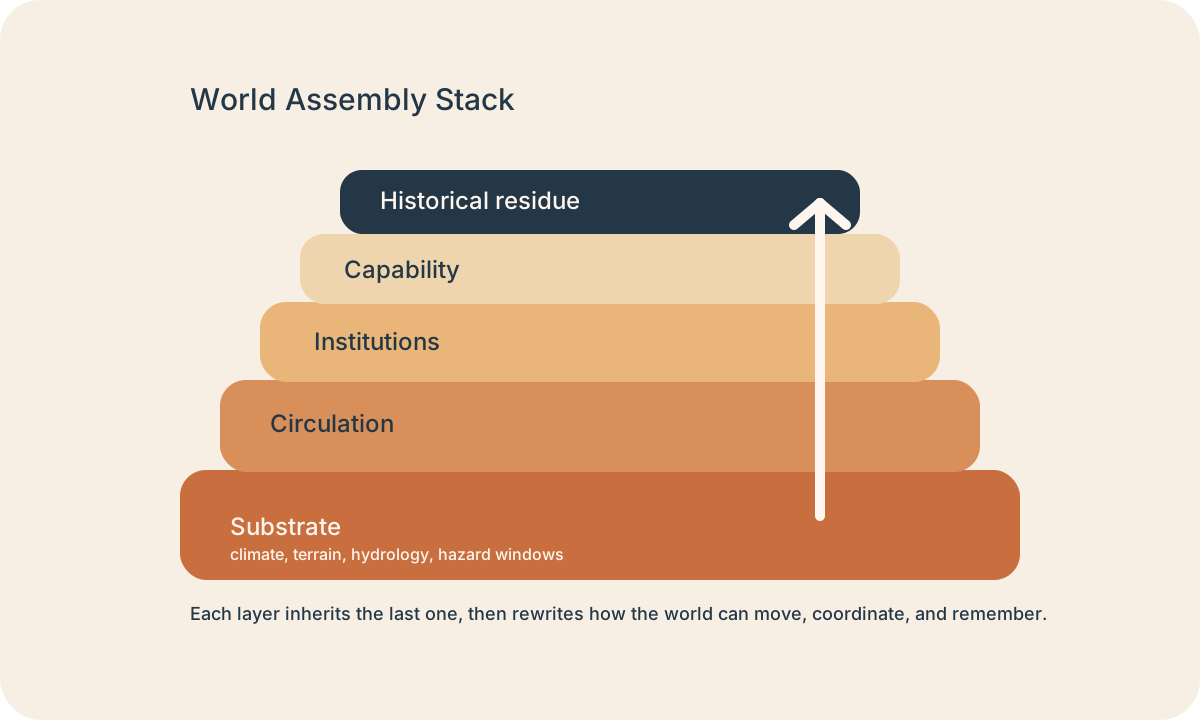
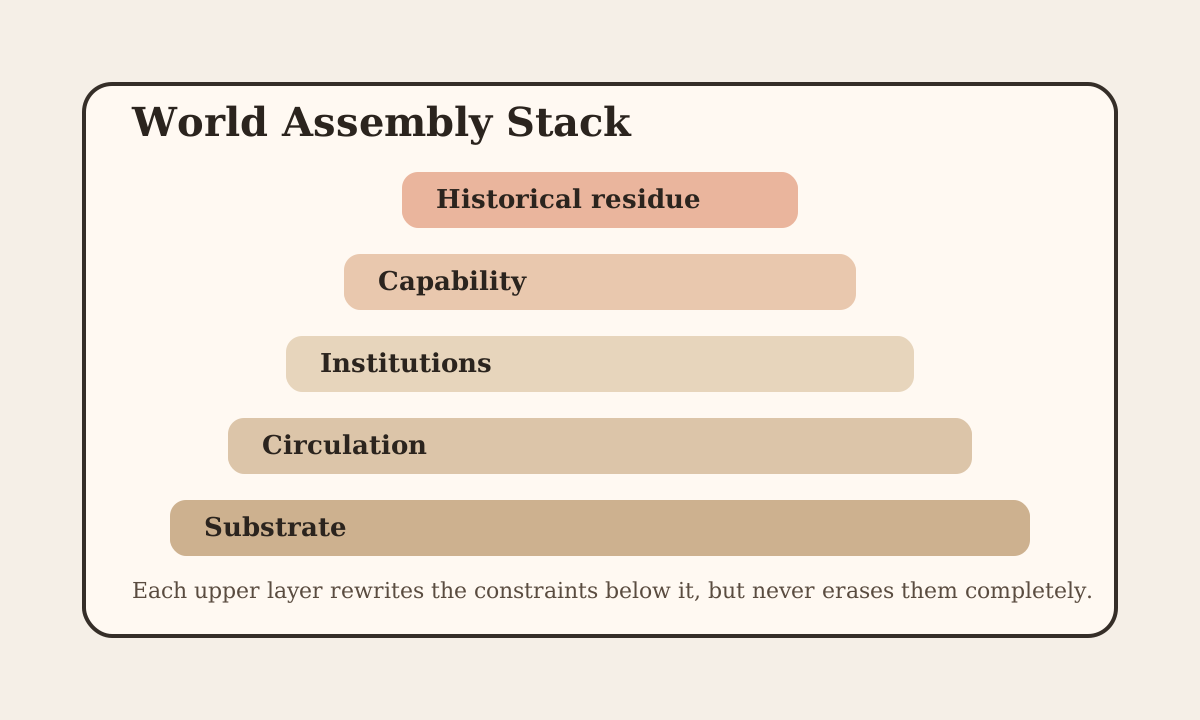
Complete worlds become comparable when they are assembled through the same stack instead of being described as loose mixtures of lore, mechanics, and map flavor.
The stack begins with substrate, then adds circulation, institutions, capability, and historical residue. Each later layer should rewrite the earlier ones without abolishing them. A world only becomes legible when readers can move through those layers deliberately instead of trying to hold every domain in mind at once.
Fix climate, terrain, hydrology, and hazard windows before you describe political or magical outcomes.
Show how matter, people, and information move through corridors, ports, relays, and chokepoints.
Add the actors and operating regimes that count, guard, accelerate, or rewrite the baseline.
Preserve what old roads, capitals, fears, and laws still force the present world to inherit unevenly.
| Axis | Question | Signal |
|---|---|---|
| Substrate | What hard environment does every later layer inherit? | Climate rhythm, terrain friction, hydrology, hazard windows, carrying gradients |
| Circulation | How do matter, people, and information actually move? | Corridors, route hierarchy, storage nodes, relay settlements, chokepoints |
| Institutions | Who governs, counts, guards, and redistributes the system? | Tax ledgers, coercive reach, delegated rule, merchant leagues, ritual authority |
| Capability | What technology, magic, or special operating regime rewrites the baseline constraints? | Diffusion ceilings, operating cost, monopoly, communication compression, transformation power |
| Historical residue | What from earlier eras still shapes the current map? | Road residue, old capitals, inherited fear, legal memory, abandoned fort belts |
Use the stepper when you want to see how each layer inherits the previous one and then changes what the whole world is allowed to do.
Start with climate rhythm, terrain friction, hydrology, and carrying gradients. This layer defines what later politics and capability must survive rather than what they wish existed.
The stack is useful because each layer changes the meaning of the layers beneath it rather than merely sitting on top of them. Substrate determines what is expensive, slow, seasonal, or exposed. Circulation turns those raw limits into actual corridor timing, storage depth, and route hierarchy. Institutions decide which of those corridors become governable, taxable, or defensible. Capability then rewrites some inherited limits by compressing distance, raising throughput, or bypassing older bottlenecks. Historical residue decides which earlier arrangements still survive long enough to distort the present.
That sequence is what makes the framework feel formal instead of impressionistic. It gives a creator a way to answer concrete questions in order. Why is this capital here rather than elsewhere? Why do two similar climates produce different political maps? Why does a new magical or technical system change one region more than another? The answer should not jump immediately to culture or leadership. The stack asks which earlier layer made that outcome legible and which later layer altered it.
The most common failure is to start too high in the stack. Many worlds begin with factions, aesthetics, or special powers and only later try to backfill climate, corridors, or storage logic underneath them. That usually creates a setting that is vivid in isolated scenes but thin under comparison, because the reader cannot tell which features are foundational and which are recent distortions.
Another common failure is to let a later layer erase every earlier one. Capability is the usual culprit. A teleport network, magical elite, imperial bureaucracy, or industrial breakthrough should certainly rewrite the world, but it should not abolish terrain, maintenance burden, timing windows, or inherited settlement depth completely unless the setting is explicitly about total replacement. Formality comes from showing which constraints moved and which survived.
Switch the path group to decide whether your next move should stabilize the base, inspect the rewrite layers, or jump into applied examples.
Provides the first regional frame for locating terrain, settlement, resources, and infrastructure together.
Technology Diffusion RegimeShows how capability becomes a world-level rewrite rather than an isolated gimmick.
Institutional Residue MapExplains what previous layers leave behind for later eras to inherit unevenly.
In practice, the framework works best as a drafting order and a review order. In drafting, start from the lowest layer and move upward so you do not invent institutional or magical outcomes that the world cannot support. In review, move backward from a claimed outcome toward the lower layers and ask whether the setting has actually earned it. If the answer to a political or military question keeps relying on unstated geography, invisible storage, or unpriced coordination, the stack has identified what still needs to be written.
The stack is also useful for comparison. Two worlds can both have empires, portals, merchant leagues, or urban belts, but the structural meaning changes depending on which layer is doing most of the work. One empire may rest on maritime circulation, another on road residue and administrative depth, and another on command compression from a narrow capability elite. The framework makes those differences explicit enough that comparison stops collapsing into surface genre labels.
The reusable lesson is that complete worlds become easier to compare, debug, and teach when they share the same assembly order.
The stack works because it makes a world legible as one layered system instead of a pile of disconnected good ideas.