Preparing the current spcent route.
The page shell is online. Shared content and route data are still being assembled.
A structural study of how lagoon defense, convoy routes, warehouse depth, and gateway coordination turned Venice into a durable maritime corridor power.
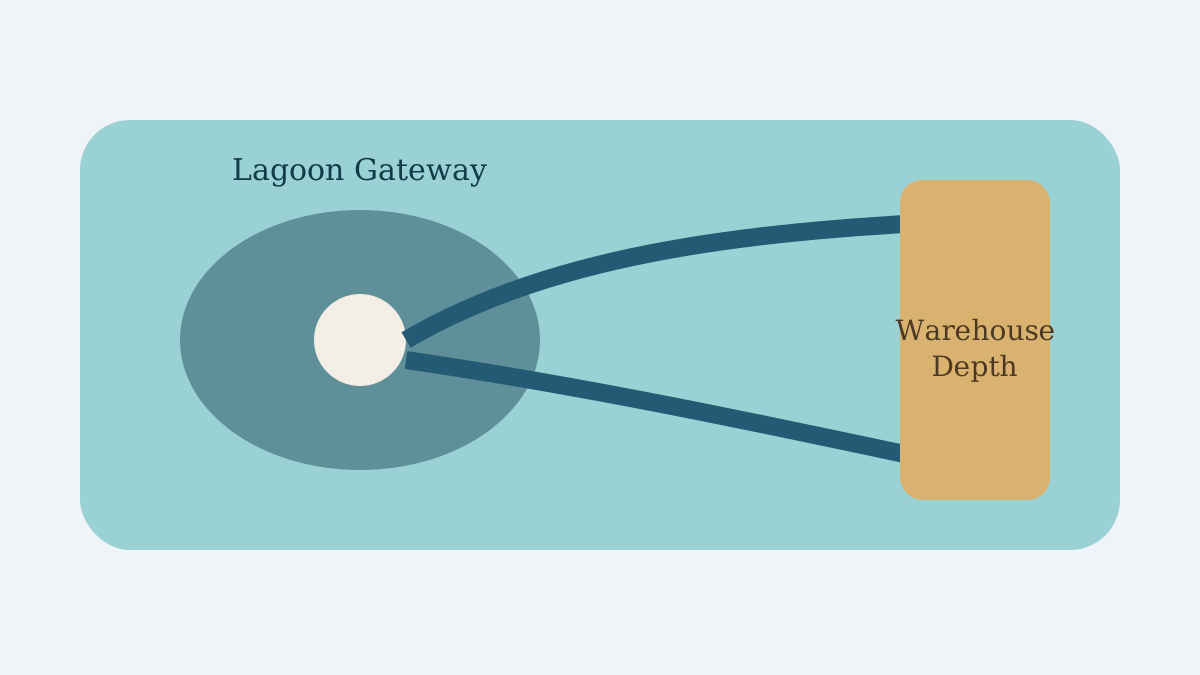
Venice is best read not as a generic rich port but as a protected gateway node inside a larger maritime corridor system. Lagoon defense lowered immediate seizure risk, convoy organization stabilized movement, and warehouse concentration turned passing trade into governable leverage.
That combination made Venice more than a city with boats. It became a node whose local defensibility and wider route coordination reinforced each other repeatedly.
Clarifies why Venice functioned as more than a market town: it coordinated gateway, depot, and political roles at once.
CorridorProvides the route logic for understanding why repeated maritime movement hardened into a durable strategic spine.
Resource Flow LoopExplains why warehouse depth and convoy timing mattered as much as the commodity mix itself.
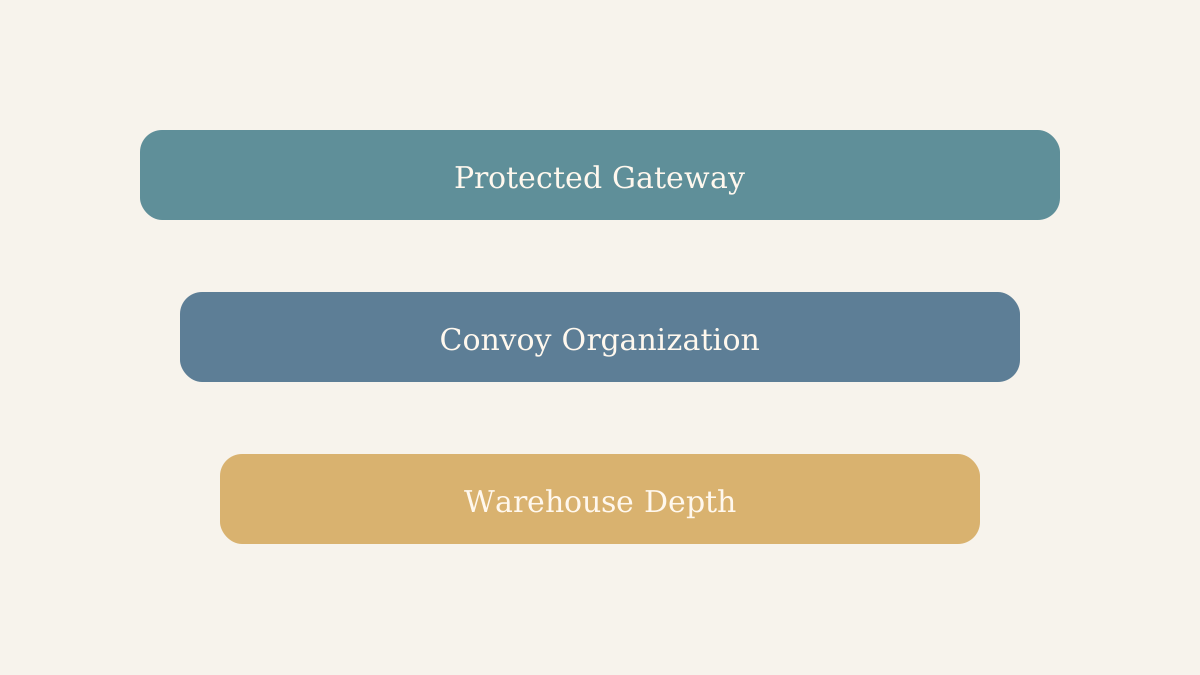
Venice converted maritime movement into power through three linked layers. First, the lagoon reduced sudden conquest risk and made the gateway harder to neutralize. Second, convoy organization made long-distance trade more predictable than an open, uncoordinated sea market. Third, concentrated warehousing let the city buffer timing shocks and bargain from storage rather than from immediate panic.
| Axis | Question | Signal |
|---|---|---|
| Protected gateway | Why was the node difficult to suppress quickly? | Lagoon access, narrow approaches, local navigation advantage, defensive standoff |
| Corridor organization | Why did repeated maritime movement keep consolidating here? | Convoy timing, route familiarity, merchant concentration, predictable staging |
| Warehouse depth | How did the city keep leverage during delay and seasonal mismatch? | Stored goods, deferred sale, credit extension, supply buffering |
| Gateway governance | How did movement become political influence? | Customs control, arbitration, convoy rules, brokered access, naval enforcement |
Use the toggle to see which layer matters most under calm trade, route stress, or direct disruption.
When convoy timing holds and warehouse depth stays strong, Venice converts predictability into bargaining power and financial patience.
The reusable lesson is that maritime power often comes from coupling a defensible gateway with disciplined route organization and storage depth. Venice works structurally because it is a corridor system with one unusually strong node, not only a famous harbor city.
Read what should come before it, what relation role matters next, and where this page should hand you off after the local graph is clear.
Start with Corridor and then return here once the surrounding concept stack is clear.
These entries clarify the footing underneath the current node before you move outward again. Start with Urban Node Hierarchy when you want the clearest next role.
Use Guides when the study should feed into a worksheet or structured revision sequence.
2 handoff nodes stay inside Flow And Logistics. 4 handoff nodes share Network.
Detail pages now expose the branch and scale of their surrounding graph before showing raw prerequisite and relation shelves, so continuation can stay taxonomy-led instead of adjacency-led.
Explain how resources, goods, labor, information, and force circulate, stall, buffer, and break.
Start from the resource-flow loop, trace storage and throughput models, compare one logistics study, then run a flow audit worksheet.
Explain how topology, region graphs, corridors, map abstraction, and scale determine movement and leverage.
Start in Spatial, reduce the map into region graph and corridor logic, test topology under disruption, then return through a spatial design guide.
Explain how cities work as filters, gateways, relays, conversion surfaces, and regional control machines.
Start with the urban logistics surface, step into gateway and throughput models, compare a port or capital study, then run a city-region worksheet.
Use this scale when routes, relays, buffers, and linked nodes matter more than territorial bulk.
Use this scale when the region is the main leverage unit for settlement, extraction, governance, or conflict.
Use this scale when city-scale transfer, concentration, or control is doing the main structural work.
Use prerequisites when you want the shortest path into the assumptions this page depends on.
A durable movement spine where terrain, settlement, exchange, and repeated transit align strongly enough to guide long-run circulation.
A location where flow is buffered, accumulated, protected, measured, or redirected strongly enough to change who can control the wider system.
These groups explain why each neighboring node matters, whether it stabilizes the concept, operationalizes it, proves it, or pushes the lane further.
Use foundation relations when this node depends on a concept, term, or framing layer that should be explicit before you branch further.
A model for how relay settlements, market towns, ports, capitals, and depot cities differentiate by throughput, storage, administration, and coordination load.
A durable movement spine where terrain, settlement, exchange, and repeated transit align strongly enough to guide long-run circulation.
Use operationalizing relations when you want the current abstraction rendered as a cleaner model, loop, or structural device.
A model for how extraction, transport, storage, transformation, and redistribution create stability or fragility in a world system.
Use contrast relations when the difference between two nodes is more useful than simple adjacency or agreement.
A historical study of how sea corridors, grain routes, roads, and layered provincial administration let Rome govern a wide empire through connected basins rather than continuous land uniformity.
These entries still matter, but they currently rely on generic adjacency instead of typed continuation semantics.
A planning frame for mapping how geography, settlement, resources, and transit form a region's structural identity.
Studies apply Spcent's lenses to complete cases. Read them to see whether geography, surplus, corridors, and pressure patterns still make sense when placed inside one setting.
The goal is not to retain setting trivia. The goal is to extract reusable patterns and structural habits you can reapply elsewhere.
Studies are strongest when you already know the frameworks and models underneath them, so you can recognize the structural moves being made.
After reading a study, identify which layer of your own draft needs work and go back there with one concrete change in mind.
Keep these collapsed until you want to turn the page into an active reading exercise.
What are the decisive regions, corridors, or chokepoints in this case?
What keeps the studied world stable, and what makes it brittle?
Which model or framework do I need next if I want to reproduce this pattern in my own project?
These routes are tuned to the kind of entry you are currently reading, so you can leave this page with one deliberate next move.
Use Guides when the study should feed into a worksheet or structured revision sequence.
Cross-layer moveReturn to the worlds module when the case highlights a weak worldbuilding layer in your own draft.
Cross-layer moveOpen models when the case reveals a mechanism you want to isolate and reuse directly.