Pulling this page together.
Preparing content, navigation, and supporting references for this route.
Preparing content, navigation, and supporting references for this route.
A planning frame for mapping how geography, settlement, resources, and transit form a region's structural identity.
Worldbuilding often starts with named places but stops before defining how those places constrain movement, exchange, and political control.
The regional systems matrix treats each region as an interaction field shaped by landform, settlement density, transport lines, and extractive capacity. It also works well as a bridge into a because the matrix clarifies which zones deserve to become meaningful nodes.
Locate basins, ridges, marshes, coasts, and passes before you name political units.
Show where concentration can reproduce itself instead of treating every town as equivalent.
Separate local wealth from transferable wealth that becomes strategic once guarded and moved.
Ask which roads, ports, and crossings keep authority and supply arriving on time under pressure.
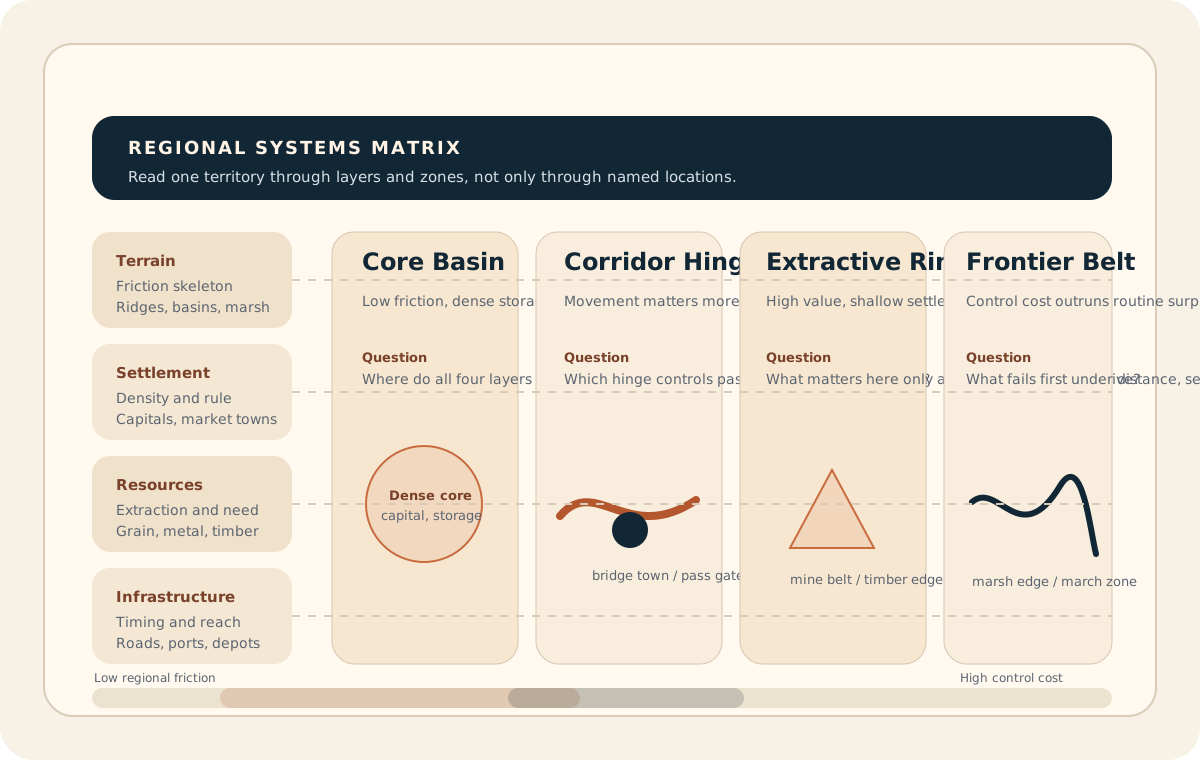
The matrix starts with terrain, then overlays settlement nodes, strategic resources, and connective infrastructure.
This lets a creator compare regions in terms of systemic leverage instead of decorative detail.
| Axis | Question | Signal |
|---|---|---|
| Terrain | What physically channels or blocks movement? | Coasts, ridges, basins, deserts, river forks |
| Settlement | Where do people and institutions cluster? | Capitals, market towns, fortified crossings |
| Resources | What does the region extract or depend on? | Metal belts, grain zones, forests, water security |
| Infrastructure | How does the region stay connected? | Road webs, ports, passes, canal lines |
Use the stepper to separate what the terrain gives you, what settlement concentrates, what resources change, and what infrastructure finally makes governable scale possible.
Terrain is the first constraint layer because it decides where movement is cheap, delayed, seasonal, or impossible. Every later layer inherits this friction skeleton.
The matrix works best when it is used as a sequence rather than as a decorative checklist. Start with terrain because terrain sets friction. Add settlements because people cluster where friction, food security, and defensibility are tolerable. Add resources because extraction changes why the region matters. Add infrastructure because roads, ports, and relay lines decide whether the previous three layers can compound into durable power.
In practice, the framework is asking four questions in order:
When those four answers overlap, a region tends to become a core. When they diverge, the region becomes brittle, peripheral, or contested.
Many creators stop after listing the four layers. The more useful move is to identify which zones those layers create when stacked on top of one another.
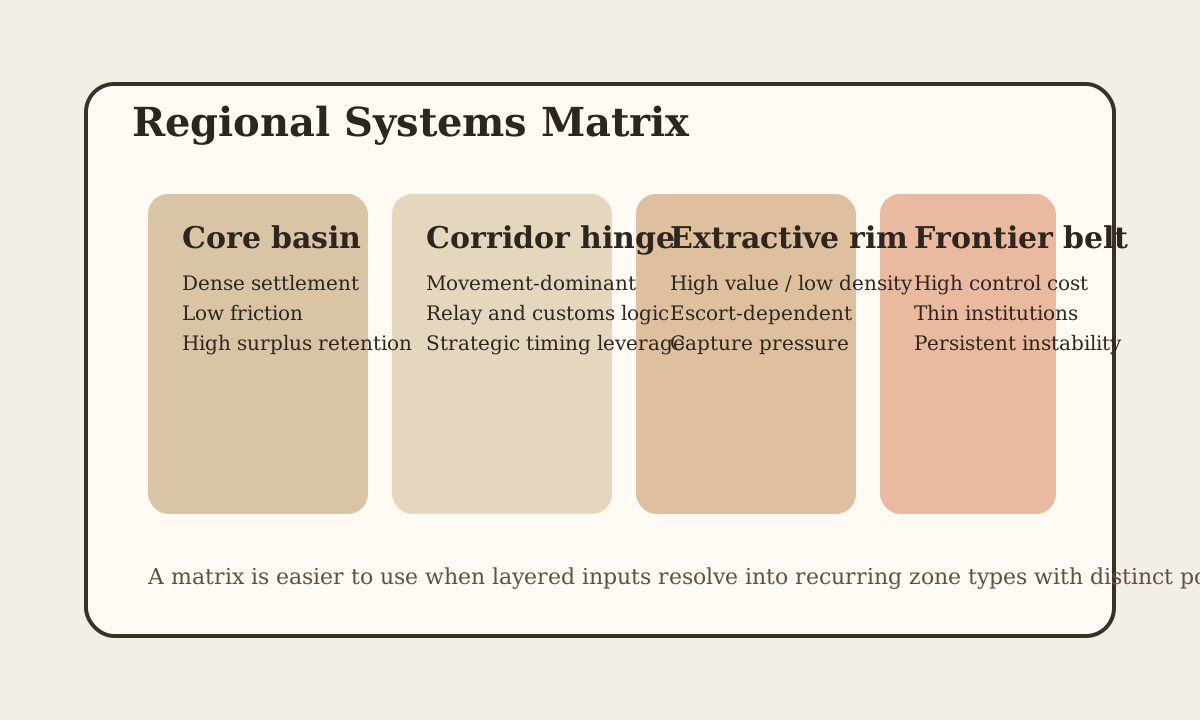
A productive matrix usually reveals a small number of repeatable regional conditions:
| Axis | Question | Signal |
|---|---|---|
| Core basin | Where do all four layers reinforce one another? | Low-friction terrain, dense settlements, surplus-rich land, reliable route concentration |
| Corridor hinge | Where does movement matter more than local density? | Pass towns, bridge markets, river-port chains, canal junctions, fortified narrows |
| Extractive rim | Where is value high but settlement depth low? | Mining uplands, timber belts, salt flats, fisheries, seasonal plantation strips |
| Frontier belt | Where do control cost and movement risk outrun routine surplus? | Broken marches, raid zones, marsh borders, caravan margins, mountain forest edges |
These zone types matter because they create different political behaviors. A core basin tends to centralize administration. A corridor hinge tends to militarize or commercialize. An extractive rim attracts external capture attempts. A frontier belt consumes attention and revenue without returning stable density.
Switch the axis to see how the same region changes when you compare density logic, political behavior, and failure pattern instead of treating every zone as a map label.
The place where low friction, dense settlement, and repeatable surplus align.
Dense settlement reproduces itself because food, storage, and institutions reinforce one another.
The place where movement leverage matters more than local depth.
Settlement stays strung along movement lines rather than thickening into a deep interior.
The place where value is high but holding depth stays shallow.
Settlement remains sparse because extraction matters more than everyday civilian density.
The place where risk, transition, and governance cost remain structurally unstable.
Settlement stays discontinuous because protection and compliance cost remain high.
Use the path explorer when you want to leave the regional frame through the right continuation role instead of treating every adjacent node as equivalent.
When building a region from scratch, use the matrix as a diagnostic pass after the first draft of the map.
Before naming provinces, identify ridges, basins, floodplains, coasts, river forks, marsh edges, seasonal snow lines, and desert margins. This is the skeleton that tells you where effort rises sharply.
If the friction skeleton is unclear, every later layer will float. Roads will appear anywhere, towns will sit where they look dramatic, and strategic importance will feel arbitrary.
Dense settlement should usually sit where food, water, labor circulation, and defensible storage can reinforce one another. A capital should not only be symbolic. It should sit where institutions can continue to count, store, redistribute, and project authority.
This does not mean every large city must be agricultural. Port complexes, mining service hubs, and pilgrimage centers can also become dense. The point is that density needs a repeatable operating basis.
Resources are important not because they exist, but because they can be moved, guarded, taxed, or monopolized. Some regions are rich in a self-sustaining way. Others are rich only after infrastructure and coercion arrive.
A grain basin supports density directly. A copper ridge may support only sparse local settlement but produce enormous geopolitical value once roads, smelters, and escorts exist.
Infrastructure should be read as a timing layer. Ask how fast grain reaches the capital, how quickly patrols can arrive, how often winter breaks the route, and how many alternative paths exist when the main line is cut.
This is where many maps become flat. A map with many roads is not necessarily connected. A map with one reliable corridor may be more politically coherent than a map full of decorative lines.
The final pass is not "what exists?" but "what fails under stress?" In drought, blockade, succession conflict, flood, or invasion, does the region lose food, movement, legitimacy, or extraction first?
The first failure point often tells you the real identity of the region. Some territories are agricultural cores with logistic vulnerabilities. Others are corridor states with shallow food security. Others are extractive regions that collapse when escort cost spikes.
The matrix is most valuable where it prevents common worldbuilding mistakes.
One mistake is treating all resources as equal. Iron in a secure basin is not the same as iron in an isolated upland behind winter passes. Another is confusing map adjacency with operational adjacency. Two regions may border each other on the page and still have almost no practical connection because of swamps, ridges, or hostile intermediaries.
A third mistake is overestimating state reach. A kingdom may claim a frontier belt, but if roads fail seasonally and supply depots are sparse, actual control may extend only to a corridor chain and a few fortified nodes.
Imagine a region with a navigable river basin, mineral uplands to the north, and a marshy border to the east.
This matrix immediately implies politics. The basin core wants central administration and storage coordination. The pass towns want toll autonomy. The upland extractors need escorts and bargaining leverage. The marsh frontier drains military budget without producing equal fiscal return.
That is already enough structure to support faction conflict, military geography, trade asymmetry, and believable uneven development, all before writing lore chronologies.
Use the regional systems matrix early, when you are still determining what a territory can plausibly support. Then hand off to more specific tools once the region has a visible structural identity.
The matrix is therefore not a full world model by itself. It is an early integrator. Its job is to make a region legible enough that later models can operate on something real instead of on decoration.
The framework becomes insufficient once the main question is no longer what a region can support, but how a region behaves over time under pressure. The matrix can tell you where density, extraction, and route concentration are likely to reinforce one another. It cannot by itself explain how storage buffers fail, how political capture compounds, or how corridor timing changes the entire region once one hinge closes.
That boundary matters because many worldbuilders ask the matrix to solve later-stage questions that belong to more operational tools. If the real issue is why grain stops arriving on time, why a customs belt can dominate the surrounding basin, or why a mining rim suddenly becomes strategic after one canal project, you have already crossed from regional diagnosis into flow behavior. At that point the right move is to hand off to a circulation model instead of adding more decorative labels to the same regional chart.
The framework becomes reusable when you stop asking "what is in this region?" and start asking "which layers reinforce one another strongly enough to create a durable pattern?"
That shift is what turns a region from a named area on a map into a structural unit that can support believable settlement hierarchy, strategic competition, and historical consequence. It also gives you a disciplined stopping point: once the region is structurally legible, you can decide whether to continue into circulation, governance, conflict, or complete-case proof without pretending one framework must do every job.
Turns static regional resources into a moving system of dependency and resilience.
Region GraphAbstracts regional adjacency so the matrix can be reasoned about beyond cartographic detail.
Flow Architecture FrameworkExtends the regional frame into storage, throughput, and capture timing once the map's structural inputs are already clear.
Terrain Settlement GradientExplains how terrain and settlement layers collapse into density bands rather than evenly distributed habitation.
World Assembly StackCarries the regional frame upward into a wider world model once the territory is coherent enough to support civilization, capability, and historical layering.
River Port PolityShows how a basin core, corridor hinge, and extractive edges become one political and economic pattern.