Preparing the current spcent route.
The page shell is online. Shared content and route data are still being assembled.
An advanced synthetic study of how a shattered continental rail system fragments, cascades, and then reassembles into a narrower successor order built on surviving trunks and depot residue.
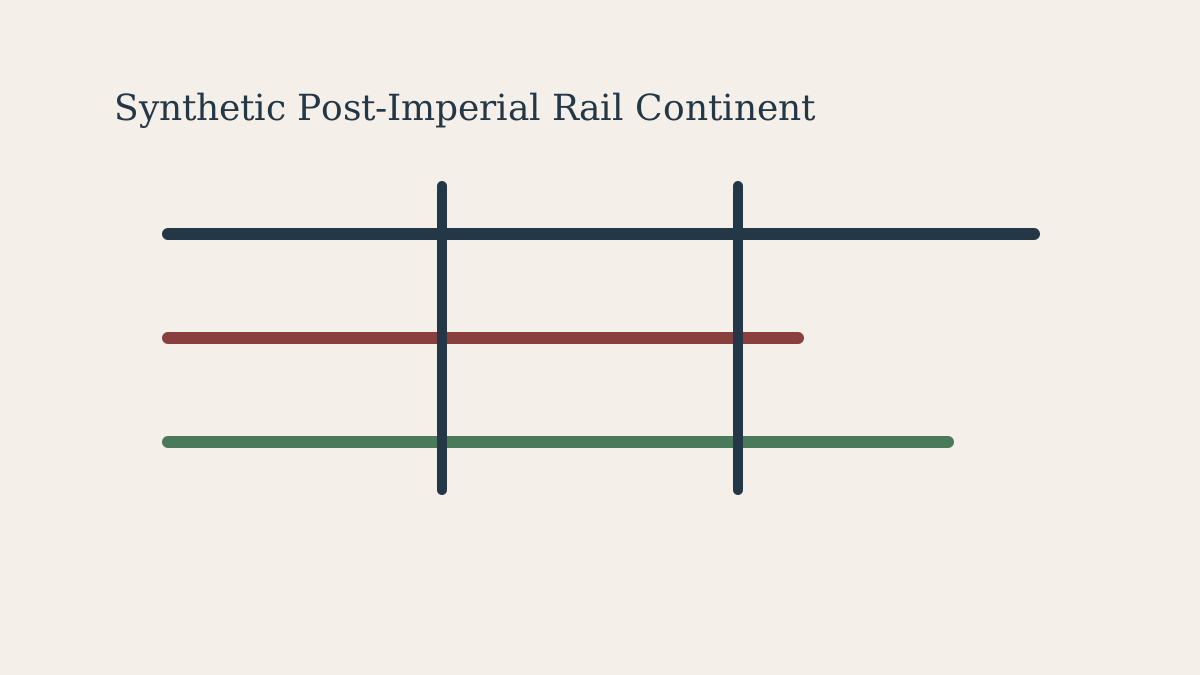
This synthetic case is designed to expose the full M018 stack clearly. An imperial rail continent fragments when a few trunk failures overload substitute lines, reserves arrive too late, and branch systems lose interoperability. But collapse is only half the story. The later question is which trunks, depots, and regional standards survive strongly enough to assemble a successor order.
That makes the study a useful bridge between cascading failure, infrastructure rewrite, and post-collapse reassembly.
Explains how trunk loss propagates through overloaded substitutes and regional isolation.
Infrastructure Rewrite RegimeShows how the successor order favors a new rail-energy-communication stack rather than restoring the imperial one wholesale.
Post-Collapse Reassembly ModelFrames the later phase around surviving residue, narrowed geography, and rebuilt coordination.
The case is useful because it contains both advanced failure and advanced recovery in one system. The old imperial continent fails through coupled trunks and shared dispatch. The successor continent emerges by accepting narrower scale, different reserve geometry, and a new standard hierarchy instead of trying to restore total coverage immediately.
| Axis | Question | Signal |
|---|---|---|
| Imperial integration | What made the old rail order continent-wide in practice? | Standard gauge, reserve depots, centralized dispatch, protected repair corridors, trunk priority |
| Cascade onset | How did local trunk failure begin propagating systemically? | Substitute overload, depot exhaustion, crew shortages, dispatch lag, branch abandonment |
| Residue geography | What remained usable after the widest breakdown passed? | Repairable cores, mountain bypasses, coastal trunk segments, intact workshops, regional fuel nodes |
| Successor reassembly | How does a narrower but stable order emerge? | Regional federation, new standards, rebuilt reserve hierarchy, corridor-first governance, selective reconnection |
The reusable lesson is that successor transport orders emerge from surviving trunks, repair capacity, and narrowed scale. This synthetic case helps expert readers think through how a complex network fails in stages and then reassembles around what remains structurally valuable.
Read what should come before it, what relation role matters next, and where this page should hand you off after the local graph is clear.
Start with Strategic Reserve Network and then return here once the surrounding concept stack is clear.
These entries clarify the footing underneath the current node before you move outward again. Start with Cascading Failure Topology when you want the clearest next role.
Use Guides when the study should feed into a worksheet or structured revision sequence.
3 handoff nodes stay inside Evolution And Breakdown. 4 handoff nodes share Cross Scale.
Detail pages now expose the branch and scale of their surrounding graph before showing raw prerequisite and relation shelves, so continuation can stay taxonomy-led instead of adjacency-led.
Explain transition, disturbance, collapse, recovery, and reassembly across eras and stress cycles.
Start with transformation and failure models, trace residue and recovery paths, compare a collapse or successor-order study, then run a failure-mode review.
Explain how technology, magic, infrastructure, communication, and transformation capacity rewrite baseline constraints.
Start with the operating regime, price the capability through diffusion or monopoly models, compare a regime-rewrite case, then run a capability sanity check.
Explain how resources, goods, labor, information, and force circulate, stall, buffer, and break.
Start from the resource-flow loop, trace storage and throughput models, compare one logistics study, then run a flow audit worksheet.
Use this scale when the strongest explanation depends on several levels staying visible together.
Use this scale when routes, relays, buffers, and linked nodes matter more than territorial bulk.
Use prerequisites when you want the shortest path into the assumptions this page depends on.
A model for locating where reserves are stored, who can release them, and how fast they can stabilize the wider system under delay, shock, or surge.
A model for tracing which roads, archives, forts, cadasters, cults, and legal habits survive from earlier eras and continue to structure the present.
These groups explain why each neighboring node matters, whether it stabilizes the concept, operationalizes it, proves it, or pushes the lane further.
Use foundation relations when this node depends on a concept, term, or framing layer that should be explicit before you branch further.
An advanced model for tracing how disruption propagates across tightly coupled routes, reserves, institutions, and infrastructures once local failure begins rewriting the wider network.
An advanced model for tracing how successor systems rebuild from surviving corridors, residue institutions, reserve fragments, and narrowed but usable geographies after collapse.
Use operationalizing relations when you want the current abstraction rendered as a cleaner model, loop, or structural device.
An advanced model for explaining how new transport, energy, communication, or logistical substrates reorganize settlement, authority, and strategic tempo across an existing world.
These entries still matter, but they currently rely on generic adjacency instead of typed continuation semantics.
A framework for reading long-run structural change through continuity, rupture, inheritance, infrastructure rewrite, and post-shock reassembly rather than through event chronology alone.
Studies apply Spcent's lenses to complete cases. Read them to see whether geography, surplus, corridors, and pressure patterns still make sense when placed inside one setting.
The goal is not to retain setting trivia. The goal is to extract reusable patterns and structural habits you can reapply elsewhere.
Studies are strongest when you already know the frameworks and models underneath them, so you can recognize the structural moves being made.
After reading a study, identify which layer of your own draft needs work and go back there with one concrete change in mind.
Keep these collapsed until you want to turn the page into an active reading exercise.
What are the decisive regions, corridors, or chokepoints in this case?
What keeps the studied world stable, and what makes it brittle?
Which model or framework do I need next if I want to reproduce this pattern in my own project?
These routes are tuned to the kind of entry you are currently reading, so you can leave this page with one deliberate next move.
Use Guides when the study should feed into a worksheet or structured revision sequence.
Cross-layer moveReturn to the worlds module when the case highlights a weak worldbuilding layer in your own draft.
Cross-layer moveOpen models when the case reveals a mechanism you want to isolate and reuse directly.