Preparing the current spcent route.
The page shell is online. Shared content and route data are still being assembled.
A historical study of how canal transport, grain reserves, courier timing, and administrative corridors helped hold a large imperial system together unevenly.
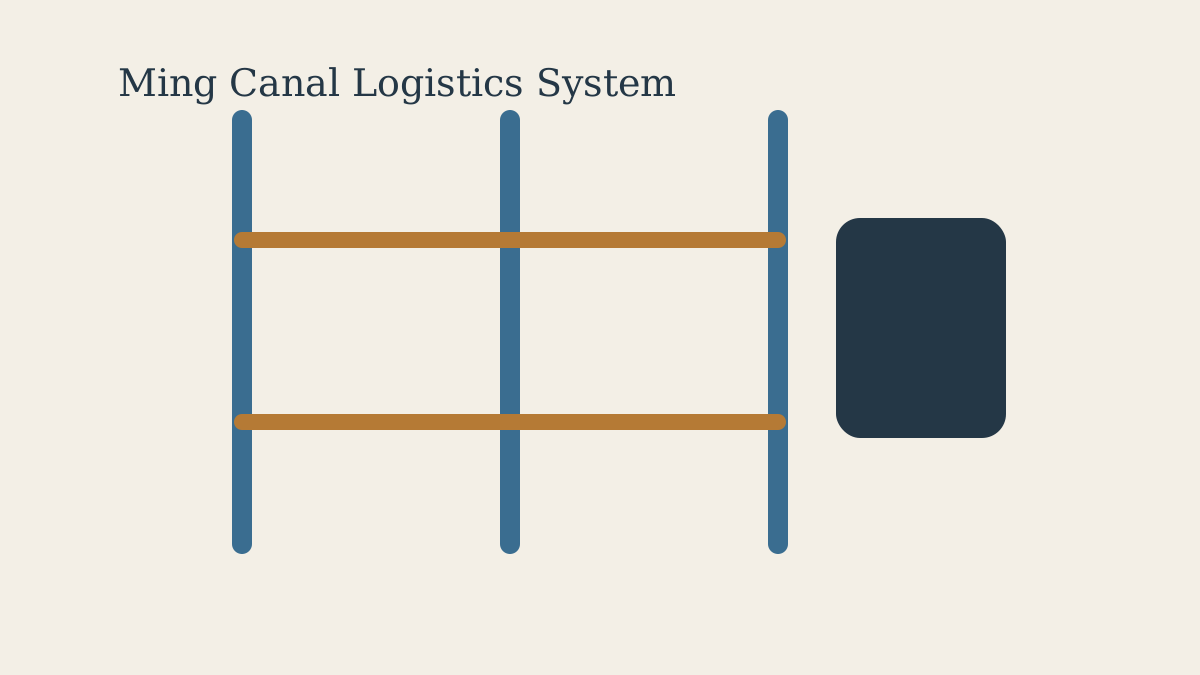
The useful lens for the Ming canal system is not only transport efficiency. It is corridor governance. The canal linked grain movement, reserve buffering, tax visibility, official travel, and command timing through one sustained spine.
That made the canal more than an economic artery. It functioned as an administrative corridor whose reliability shaped how far central coordination could remain practical.
Names the governable route function that the canal performed for grain, officials, and records together.
Communication Latency RegimeExplains why command timing and verification mattered alongside bulk transport.
Strategic Reserve NetworkShows why reserve depth only helped when depots and release paths remained visible through the corridor.
Compared with a looser river trade system, the canal creates tighter alignment between transport, reserve placement, and administrative reach. That can increase stability, but it also concentrates dependence. When one corridor shoulders too many functions, disruption becomes politically expensive very quickly.
| Axis | Question | Signal |
|---|---|---|
| Bulk transport | Why could grain move at the necessary scale? | Navigable canal spine, lock maintenance, barge organization, protected transfer points |
| Reserve visibility | How did stored grain remain governable rather than merely local? | Depot network, audited inventories, release authority, route security |
| Courier timing | How fast could problems be reported and permissions returned? | Relay stations, administrative dispatch, inspection cadence, repair orders |
| Concentrated dependence | What became fragile because so much passed through one spine? | Maintenance backlog, local corruption, delayed relief, canal block, regional exposure |
The canal is powerful not just because it can move grain cheaply, but because it aligns transport, reserve visibility, and command verification inside the same corridor. That turns a transport line into a state-supporting spine. Grain, reports, permissions, and repair instructions become easier to synchronize because they share the same governable geometry.
That same concentration creates systemic sensitivity. When maintenance slows, corruption thickens, or one section of the corridor is blocked, the disruption is administrative as well as logistical. A large polity can therefore remain territorially wide while already becoming narrower in practical command if the canal spine stops reproducing confidence.
The case is useful precisely because it shows how one corridor can be simultaneously a transport advantage and a governance vulnerability. What looks like infrastructural strength in calm periods becomes a revealing stress test in bad periods, because the same spine is carrying grain, information, supervision, and state credibility together.
The reusable lesson is that large systems often hold together through corridors that move governance as much as goods. The Ming canal case is useful because it makes reserve behavior, command timing, and transport reliability visible inside one shared structure. It also shows why administrative confidence can narrow long before a state loses nominal reach, because one overburdened corridor is often carrying both material supply and proof that the center still works. The corridor is therefore moving grain, instruction, audit, and reassurance at the same time. That is why corridor maintenance becomes a question of state coherence, not simple transport upkeep. A weak canal is a weak center. The route is carrying the state itself.
Read what should come before it, what relation role matters next, and where this page should hand you off after the local graph is clear.
Start with Storage Node and then return here once the surrounding concept stack is clear.
These entries clarify the footing underneath the current node before you move outward again. Start with Administrative Corridor when you want the clearest next role.
Use Guides when the study should feed into a worksheet or structured revision sequence.
2 handoff nodes stay inside Flow And Logistics. 5 handoff nodes share Network.
Detail pages now expose the branch and scale of their surrounding graph before showing raw prerequisite and relation shelves, so continuation can stay taxonomy-led instead of adjacency-led.
Explain how resources, goods, labor, information, and force circulate, stall, buffer, and break.
Start from the resource-flow loop, trace storage and throughput models, compare one logistics study, then run a flow audit worksheet.
Explain how topology, region graphs, corridors, map abstraction, and scale determine movement and leverage.
Start in Spatial, reduce the map into region graph and corridor logic, test topology under disruption, then return through a spatial design guide.
Explain how technology, magic, infrastructure, communication, and transformation capacity rewrite baseline constraints.
Start with the operating regime, price the capability through diffusion or monopoly models, compare a regime-rewrite case, then run a capability sanity check.
Use this scale when routes, relays, buffers, and linked nodes matter more than territorial bulk.
Use this scale when the strongest explanation depends on several levels staying visible together.
Use prerequisites when you want the shortest path into the assumptions this page depends on.
A location where flow is buffered, accumulated, protected, measured, or redirected strongly enough to change who can control the wider system.
A durable movement spine where terrain, settlement, exchange, and repeated transit align strongly enough to guide long-run circulation.
These groups explain why each neighboring node matters, whether it stabilizes the concept, operationalizes it, proves it, or pushes the lane further.
Use foundation relations when this node depends on a concept, term, or framing layer that should be explicit before you branch further.
A route whose main importance lies in keeping orders, permits, reserves, and repair capacity moving reliably enough for governance to hold.
A model for locating where reserves are stored, who can release them, and how fast they can stabilize the wider system under delay, shock, or surge.
Use operationalizing relations when you want the current abstraction rendered as a cleaner model, loop, or structural device.
A model for explaining how courier time, relay density, verification delay, and command visibility reshape coordination, legitimacy, and operational response.
These entries still matter, but they currently rely on generic adjacency instead of typed continuation semantics.
A framework for reading movement as stacked road, river, sea, border, and administrative layers whose overlaps decide gateway leverage, rerouting options, and operating reach.
Studies apply Spcent's lenses to complete cases. Read them to see whether geography, surplus, corridors, and pressure patterns still make sense when placed inside one setting.
The goal is not to retain setting trivia. The goal is to extract reusable patterns and structural habits you can reapply elsewhere.
Studies are strongest when you already know the frameworks and models underneath them, so you can recognize the structural moves being made.
After reading a study, identify which layer of your own draft needs work and go back there with one concrete change in mind.
Keep these collapsed until you want to turn the page into an active reading exercise.
What are the decisive regions, corridors, or chokepoints in this case?
What keeps the studied world stable, and what makes it brittle?
Which model or framework do I need next if I want to reproduce this pattern in my own project?
These routes are tuned to the kind of entry you are currently reading, so you can leave this page with one deliberate next move.
Use Guides when the study should feed into a worksheet or structured revision sequence.
Cross-layer moveReturn to the worlds module when the case highlights a weak worldbuilding layer in your own draft.
Cross-layer moveOpen models when the case reveals a mechanism you want to isolate and reuse directly.