Preparing the current spcent route.
The page shell is online. Shared content and route data are still being assembled.
A model for how extraction, transport, storage, transformation, and redistribution create stability or fragility in a world system.
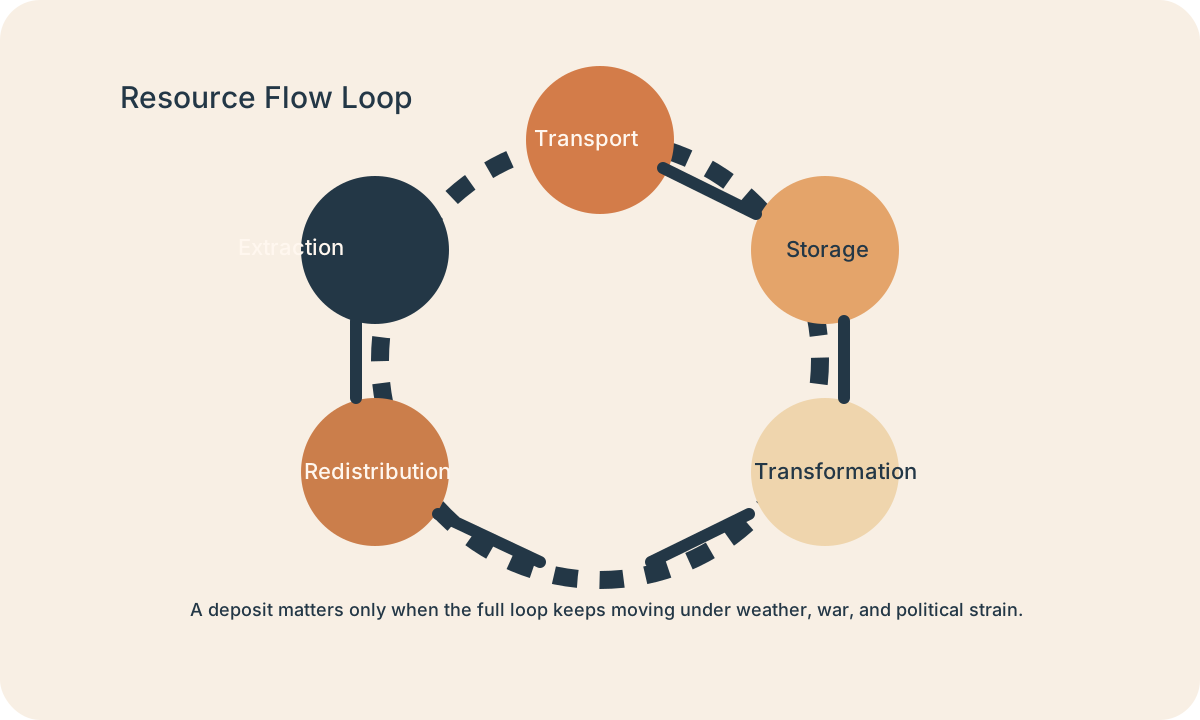
Resources do not matter only at the point of origin. Their systemic importance comes from how reliably they move and how many institutions depend on that movement.
The loop model tracks extraction, transport, storage, transformation, and redistribution as one chain.
Identify where the system first captures grain, ore, timber, or other strategic material.
Map the roads, ports, and storage nodes that keep output alive long enough to matter elsewhere.
Show how workshops, tax systems, rationing, or markets turn raw material into usable power and political leverage.
| Axis | Question | Signal |
|---|---|---|
| Extraction | Where does material enter the system? | Mines, fields, forests, fisheries |
| Transport | How does it move? | River barges, caravans, roads, ports |
| Storage | Where is surplus buffered? | Granaries, depots, cisterns, vaults |
| Transformation | How is raw material converted into usable power? | Mills, workshops, foundries, tax systems |
| Redistribution | Who receives the output and under what logic? | Markets, tribute, rationing, elite capture |
The model gets more useful once resources stop being treated as a pile of stuff and start being treated as an exposed chain. A fertile basin, rich mine, or magical grove is not yet system-wide power. It becomes system-wide only when output survives extraction, transport, storage, conversion, and release often enough that many actors begin depending on it. That is why shortages often appear far from the source and why political panic can arrive even while production still looks healthy on paper.
This also explains why the loop belongs in worldbuilding rather than in narrow economic simulation. The route between stages determines settlement ranking, fiscal depth, military tempo, and urban stability. The more institutions lean on the same loop, the more every interruption becomes structurally visible.
Power usually enters where material becomes countable, delay-sensitive, or capturable. Storage nodes matter because they concentrate surplus. Transformation matters because it changes raw material into bread, weapons, wages, or taxable output. Redistribution matters because it decides who feels scarcity first and who can stay insulated. Once those gates are explicit, the model can explain why some states govern through granaries, others through toll roads, and others through industrial conversion or rationing systems.
A world becomes more believable when its shortages come from bottlenecks, seasonal breaks, or political disruption rather than arbitrary scarcity.
The most useful diagnostic move is to ask which stage is easiest to interrupt with the least visible effort. In many settings, transport or storage fails long before extraction does, which is why apparent abundance can coexist with local crisis and political panic.
When reviewing a setting, ask three questions in order. Which stage is easiest to interrupt? Which actor gains the most from controlling that stage? Which populations experience the break first? Those answers usually reveal whether the loop is resilient, monopolized, or politically combustible long before a full crisis is narrated on the page.
The reusable lesson is that resources are system-wide only when their loop remains intact. Use the model to explain why abundance can still feel fragile, why shortages can begin far from the source, and why transport and buffering often matter more than raw deposits.
Read what should come before it, what relation role matters next, and where this page should hand you off after the local graph is clear.
Start with Surplus and then return here once the surrounding concept stack is clear.
These entries clarify the footing underneath the current node before you move outward again. Start with Regional Systems Matrix when you want the clearest next role.
Return to broader lenses when this model is too specific for the question you are asking.
4 handoff nodes stay inside Flow And Logistics. 1 handoff nodes share Network.
Detail pages now expose the branch and scale of their surrounding graph before showing raw prerequisite and relation shelves, so continuation can stay taxonomy-led instead of adjacency-led.
Explain how resources, goods, labor, information, and force circulate, stall, buffer, and break.
Start from the resource-flow loop, trace storage and throughput models, compare one logistics study, then run a flow audit worksheet.
Explain what the world is materially built from before politics, balance, or style are discussed.
Start in Worlds, read the anchor framework, open one regional model, validate with a complete study, then finish with a world assembly guide pass.
Use this scale when the region is the main leverage unit for settlement, extraction, governance, or conflict.
Use this scale when the strongest explanation depends on several levels staying visible together.
Use this scale when routes, relays, buffers, and linked nodes matter more than territorial bulk.
Use prerequisites when you want the shortest path into the assumptions this page depends on.
Output that remains after immediate subsistence and maintenance needs are covered, making storage, exchange, taxation, or concentrated reinvestment possible.
A location where flow is buffered, accumulated, protected, measured, or redirected strongly enough to change who can control the wider system.
These groups explain why each neighboring node matters, whether it stabilizes the concept, operationalizes it, proves it, or pushes the lane further.
Use foundation relations when this node depends on a concept, term, or framing layer that should be explicit before you branch further.
A planning frame for mapping how geography, settlement, resources, and transit form a region's structural identity.
Use applied relations when the next useful move is to see the current pattern survive inside a study or assembled world.
A sample systems study showing how basin agriculture, defensive ridges, and narrow passes produce a dense but brittle civilization pattern.
A systems study of how estuaries, port warehousing, and toll control create a state that is wealthy, connective, and strategically exposed.
Use extension relations when the next move is not prerequisite or proof, but a deeper neighboring step in the same graph lane.
A model for how raw surplus becomes taxable, storable, and politically controllable through successive layers of capture.
Models formalize behavior. Use them when you need a concrete chain, loop, stress scenario, or layered mechanism that can be tested and reused.
A model should explain how something behaves over time or under pressure, not just identify a broad topic area.
When a setting feels plausible at rest but still behaves vaguely, models provide the explicit structure needed to test it.
A strong workflow often moves from broad lens to formal model to applied case reading.
Keep these collapsed until you want to turn the page into an active reading exercise.
What mechanism is this model making explicit?
Where does this model break or become most interesting under stress?
Which study would verify whether this model survives in a complete setting?
These routes are tuned to the kind of entry you are currently reading, so you can leave this page with one deliberate next move.
Return to broader lenses when this model is too specific for the question you are asking.
Cross-layer moveMove through the systems module when you want to navigate models by design intent.
Cross-layer moveVerify the model inside applied cases where multiple structures interact at once.