Preparing the current spcent route.
The page shell is online. Shared content and route data are still being assembled.
A historical study of how soil loss, harvest collapse, debt pressure, and migration turned ecological disturbance into a long recovery problem rather than one bad season.
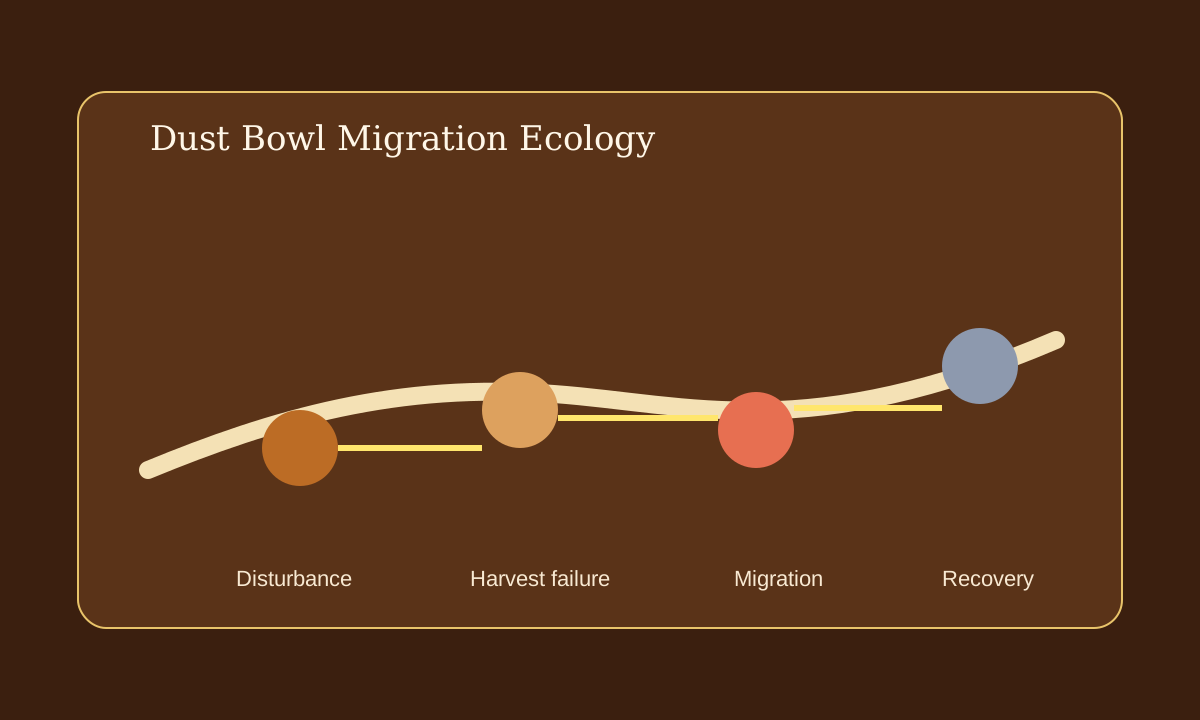
The Dust Bowl is most useful as a disturbance-and-recovery case, not only as a drought story. Drought and wind erosion mattered, but the lasting structural effect came from how ecological damage kept interacting with cropping patterns, debt, labor exit, and migration corridors.
That turns the case into a strong ecology-shock study. The question is not only why the harvest failed. It is why recovery took so long and why movement, abandonment, and soil damage kept reinforcing one another after the initial climatic trigger.
Provides the core lens for reading ecological shock as a recurring cycle with a long degraded phase instead of one isolated climatic event.
Harvest Failure LadderClarifies how crop loss climbed into reserve stress, debt, migration, and political burden instead of remaining a field-level problem.
Migration Corridor ModelShows why recovery pressure also rewrote movement patterns, labor geography, and where families sought viable continuation.
The decisive pattern is delayed recovery. Drought and dust storms reduced output quickly, but the deeper structural problem was that soil loss, depleted households, and outward migration made the next planting cycle harder too. The ecology could not simply reset at the end of one bad season.
| Axis | Question | Signal |
|---|---|---|
| Climatic disturbance | What pushed the plains out of baseline stability? | Drought sequence, wind intensity, exposed topsoil, weak moisture retention, crop stress |
| Harvest collapse | How did ecological damage leave the farm layer and enter the wider economy? | Failed yields, debt pressure, fodder loss, reserve exhaustion, land abandonment |
| Migration corridor | Who moved, where, and why did that movement become a structural outcome rather than a temporary workaround? | Out-migration routes, family flight, labor redistribution, relief pull, destination bottlenecks |
| Slow recovery | Why did repair take longer than the first shock? | Soil restoration, capital shortage, labor exit, altered cropping practice, policy lag, ecological memory |
Use the timeline to see why the Dust Bowl cannot be modeled as one bad harvest season.
The plains remain productive only while rainfall and soil structure stay inside a relatively narrow stability range.
The reusable lesson is that ecological collapse should be modeled through recovery burden as much as through the initial shock. The Dust Bowl is useful because it shows how degraded land, harvest failure, and migration can keep extending one another across several cycles.
Read what should come before it, what relation role matters next, and where this page should hand you off after the local graph is clear.
Start with Disturbance Recovery Cycle and then return here once the surrounding concept stack is clear.
These entries clarify the footing underneath the current node before you move outward again. Start with Disturbance Recovery Cycle when you want the clearest next role.
Use Guides when the study should feed into a worksheet or structured revision sequence.
3 handoff nodes stay inside Evolution And Breakdown. 2 handoff nodes share Regional.
Detail pages now expose the branch and scale of their surrounding graph before showing raw prerequisite and relation shelves, so continuation can stay taxonomy-led instead of adjacency-led.
Explain transition, disturbance, collapse, recovery, and reassembly across eras and stress cycles.
Start with transformation and failure models, trace residue and recovery paths, compare a collapse or successor-order study, then run a failure-mode review.
Explain how resources, goods, labor, information, and force circulate, stall, buffer, and break.
Start from the resource-flow loop, trace storage and throughput models, compare one logistics study, then run a flow audit worksheet.
Explain what the world is materially built from before politics, balance, or style are discussed.
Start in Worlds, read the anchor framework, open one regional model, validate with a complete study, then finish with a world assembly guide pass.
Use this scale when routes, relays, buffers, and linked nodes matter more than territorial bulk.
Use this scale when the region is the main leverage unit for settlement, extraction, governance, or conflict.
Use this scale when the whole world model or planetary constraint pattern should stay visible at once.
Use prerequisites when you want the shortest path into the assumptions this page depends on.
A model for how fires, floods, storms, pest waves, and disease pulses repeatedly reset ecological and settlement stability before recovery rebuilds density.
A model for how local crop shortfall escalates into price stress, labor reallocation, migration, reserve drawdown, and wider political crisis.
These groups explain why each neighboring node matters, whether it stabilizes the concept, operationalizes it, proves it, or pushes the lane further.
Use foundation relations when this node depends on a concept, term, or framing layer that should be explicit before you branch further.
A model for how fires, floods, storms, pest waves, and disease pulses repeatedly reset ecological and settlement stability before recovery rebuilds density.
A model for how repeated displacement, opportunity seeking, and frontier movement consolidate into durable corridors that reshape identity, labor, and political load.
Use operationalizing relations when you want the current abstraction rendered as a cleaner model, loop, or structural device.
A model for how local crop shortfall escalates into price stress, labor reallocation, migration, reserve drawdown, and wider political crisis.
Use contrast relations when the difference between two nodes is more useful than simple adjacency or agreement.
A historical study of how maritime ports, inland corridors, quarantine filters, and dense urban nodes turned disease exposure into a system-wide commercial and political shock.
These entries still matter, but they currently rely on generic adjacency instead of typed continuation semantics.
A model for how repeating weather and seasonal windows structure labor, harvest timing, travel reliability, and crisis pacing across a world.
A model for how extraction, transport, storage, transformation, and redistribution create stability or fragility in a world system.
Studies apply Spcent's lenses to complete cases. Read them to see whether geography, surplus, corridors, and pressure patterns still make sense when placed inside one setting.
The goal is not to retain setting trivia. The goal is to extract reusable patterns and structural habits you can reapply elsewhere.
Studies are strongest when you already know the frameworks and models underneath them, so you can recognize the structural moves being made.
After reading a study, identify which layer of your own draft needs work and go back there with one concrete change in mind.
Keep these collapsed until you want to turn the page into an active reading exercise.
What are the decisive regions, corridors, or chokepoints in this case?
What keeps the studied world stable, and what makes it brittle?
Which model or framework do I need next if I want to reproduce this pattern in my own project?
These routes are tuned to the kind of entry you are currently reading, so you can leave this page with one deliberate next move.
Use Guides when the study should feed into a worksheet or structured revision sequence.
Cross-layer moveReturn to the worlds module when the case highlights a weak worldbuilding layer in your own draft.
Cross-layer moveOpen models when the case reveals a mechanism you want to isolate and reuse directly.