Preparing the current spcent route.
The page shell is online. Shared content and route data are still being assembled.
A model for reducing a full map into a small graph of meaningful nodes, edges, weights, and transfer surfaces without losing the questions that matter operationally.
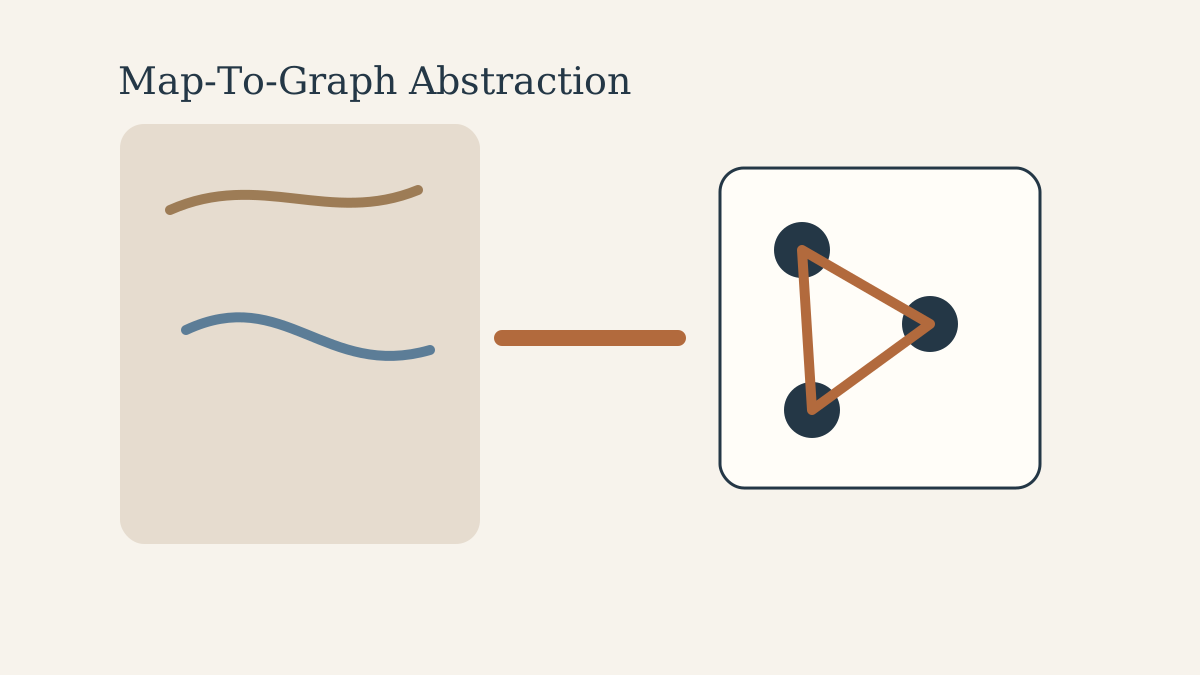
Maps become thinkable when they are reduced to the few relations that still change outcomes. The map-to-graph abstraction model turns a detailed world map into a smaller graph of meaningful regions, route edges, gateway nodes, and transfer weights.
The goal is not simplification for its own sake. It is to preserve the operational question. If the question is trade disruption, your graph should keep throughput, substitutes, and crossings. If the question is governance, it should keep courier time, administrative corridors, and reserve visibility.
Name whether you are abstracting for logistics, governance, military reach, migration, or visual explanation.
Merge areas whose internal variation does not change the current question enough to deserve separate nodes.
Assign each remaining connection the cost, throughput, risk, or control signal that the question needs most.
Close one edge, delay one transfer, or remove one gateway to verify that the graph still predicts meaningful behavior.
Most abstraction failures happen when the graph keeps the wrong truth. A beautiful reduced diagram can still be analytically weak if it preserves decorative coast complexity while deleting the transfer point, reserve route, or customs edge that actually changes outcomes.
| Axis | Question | Signal |
|---|---|---|
| Node choice | What detail can be collapsed without changing the answer? | Shared basin behavior, uniform island arc, stable district block, common depot belt |
| Edge meaning | What exactly does a connection represent? | Bulk freight, courier speed, military passage, regulated crossing, seasonal navigation |
| Transfer surface | Where does movement change mode or jurisdiction? | Portage points, gateway cities, customs mouths, rail breaks, canal locks |
| Stress fidelity | Does the abstract graph still react credibly under closure or delay? | Rerouting pattern, queue growth, reserve lag, node isolation, cascade exposure |
The reusable lesson is that abstraction is a modeling decision, not just a design convenience. Use this model when a map needs to become testable, teachable, or reusable across several spatial questions without dragging all its visual detail with it.
Read what should come before it, what relation role matters next, and where this page should hand you off after the local graph is clear.
Start with Region Graph and then return here once the surrounding concept stack is clear.
These entries clarify the footing underneath the current node before you move outward again. Start with Region Graph when you want the clearest next role.
Return to broader lenses when this model is too specific for the question you are asking.
4 handoff nodes stay inside Spatial Structures. 3 handoff nodes share Cross Scale.
Detail pages now expose the branch and scale of their surrounding graph before showing raw prerequisite and relation shelves, so continuation can stay taxonomy-led instead of adjacency-led.
Explain how topology, region graphs, corridors, map abstraction, and scale determine movement and leverage.
Start in Spatial, reduce the map into region graph and corridor logic, test topology under disruption, then return through a spatial design guide.
Use this scale when the strongest explanation depends on several levels staying visible together.
Use this scale when routes, relays, buffers, and linked nodes matter more than territorial bulk.
Use prerequisites when you want the shortest path into the assumptions this page depends on.
A spatial abstraction that represents regions as connected nodes so adjacency, flow, and chokepoints can be reasoned about systematically.
A model for separating terrain, routes, ownership, throughput, and risk into deliberate visual layers so a map answers one structural question clearly.
These groups explain why each neighboring node matters, whether it stabilizes the concept, operationalizes it, proves it, or pushes the lane further.
Use foundation relations when this node depends on a concept, term, or framing layer that should be explicit before you branch further.
A spatial abstraction that represents regions as connected nodes so adjacency, flow, and chokepoints can be reasoned about systematically.
A model for separating terrain, routes, ownership, throughput, and risk into deliberate visual layers so a map answers one structural question clearly.
Use operationalizing relations when you want the current abstraction rendered as a cleaner model, loop, or structural device.
A framework for reading movement as stacked road, river, sea, border, and administrative layers whose overlaps decide gateway leverage, rerouting options, and operating reach.
These entries still matter, but they currently rely on generic adjacency instead of typed continuation semantics.
A model for testing how a spatial layout behaves under congestion, disruption, seasonal shifts, and asymmetric pressure.
Models formalize behavior. Use them when you need a concrete chain, loop, stress scenario, or layered mechanism that can be tested and reused.
A model should explain how something behaves over time or under pressure, not just identify a broad topic area.
When a setting feels plausible at rest but still behaves vaguely, models provide the explicit structure needed to test it.
A strong workflow often moves from broad lens to formal model to applied case reading.
Keep these collapsed until you want to turn the page into an active reading exercise.
What mechanism is this model making explicit?
Where does this model break or become most interesting under stress?
Which study would verify whether this model survives in a complete setting?
These routes are tuned to the kind of entry you are currently reading, so you can leave this page with one deliberate next move.
Return to broader lenses when this model is too specific for the question you are asking.
Cross-layer moveMove through the systems module when you want to navigate models by design intent.
Cross-layer moveVerify the model inside applied cases where multiple structures interact at once.