Pulling this page together.
Preparing content, navigation, and supporting references for this route.
Preparing content, navigation, and supporting references for this route.
A framework for tracking which passes, ports, narrows, and crossings decide political leverage at the edge of a system.
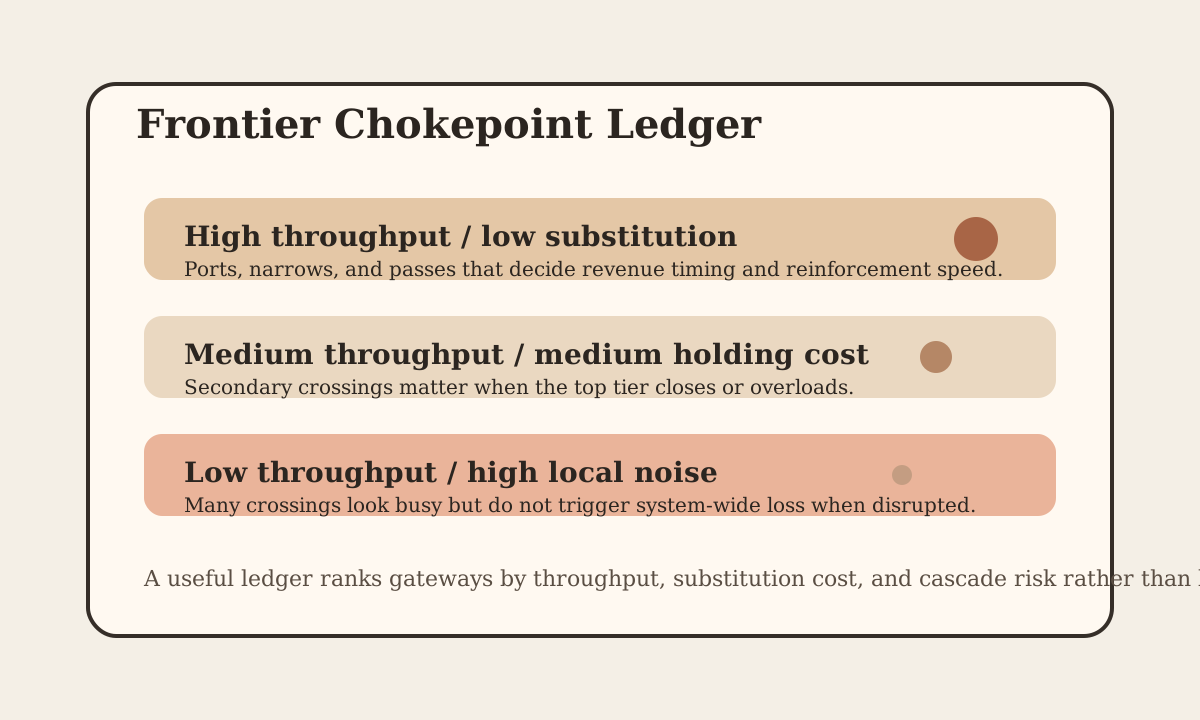
A frontier is rarely a line of equal risk. Some points matter far more than others because they compress movement, taxation, reinforcement, and exchange into narrow channels.
The ledger approach treats each chokepoint as an asset with maintenance cost, extraction value, and failure consequences.
| Axis | Question | Signal |
|---|---|---|
| Throughput | How much movement or value is forced through this point? | Trade tonnage, seasonal caravans, migration traffic, military routes |
| Control cost | How expensive is it to hold this point over time? | Garrison load, maintenance burden, political bargaining, patrol distance |
| Substitution | Can actors reroute around it without major loss? | Alternative passes, secondary ports, parallel valleys, sea bypasses |
| Cascade risk | What fails if this point is disrupted? | Revenue collapse, delayed reinforcement, isolated provinces, supply shock |
The same crossing changes meaning as throughput, holding cost, and substitution pathways change. The ledger matters because leverage migrates.
Trade, migration, and reinforcement begin to converge on one pass, port, or narrows. At this stage the value comes less from fortification alone and more from the simple fact that movement has few viable alternatives.
The ledger is strongest when it treats each site as part of a portfolio rather than as an isolated fortification. Start by asking which points actually carry compulsory throughput. Then separate those from points that are merely visible or symbolic. A pass can look dramatic on a map and still matter less than a dull customs crossing if the latter decides tax timing, convoy flow, or the only low-cost route for bulk movement.
After throughput, rank each point by substitution cost and cascade risk. Some sites are profitable but replaceable. Others are modest in ordinary traffic yet decisive because losing them forces long detours, splits administrative fields, or isolates a reserve basin from the center. The ledger makes frontier design formal by showing that leverage is about rerouting cost and downstream consequence, not only about local violence.
Use this framework when a world needs more than a generic border. It clarifies why some passes become fortified, why ports create rent-seeking states, and why peripheral pressure often concentrates at only a few sites.
It is also useful when a setting needs to explain unequal frontier investment. A regime can ignore dozens of minor crossings if two narrows decide customs revenue, reinforcement timing, and migration screening for the whole edge.
Shows how chokepoint strain contributes to frontier resistance and administrative fatigue.
Region GraphProvides the abstraction for locating which nodes and edges carry disproportionate leverage.
River Port PolityApplies the ledger to a polity built around estuaries, toll points, and maritime bottlenecks.
The first mistake is to confuse local defensibility with systemic leverage. A mountain fort may be hard to storm and still have low strategic value if most movement already bypasses it. The second mistake is to ignore maintenance burden. A lucrative gateway that requires constant escort, dredging, road repair, and bargaining with local intermediaries may be weaker in practice than a less profitable but cheaper node.
The third mistake is to assume chokepoints stay important forever. Ports silt up, alternate roads open, rail or portal systems bypass old narrows, and political boundaries shift customs value away from a traditional gate. The ledger should therefore be read dynamically. Frontier leverage migrates whenever throughput, holding cost, or substitute infrastructure changes.
The framework prevents a common flattening error where every border fort, pass, and harbor is treated as equally strategic. In practice, only a small subset carries the volume, timing, and substitution profile that makes disruption truly systemic.
Once those few sites are ranked, it becomes easier to explain why some frontier governors become powerful brokers, why military budgets cluster around a handful of gates, and why losing one crossing can matter more than holding ten empty miles of line.