Pulling this page together.
Preparing content, navigation, and supporting references for this route.
Preparing content, navigation, and supporting references for this route.
An assembled example world showing how convoy seasons, relay ports, warehouse islands, and distributed sovereignty create a maritime commonwealth that is connective but fragile.
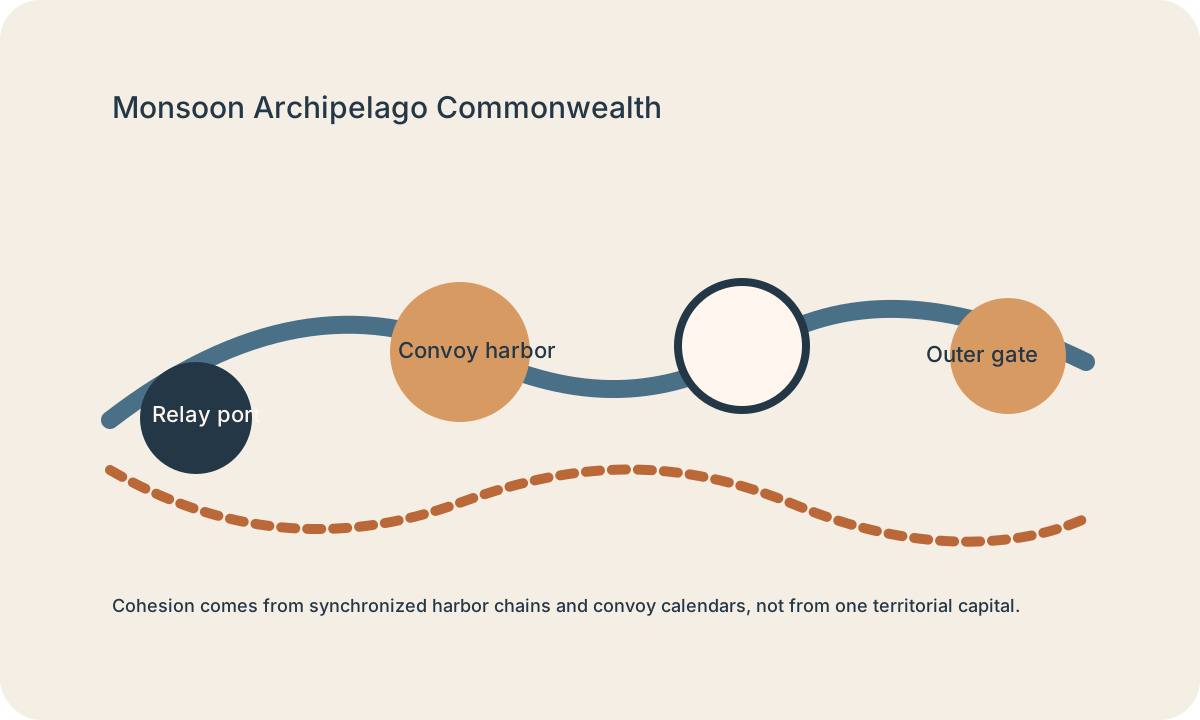
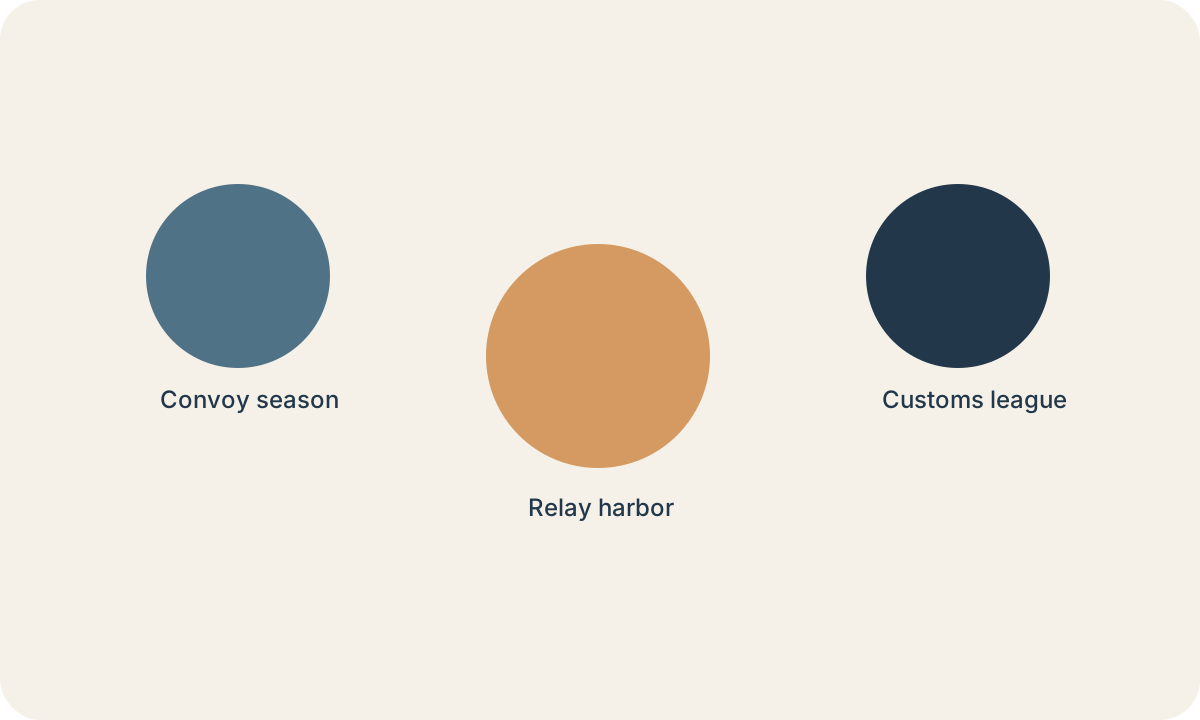
This example world is built from many medium islands rather than one dominant continental core. Trade and political cohesion therefore depend on relay harbors, convoy timing, and seasonal predictability rather than on broad land corridors.
That creates a commonwealth instead of a centralized empire. Authority is shared across ports, customs leagues, and maritime houses that can coordinate movement better than they can rule inland depth. The result is a maritime shaped more by convoy trust than by contiguous territory.
Begin with the wind rhythm and anchorages that make convoy motion predictable enough to insure and tax.
Identify the islands where value is counted, buffered, and transferred from one leg of the route to the next.
Show why councils, harbor law, and oath leagues matter more than deep inland administration.
Provides the cleanest abstraction for understanding why a few island narrows and transfer harbors dominate the whole commonwealth.
Circulation Fragility IndexExplains why prosperity depends on keeping convoy rhythm, storage continuity, and handoff timing stable.
Institutional Residue MapShows how older beacon chains, ritual harbors, and customs law keep structuring later political unity.
The strongest pattern is distributed concentration. Value is not produced at one capital, but it is repeatedly compressed through the same harbor chain. That lets merchant councils and naval brokers coordinate the system without fully owning every island.
The same structure also makes the commonwealth brittle. If monsoon timing shifts, a beacon chain fails, or a convoy harbor falls into dispute, the whole maritime field experiences delay, price divergence, and political mistrust at once.
| Axis | Question | Signal |
|---|---|---|
| Seasonal corridor | What makes the sea-lane network predictable enough to govern? | Wind rhythm, convoy calendars, protected anchorages, lighthouse relays |
| Relay port | Where does value become countable and taxable? | Bonded warehouses, customs houses, pilot guilds, naval escorts |
| Distributed sovereignty | Why is the polity cohesive without being centralized? | Chartered islands, maritime councils, shared weights, convoy law, oath leagues |
| Break season | What turns prosperity into system-wide strain? | Monsoon failure, harbor blockade, piracy concentration, beacon collapse |
Use the toggle to see how the same harbor chain behaves under synchronized convoy seasons, delayed winds, or open harbor conflict.
Winds arrive on time, beacon chains coordinate departures, and relay ports price goods with confidence. Under these conditions distributed sovereignty feels efficient because every harbor can trust the next handoff.
Switch the axis to compare how seasonal corridors, relay ports, distributed sovereignty, and break season each shape the commonwealth.
Wind rhythm and protected sea lanes make the maritime field predictable enough to govern.
Predictable winds and anchorages let convoy calendars become trustworthy institutions rather than guesswork.
Harbors transform moving cargo into taxable, insurable, and synchronized value.
Ports keep the chain coherent by buffering delay, certifying transfer, and pricing risk before it compounds.
Shared law and negotiated councils keep the network cohesive without a single territorial core.
Shared maritime law keeps councils and houses cooperating even when no single island dominates.
The condition under which timing slips reveal how fragile coordination really is.
Break season keeps the system honest by showing whether redundancy really exists or only seemed to exist in calm water.
Use the path explorer to decide whether you should abstract the harbor network, test its fragility, or move sideways into adjacent frontier logic.
The commonwealth works because maritime trust is concentrated even when sovereignty is not. Harbors, pilot guilds, customs leagues, and beacon chains give separate islands a shared operating rhythm. The polity therefore does not need one territorial capital to dominate the whole field. It needs enough trustworthy relay points that merchants, escorts, and councils can all predict the next handoff.
That is what makes the example more formal than a generic island federation. Distributed sovereignty is not just a constitutional preference. It is the political form best suited to a world where synchronized movement matters more than inland administrative depth and where several ports must each remain partially autonomous to keep the larger chain usable.
Its strength and weakness come from the same source. Because legitimacy and prosperity both depend on repeated handoff trust, disruption has unusually high political cost. A failed beacon chain, disputed customs ruling, or delayed convoy season is not only a local commercial problem. It becomes evidence that shared maritime law may no longer be reliable enough to coordinate distributed rule.
This means the system is resilient against some kinds of territorial fragmentation but fragile against timing failure and harbor mistrust. The commonwealth can survive the relative independence of many islands more easily than it can survive the loss of confidence in the relay chain connecting them.
The portable lesson is that a decentralized order can still behave as one coherent world if route timing, transfer law, and buffer harbors keep selecting the same movement spine repeatedly. A creator can reuse this logic for sea confederacies, portal archipelagos, orbital station leagues, or caravan commonwealths where sovereignty is negotiated but handoff trust must remain standardized.
The reusable lesson is that an assembled world can feel cohesive through synchronization rather than through territorial uniformity.
This example works because climate rhythm, storage ports, legal habit, and naval protection all reinforce one another instead of being described as separate setting flourishes.