Preparing the current spcent route.
The page shell is online. Shared content and route data are still being assembled.
A historical study of how telegraph lines, rail corridors, operator discipline, and maintenance standards compressed command time and rewrote territorial governance.
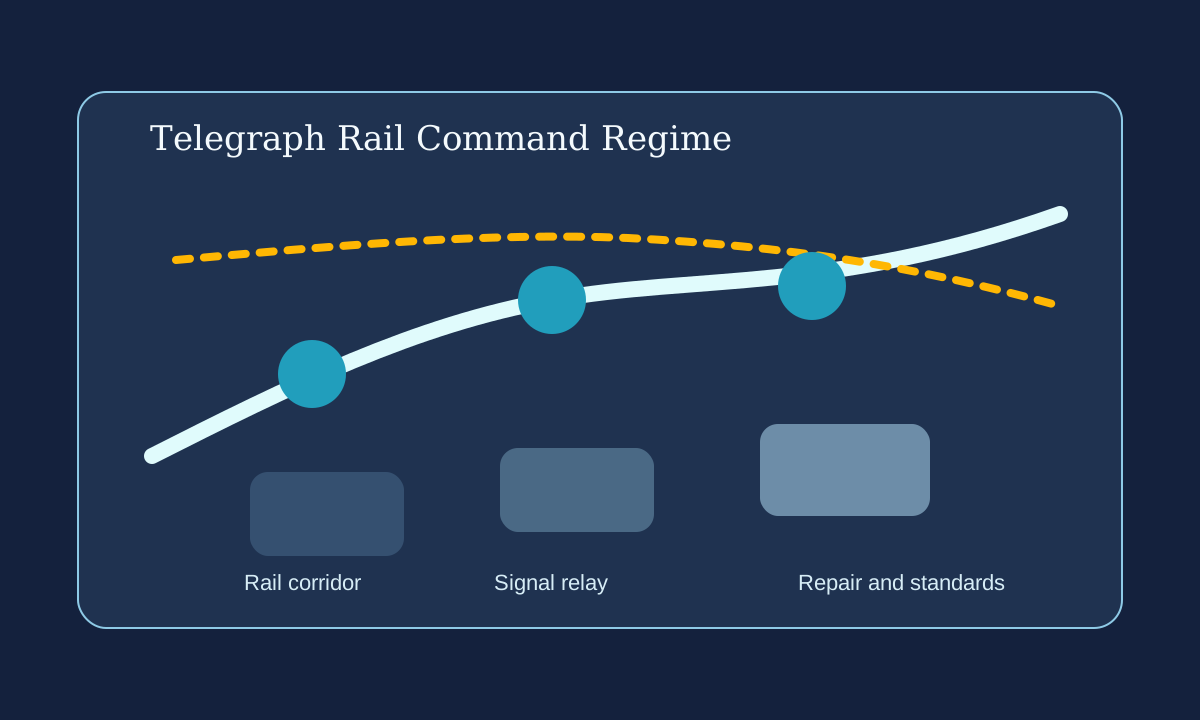
Telegraph and rail are most useful here when read as one command regime rather than as two separate inventions. Rail compresses movement and throughput. Telegraph compresses reporting and response. But neither rewrites territorial governance unless operators, depots, repair crews, and corridor discipline can reproduce both systems repeatedly.
That makes this a strong capability-proof case. The question is not whether faster command is possible. It is whether a state or network can keep signal lines live, schedules standardized, spare parts moving, and trained operators distributed across a widening corridor system.
Provides the core lens for why rail and telegraph only become world-changing when inputs, operators, maintenance, and standards can all scale together.
Communication Latency RegimeClarifies why compressed signaling changes what territorial command can attempt before local drift outruns central response.
Infrastructure Footprint ModelShows why every extension of the line creates more vulnerable track, relay, and repair burden instead of free control.
The regime becomes structurally distinct when speed stops being exceptional and becomes governable routine. Telegraph relays reduce information delay. Rail schedules and depots make movement more legible and enforceable. Standard gauges, repair crews, and trained station staff keep the network from fragmenting into local improvisation.
| Axis | Question | Signal |
|---|---|---|
| Signal compression | How much faster can reporting and instructions move than before? | Relay stations, dispatch timing, coded signaling, station hierarchy, reduced reporting lag |
| Corridor discipline | What keeps faster movement and faster command on the same territorial spine? | Schedules, depots, line rights, station spacing, interoperable routing, predictable stops |
| Operator and repair base | Who keeps the system reproducible instead of heroic and local? | Telegraph clerks, track crews, parts depots, inspection routines, standard training |
| Extended footprint | What new fragility appears as the network widens? | Sabotage risk, delayed repairs, track choke points, relay gaps, regional overload, maintenance debt |
The regime only rewrites the world once command speed, transport speed, and maintenance discipline all stabilize together.
Early gains are real, but command still depends on a narrow corridor and a fragile operator base that has not yet become routine.
Rail without synchronized signaling still leaves command waiting on delay and uncertainty. Telegraph without rail still improves awareness more easily than intervention. The historical force of the case comes from their pairing. Messages, schedules, depots, operators, and repair routines begin reinforcing one another strongly enough that territorial response changes phase rather than merely getting faster in isolated moments.
This is why the case works so well as capability proof. It shows that structural change comes from reproduced operating discipline, not only from invention. Once signaling and transport move inside the same maintained corridor logic, administrators and military planners can begin acting on a wider field before local divergence hardens.
The same system that compresses command also multiplies its maintenance surface. Relay lines can be cut, tracks can fail, operators can bottleneck, and remote corridors can remain dependent on specialist repair. In other words, the regime creates a new geography of vulnerability even while it solves older delay problems.
That is the transferable lesson many drafts miss. Faster coordination does not float above material burden. It depends on corridor integrity, standards, staffing, and recurring upkeep. The regime becomes believable once those burdens are shown as constitutive rather than incidental.
The reusable lesson is that capability diffusion matters when it reproduces disciplined routine rather than isolated speed. Telegraph and rail are useful because they show how faster signaling and faster movement only become governing power when standards, operators, and corridor upkeep scale together.
Read what should come before it, what relation role matters next, and where this page should hand you off after the local graph is clear.
Start with Technology Diffusion Regime and then return here once the surrounding concept stack is clear.
These entries clarify the footing underneath the current node before you move outward again. Start with Technology Diffusion Regime when you want the clearest next role.
Use Guides when the study should feed into a worksheet or structured revision sequence.
4 handoff nodes stay inside Capability Regimes. 4 handoff nodes share Network.
Detail pages now expose the branch and scale of their surrounding graph before showing raw prerequisite and relation shelves, so continuation can stay taxonomy-led instead of adjacency-led.
Explain how technology, magic, infrastructure, communication, and transformation capacity rewrite baseline constraints.
Start with the operating regime, price the capability through diffusion or monopoly models, compare a regime-rewrite case, then run a capability sanity check.
Explain how resources, goods, labor, information, and force circulate, stall, buffer, and break.
Start from the resource-flow loop, trace storage and throughput models, compare one logistics study, then run a flow audit worksheet.
Use this scale when routes, relays, buffers, and linked nodes matter more than territorial bulk.
Use this scale when the region is the main leverage unit for settlement, extraction, governance, or conflict.
Use this scale when city-scale transfer, concentration, or control is doing the main structural work.
Use prerequisites when you want the shortest path into the assumptions this page depends on.
A model for how tools, infrastructure, training, maintenance, and standardization determine whether a technology stays elite or rewrites everyday world structure.
A model for explaining how courier time, relay density, verification delay, and command visibility reshape coordination, legitimacy, and operational response.
These groups explain why each neighboring node matters, whether it stabilizes the concept, operationalizes it, proves it, or pushes the lane further.
Use foundation relations when this node depends on a concept, term, or framing layer that should be explicit before you branch further.
A model for how tools, infrastructure, training, maintenance, and standardization determine whether a technology stays elite or rewrites everyday world structure.
A model for reading how roads, grids, canals, wards, depots, and maintenance corridors spread capability by enlarging the physical footprint a society must keep repaired.
Use operationalizing relations when you want the current abstraction rendered as a cleaner model, loop, or structural device.
A model for explaining how courier time, relay density, verification delay, and command visibility reshape coordination, legitimacy, and operational response.
Use contrast relations when the difference between two nodes is more useful than simple adjacency or agreement.
A historical study of how canal transport, grain reserves, courier timing, and administrative corridors helped hold a large imperial system together unevenly.
These entries still matter, but they currently rely on generic adjacency instead of typed continuation semantics.
A model for locating where reserves are stored, who can release them, and how fast they can stabilize the wider system under delay, shock, or surge.
A fiction study of how life support, industrial buildout, habitat maintenance, and territorial expansion turn Red Mars into a governance problem before it becomes a mature civilization.
Studies apply Spcent's lenses to complete cases. Read them to see whether geography, surplus, corridors, and pressure patterns still make sense when placed inside one setting.
The goal is not to retain setting trivia. The goal is to extract reusable patterns and structural habits you can reapply elsewhere.
Studies are strongest when you already know the frameworks and models underneath them, so you can recognize the structural moves being made.
After reading a study, identify which layer of your own draft needs work and go back there with one concrete change in mind.
Keep these collapsed until you want to turn the page into an active reading exercise.
What are the decisive regions, corridors, or chokepoints in this case?
What keeps the studied world stable, and what makes it brittle?
Which model or framework do I need next if I want to reproduce this pattern in my own project?
These routes are tuned to the kind of entry you are currently reading, so you can leave this page with one deliberate next move.
Use Guides when the study should feed into a worksheet or structured revision sequence.
Cross-layer moveReturn to the worlds module when the case highlights a weak worldbuilding layer in your own draft.
Cross-layer moveOpen models when the case reveals a mechanism you want to isolate and reuse directly.