Preparing the current spcent route.
The page shell is online. Shared content and route data are still being assembled.
A model for comparing how borders change crossing cost, asymmetry, inspection burden, and rerouting behavior for different actors and flows.
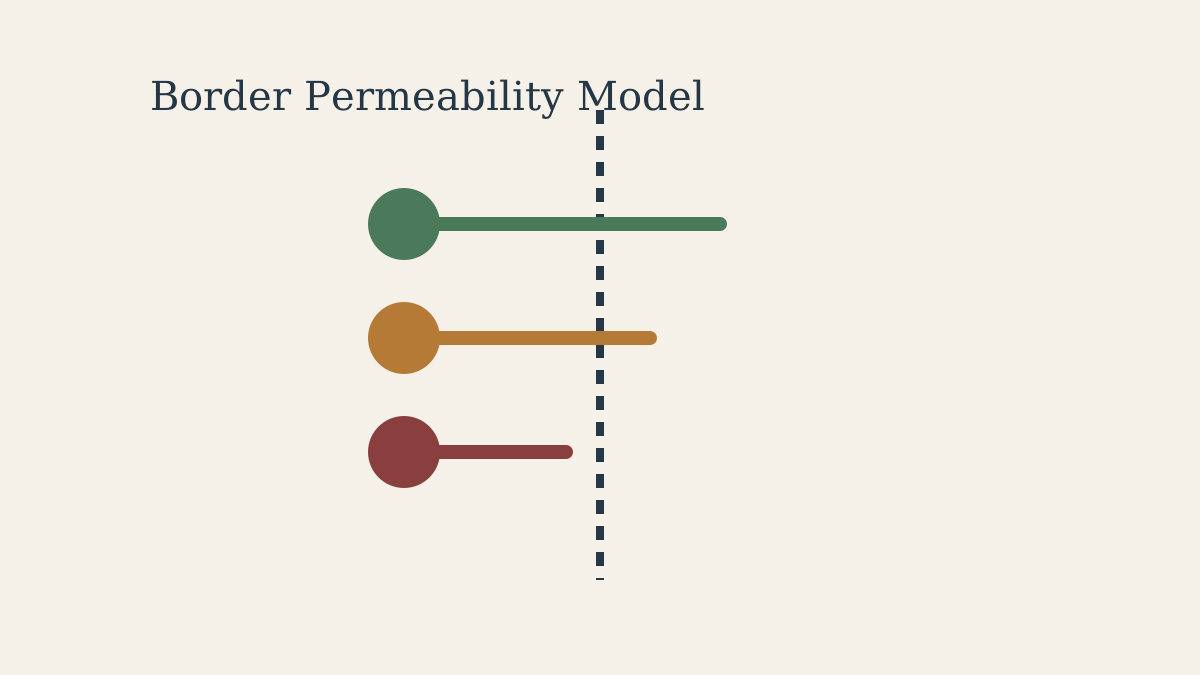
A border is usually not a wall. It is a cost-transforming surface. The border permeability model compares how crossings vary by actor, cargo, direction, season, and political condition.
That turns vague frontier language into operational structure. Instead of saying the border is tense or porous, you can state which movements remain cheap, which become inspectable, and which trigger rerouting or concentration at a few licensed gates.
| Axis | Question | Signal |
|---|---|---|
| Crossing cost | What time, money, or exposure does the crossing add? | Tariffs, queue time, escort demand, document burden, search delay |
| Asymmetry | Who crosses more easily than whom and in which direction? | Inbound tax bias, military restriction, favored brokers, one-way migration pressure |
| Concentration | Does the border force movement into a few controllable gates? | Licensed ports, fortified bridges, customs mouths, watched passes |
| Rerouting effect | What alternative routes appear when the crossing becomes expensive? | Smuggling belts, offshore transfers, desert bypasses, unofficial corridors |
Most borders are not interesting because they close everything equally. They are interesting because they impose different burdens on different flows. Merchants, migrants, armies, smugglers, and couriers do not experience the same line in the same way. The model becomes useful when those unequal costs start reorganizing route hierarchy, warehouse location, and political leverage.
Use the model whenever a frontier needs to do more than separate colors on a map. It is especially useful for trade states, migration pressure, customs empires, occupation zones, and borderlands where the same route is politically different depending on who attempts it.
Ask which actor gains most when the border tightens and which actor reroutes first. That answer usually reveals whether the frontier behaves mainly as a tax surface, a coercive screen, a broker monopoly, or a smuggling accelerator. The line on the map matters less than the cost asymmetry it creates.
The reusable lesson is that borders should be modeled by the costs they impose unevenly, not only by whether they exist. That makes route control, smuggling, customs leverage, and frontier bargaining much easier to explain. A border becomes analytically useful once the draft can say who crosses routinely, who pays extra, and who is effectively excluded without any formal closure. That distribution is the real operating rule. It is the border's actual mechanism.
Read what should come before it, what relation role matters next, and where this page should hand you off after the local graph is clear.
Start with Permeable Border and then return here once the surrounding concept stack is clear.
These entries clarify the footing underneath the current node before you move outward again. Start with Permeable Border when you want the clearest next role.
Return to broader lenses when this model is too specific for the question you are asking.
2 handoff nodes stay inside Governance And Power. 2 handoff nodes share Regional.
Detail pages now expose the branch and scale of their surrounding graph before showing raw prerequisite and relation shelves, so continuation can stay taxonomy-led instead of adjacency-led.
Explain how topology, region graphs, corridors, map abstraction, and scale determine movement and leverage.
Start in Spatial, reduce the map into region graph and corridor logic, test topology under disruption, then return through a spatial design guide.
Explain how legitimacy, coercion, administrative reach, frontier bargaining, and elite control are structured.
Start with the pressure map, locate legitimacy and capture mechanisms, validate against a frontier or state case, then run a governance stress test.
Explain how resources, goods, labor, information, and force circulate, stall, buffer, and break.
Start from the resource-flow loop, trace storage and throughput models, compare one logistics study, then run a flow audit worksheet.
Use this scale when the strongest explanation depends on several levels staying visible together.
Use this scale when routes, relays, buffers, and linked nodes matter more than territorial bulk.
Use this scale when the region is the main leverage unit for settlement, extraction, governance, or conflict.
Use prerequisites when you want the shortest path into the assumptions this page depends on.
A border that does not fully close movement but changes crossing cost unevenly by actor, cargo type, season, or political condition.
A structural condition in which a small number of passages or gateways determine the behavior of a much larger region or system.
These groups explain why each neighboring node matters, whether it stabilizes the concept, operationalizes it, proves it, or pushes the lane further.
Use foundation relations when this node depends on a concept, term, or framing layer that should be explicit before you branch further.
A border that does not fully close movement but changes crossing cost unevenly by actor, cargo type, season, or political condition.
A framework for reading movement as stacked road, river, sea, border, and administrative layers whose overlaps decide gateway leverage, rerouting options, and operating reach.
Use applied relations when the next useful move is to see the current pattern survive inside a study or assembled world.
A synthetic study of a route-control empire where licensed desert crossings, port relays, and selective border openness turn movement into administrative leverage.
These entries still matter, but they currently rely on generic adjacency instead of typed continuation semantics.
A framework for tracking which passes, ports, narrows, and crossings decide political leverage at the edge of a system.
A model for reducing a full map into a small graph of meaningful nodes, edges, weights, and transfer surfaces without losing the questions that matter operationally.
Models formalize behavior. Use them when you need a concrete chain, loop, stress scenario, or layered mechanism that can be tested and reused.
A model should explain how something behaves over time or under pressure, not just identify a broad topic area.
When a setting feels plausible at rest but still behaves vaguely, models provide the explicit structure needed to test it.
A strong workflow often moves from broad lens to formal model to applied case reading.
Keep these collapsed until you want to turn the page into an active reading exercise.
What mechanism is this model making explicit?
Where does this model break or become most interesting under stress?
Which study would verify whether this model survives in a complete setting?
These routes are tuned to the kind of entry you are currently reading, so you can leave this page with one deliberate next move.
Return to broader lenses when this model is too specific for the question you are asking.
Cross-layer moveMove through the systems module when you want to navigate models by design intent.
Cross-layer moveVerify the model inside applied cases where multiple structures interact at once.