Preparing the current spcent route.
The page shell is online. Shared content and route data are still being assembled.
A synthetic study of a route-control empire where licensed desert crossings, port relays, and selective border openness turn movement into administrative leverage.
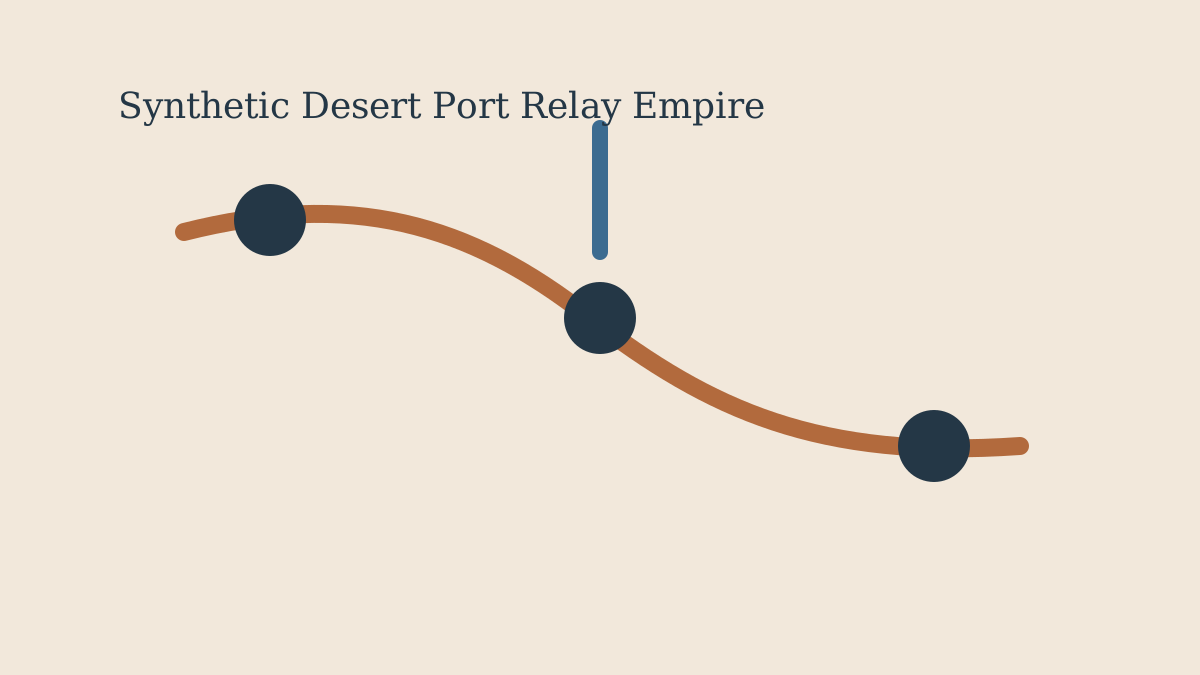
This synthetic case is built to show the M017 lens clearly: movement is governed through several linked layers rather than one continuous territorial hold. Sea access enters through licensed ports, caravans transfer through desert relays, and inland passage depends on selectively permeable borders.
That makes empire look less like flat occupation and more like route choreography. Control depends on where movement must convert, queue, declare itself, or buy escort.
Provides the stacked view needed to read ports, caravan relays, and inland authority as one mobility field.
Border Permeability ModelExplains how licensed openness changes who may cross, at what cost, and on which schedule.
Maritime Chokepoint NetworkShows how the sea entrance remains part of the same route-control system rather than a detached harbor story.
Compared with a continuous inland empire, this system accepts thinner direct territorial control in exchange for stronger gateway governance. Revenue and coercion concentrate around transfer points instead of trying to saturate every desert edge evenly.
| Axis | Question | Signal |
|---|---|---|
| Sea entry | Where is long-distance cargo forced to declare itself? | Licensed ports, customs quays, convoy schedules, protected anchorage |
| Desert relay | How is otherwise unmanageable interior transit made repeatable? | Escort stations, cistern depots, caravanserai chains, permit checkpoints |
| Selective inland border | Who may continue onward, and on what terms? | Broker licenses, tariff waivers, military restriction, smuggling arcs, seasonal closure |
The same empire behaves differently depending on whether trade is routine, border stress is rising, or a port gate is threatened.
Selective permeability creates queueing and rent without yet pushing most traffic into illicit routes.
The empire remains governable because it does not try to shut movement down completely. It licenses and prices movement instead. That keeps trade profitable enough to remain visible while still forcing caravans, brokers, and escorts through a smaller set of controllable transfer points. The border therefore becomes a revenue and intelligence surface rather than just a defensive line.
The same design creates a narrow band of failure. If licensed gates stop being trusted or if the sea entry is blocked, inland relay authority loses both revenue and escort capacity quickly. The system is resilient against diffuse smuggling but fragile against gateway mistrust and maritime interruption because so much of its governability begins at the same few conversion points.
That is what makes the case useful as a route empire rather than as a desert empire in the abstract.
The reusable lesson is that route empires can govern by selective openness rather than dense occupation. This synthetic case is useful because it makes border cost, relay dependence, and gateway sequencing visible inside one comparative structure. It is especially useful for revisions that need to explain why an apparently thin empire can still feel organized without pretending every mile is equally controlled. The real cohesion sits in licensed movement, not in uniform territorial saturation. What looks empty on the map can still be tightly governed at the crossings. The empire survives by pricing passage better than it could ever police the full desert. Revenue follows the route faster than troops can. Control is concentrated where movement must declare itself. That is the empire's real map.
Read what should come before it, what relation role matters next, and where this page should hand you off after the local graph is clear.
Start with Corridor and then return here once the surrounding concept stack is clear.
These entries clarify the footing underneath the current node before you move outward again. Start with Multi-Layer Mobility Framework when you want the clearest next role.
Use Guides when the study should feed into a worksheet or structured revision sequence.
1 handoff nodes stay inside Flow And Logistics. 2 handoff nodes share Network.
Detail pages now expose the branch and scale of their surrounding graph before showing raw prerequisite and relation shelves, so continuation can stay taxonomy-led instead of adjacency-led.
Explain how legitimacy, coercion, administrative reach, frontier bargaining, and elite control are structured.
Start with the pressure map, locate legitimacy and capture mechanisms, validate against a frontier or state case, then run a governance stress test.
Explain how topology, region graphs, corridors, map abstraction, and scale determine movement and leverage.
Start in Spatial, reduce the map into region graph and corridor logic, test topology under disruption, then return through a spatial design guide.
Explain how resources, goods, labor, information, and force circulate, stall, buffer, and break.
Start from the resource-flow loop, trace storage and throughput models, compare one logistics study, then run a flow audit worksheet.
Use this scale when routes, relays, buffers, and linked nodes matter more than territorial bulk.
Use this scale when the region is the main leverage unit for settlement, extraction, governance, or conflict.
Use this scale when the strongest explanation depends on several levels staying visible together.
Use prerequisites when you want the shortest path into the assumptions this page depends on.
A durable movement spine where terrain, settlement, exchange, and repeated transit align strongly enough to guide long-run circulation.
A border that does not fully close movement but changes crossing cost unevenly by actor, cargo type, season, or political condition.
These groups explain why each neighboring node matters, whether it stabilizes the concept, operationalizes it, proves it, or pushes the lane further.
Use foundation relations when this node depends on a concept, term, or framing layer that should be explicit before you branch further.
A framework for reading movement as stacked road, river, sea, border, and administrative layers whose overlaps decide gateway leverage, rerouting options, and operating reach.
A model for comparing how borders change crossing cost, asymmetry, inspection burden, and rerouting behavior for different actors and flows.
Use operationalizing relations when you want the current abstraction rendered as a cleaner model, loop, or structural device.
A model for reading straits, island chains, convoy arcs, and port ladders as one network where sea-lane leverage depends on sequencing as much as on any single port.
These entries still matter, but they currently rely on generic adjacency instead of typed continuation semantics.
A border that does not fully close movement but changes crossing cost unevenly by actor, cargo type, season, or political condition.
Studies apply Spcent's lenses to complete cases. Read them to see whether geography, surplus, corridors, and pressure patterns still make sense when placed inside one setting.
The goal is not to retain setting trivia. The goal is to extract reusable patterns and structural habits you can reapply elsewhere.
Studies are strongest when you already know the frameworks and models underneath them, so you can recognize the structural moves being made.
After reading a study, identify which layer of your own draft needs work and go back there with one concrete change in mind.
Keep these collapsed until you want to turn the page into an active reading exercise.
What are the decisive regions, corridors, or chokepoints in this case?
What keeps the studied world stable, and what makes it brittle?
Which model or framework do I need next if I want to reproduce this pattern in my own project?
These routes are tuned to the kind of entry you are currently reading, so you can leave this page with one deliberate next move.
Use Guides when the study should feed into a worksheet or structured revision sequence.
Cross-layer moveReturn to the worlds module when the case highlights a weak worldbuilding layer in your own draft.
Cross-layer moveOpen models when the case reveals a mechanism you want to isolate and reuse directly.