Preparing the current spcent route.
The page shell is online. Shared content and route data are still being assembled.
A model for reading how roads, grids, canals, wards, depots, and maintenance corridors spread capability by enlarging the physical footprint a society must keep repaired.
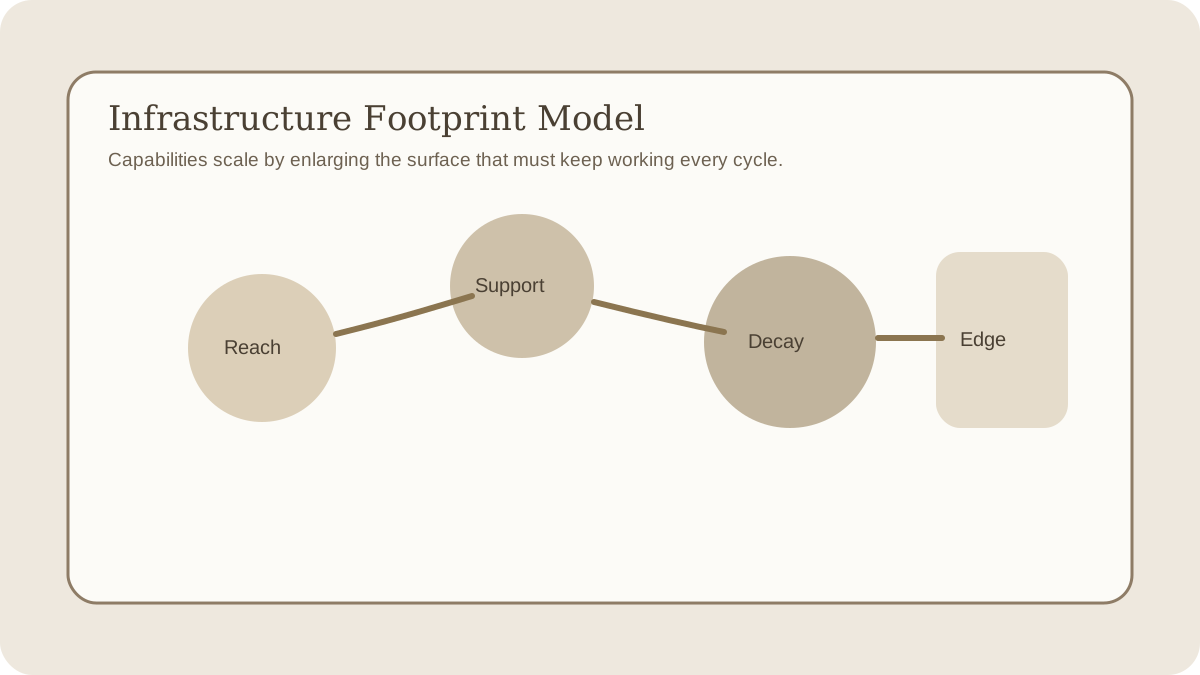
Powerful capabilities do not only unlock new actions. They also widen the footprint of roads, canals, grids, towers, depots, wards, and repair crews required to keep those actions reliable. The infrastructure footprint model makes that territorial burden visible.
This matters because worlds often describe an impressive transport, communication, hydraulic, or magical network without pricing the daily labor and material surface that network creates. A capability that reaches farther also creates more things that can rot, silt up, freeze, overload, or require guarding.
| Axis | Question | Signal |
|---|---|---|
| Reach layer | What new distance or throughput does the infrastructure make possible? | Road speed, canal volume, relay range, ward coverage, power grid span, tunnel chain |
| Support layer | Which depots, crews, stores, and monitoring points keep that reach operational? | Repair camps, lock stations, substations, watch posts, spare-part yards, dredging crews |
| Decay layer | Where does ordinary wear, weather, sabotage, or environmental drag accumulate fastest? | Floodplain silt, frost damage, corrosion, desert burial, line overload, ritual drift |
| Exposure edge | Which frontier or peripheral zones become governable only while the footprint stays intact? | Remote mines, winter roads, defended canals, fortified repeater chains, aquifer towns |
When the network expands one zone farther than before, what must now be repaired, guarded, refilled, or recalibrated every cycle that did not exist previously? That answer shows whether the capability truly scales or whether it only projects an illusion of scale.
Frostpunk Thermal Governance System is a strong reference because heat infrastructure does not merely enable survival; it dictates settlement pattern, labor scheduling, and crisis exposure. Synthetic Post-Imperial Rail Continent is the higher-scale comparison where a decaying footprint reorganizes political space by failing unevenly.
The reusable lesson is that infrastructure should be modeled as a maintenance geography, not just a convenience multiplier. Once the footprint is explicit, expansion, fragility, and peripheral control become much easier to explain.
Read what should come before it, what relation role matters next, and where this page should hand you off after the local graph is clear.
Start with Material Continuity Framework and then return here once the surrounding concept stack is clear.
These entries make the current idea more explicit and more reusable. Start with Technology Diffusion Regime when you want the clearest next role.
Return to broader lenses when this model is too specific for the question you are asking.
3 handoff nodes stay inside Capability Regimes. 1 handoff nodes share Regional.
Detail pages now expose the branch and scale of their surrounding graph before showing raw prerequisite and relation shelves, so continuation can stay taxonomy-led instead of adjacency-led.
Explain how technology, magic, infrastructure, communication, and transformation capacity rewrite baseline constraints.
Start with the operating regime, price the capability through diffusion or monopoly models, compare a regime-rewrite case, then run a capability sanity check.
Explain what the world is materially built from before politics, balance, or style are discussed.
Start in Worlds, read the anchor framework, open one regional model, validate with a complete study, then finish with a world assembly guide pass.
Explain transition, disturbance, collapse, recovery, and reassembly across eras and stress cycles.
Start with transformation and failure models, trace residue and recovery paths, compare a collapse or successor-order study, then run a failure-mode review.
Use this scale when the strongest explanation depends on several levels staying visible together.
Use this scale when routes, relays, buffers, and linked nodes matter more than territorial bulk.
Use this scale when the region is the main leverage unit for settlement, extraction, governance, or conflict.
Use this scale when city-scale transfer, concentration, or control is doing the main structural work.
Use prerequisites when you want the shortest path into the assumptions this page depends on.
A framework for reading how food, water, health, and maintenance cycles must keep reproducing beneath settlement, surplus, and political order.
A model for how tools, infrastructure, training, maintenance, and standardization determine whether a technology stays elite or rewrites everyday world structure.
These groups explain why each neighboring node matters, whether it stabilizes the concept, operationalizes it, proves it, or pushes the lane further.
Use operationalizing relations when you want the current abstraction rendered as a cleaner model, loop, or structural device.
A model for how tools, infrastructure, training, maintenance, and standardization determine whether a technology stays elite or rewrites everyday world structure.
Use applied relations when the next useful move is to see the current pattern survive inside a study or assembled world.
A game study of how heat radius, labor sacrifice, storage timing, and moral policy turn Frostpunk into a compact model of survival governance under extreme climatic pressure.
Use extension relations when the next move is not prerequisite or proof, but a deeper neighboring step in the same graph lane.
A framework for reading how food, water, health, and maintenance cycles must keep reproducing beneath settlement, surplus, and political order.
These entries still matter, but they currently rely on generic adjacency instead of typed continuation semantics.
A model for how potable water, irrigation, flood control, drainage, and navigability bind settlement density to water management burden.
An advanced model for explaining how new transport, energy, communication, or logistical substrates reorganize settlement, authority, and strategic tempo across an existing world.
An advanced synthetic study of how a shattered continental rail system fragments, cascades, and then reassembles into a narrower successor order built on surviving trunks and depot residue.
Models formalize behavior. Use them when you need a concrete chain, loop, stress scenario, or layered mechanism that can be tested and reused.
A model should explain how something behaves over time or under pressure, not just identify a broad topic area.
When a setting feels plausible at rest but still behaves vaguely, models provide the explicit structure needed to test it.
A strong workflow often moves from broad lens to formal model to applied case reading.
Keep these collapsed until you want to turn the page into an active reading exercise.
What mechanism is this model making explicit?
Where does this model break or become most interesting under stress?
Which study would verify whether this model survives in a complete setting?
These routes are tuned to the kind of entry you are currently reading, so you can leave this page with one deliberate next move.
Return to broader lenses when this model is too specific for the question you are asking.
Cross-layer moveMove through the systems module when you want to navigate models by design intent.
Cross-layer moveVerify the model inside applied cases where multiple structures interact at once.