Pulling this page together.
Preparing content, navigation, and supporting references for this route.
Preparing content, navigation, and supporting references for this route.
An advanced model for comparing how multi-center empires stabilize or fracture through delegated authority, corridor integration, reserve depth, and center-periphery bargaining.
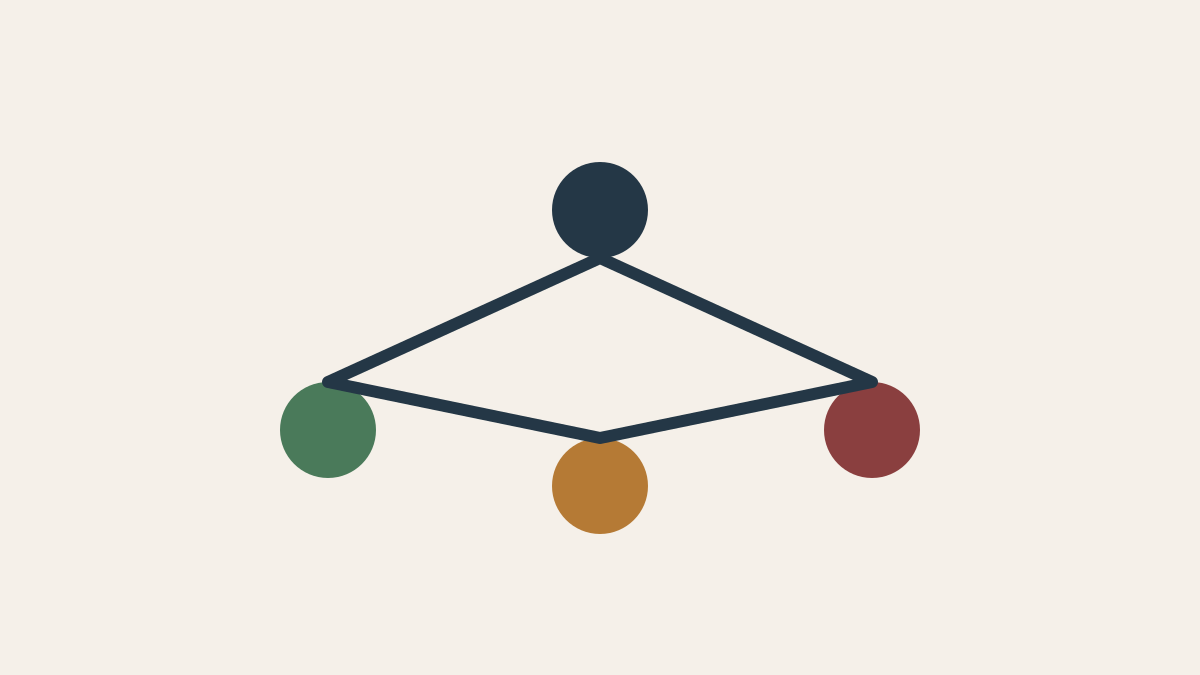
Empires with several strong centers are not simply weaker or stronger than centralized states. They are stable under a different balance. Polycentric stability depends on whether regional centers can act with enough autonomy to solve local problems while still remaining tied into reserve release, legitimacy, and corridor integration at imperial scale.
That makes the key question comparative: when does delegated strength preserve the empire, and when does the same strength become a secession-ready alternative order?
| Axis | Question | Signal |
|---|---|---|
| Delegated authority | How much regional discretion strengthens the system before it weakens central coherence? | Provincial command, fiscal autonomy, local reserve keys, independent courts |
| Corridor integration | Do the centers still depend on one another materially? | Inter-basin routes, shared granary chains, military roads, customs harmonization |
| Legitimacy hierarchy | Why do regional elites still prefer the imperial order? | Dynastic recognition, ritual rank, arbitration authority, tax privileges, succession rules |
| Reserve asymmetry | Who can survive disruption without the others? | Local stockpiles, fleet concentration, frontier depth, independent revenue base |
The same empire behaves differently depending on whether its regional centers are complementary, drifting, or preparing independent survival.
Regional discretion absorbs local shocks while shared reserve and legitimacy structures keep the empire worth preserving.
The most common failure is not immediate rebellion. It is bargaining inversion. Regional centers keep enough strength to solve local problems but stop believing that imperial coordination returns more stability than independent survival would. Once that calculation shifts, the same delegated capacity that once preserved the system starts underwriting fragmentation.
Start by identifying the system's real centers rather than the map's ceremonial capitals. Which nodes can solve local crises, release reserves, bargain with elites, or survive temporary disconnection without waiting for the nominal core? Once those centers are named, walk the four tensions in order. How much discretion do they need? How materially integrated are they? Why do they still accept the legitimacy hierarchy? Which of them could survive disruption on their own?
The model is most useful when it is treated as a comparison between fallback orders. Ask what each center loses by staying integrated and what it gains by remaining inside the imperial frame. If the center keeps arbitration, reserve release, corridor access, and symbolic rank more valuable than autonomy, the order holds. If a regional center can now reproduce those benefits locally, the system has already moved closer to breakaway readiness even if no rebellion has begun.
One misread is to treat polycentricity as instability by default. Multi-center orders are not weak because they have several strong nodes. They fail only when those nodes become independently viable enough that integration stops paying. Another misread is to assume the decisive variable is only ideology or dynastic sentiment. Those matter, but they matter inside corridor access, reserve asymmetry, and bargaining leverage rather than above them.
Another frequent mistake is to confuse local competence with disloyalty. A regional center may need real autonomy to keep the wider system functioning. The question is not whether it has capacity. The question is whether that capacity still loops back into imperial integration or has already become the seed of an alternative order.
Imagine an empire organized around two river basins and one dry corridor capital. Each basin city can tax, mobilize, and buffer its own region, but both still need the central corridor for inter-basin trade, dynastic arbitration, and frontier reserve transfer. At first the order is stable because regional strength absorbs flood, drought, and invasion shocks locally while the center keeps the only legitimate mechanism for settling inter-basin disputes. The problem starts when one basin develops enough independent fleet depth, grain reserve, and elite legitimacy to bargain without fearing corridor exclusion. At that point regional competence stops being purely stabilizing. It begins to price out the value of imperial integration.
Use this model first when the question is still comparative. Name the centers, test the four tensions, and ask which node is becoming independently survivable. Then move into proof cases that show what that geometry looks like in practice. Foundation Peripheral Control Model is useful when the center wins through replacement substrate and selective dependency. Tokugawa Sankin Kotai Control System is useful when ritual hierarchy and corridor discipline keep regional autonomy expensive to separate.
That sequence matters because the model should not stay abstract for long. Once the bargaining geometry is visible, the next question is what kind of infrastructure, legitimacy, and reserve arrangement keeps one center integrated instead of breakaway-ready.
Use this when you first need to sequence which pressure surface is making the polycentric bargain sharper before dropping into center-periphery comparison.
Communication Latency RegimeExplains why wide empires drift toward delegated improvisation as message delay outpaces crisis tempo.
Historical Transformation FrameworkPlaces regional drift inside a larger question of imperial transformation and successor order formation.
Foundation Peripheral Control ModelApplies the model to a science-fiction case where peripheral coordination and center-periphery bargaining define rule.
Tokugawa Sankin Kotai Control SystemProvides the contrasting case where a polycentric elite field stays governable because corridor discipline and ritual hierarchy keep regional autonomy expensive to separate.
The reusable lesson is that multi-center systems fail or hold through bargaining geometry, not only through size. Use this model when empires, federations, or large alliances have several viable centers whose autonomy is both the source of resilience and the seed of fragmentation. Then test the result against one concrete proof case so the question becomes operational: which center owns the decisive substrate, which one can survive disconnection, and why integration still pays until it no longer does.