Preparing the current spcent route.
The page shell is online. Shared content and route data are still being assembled.
An advanced model for tracing how successor systems rebuild from surviving corridors, residue institutions, reserve fragments, and narrowed but usable geographies after collapse.
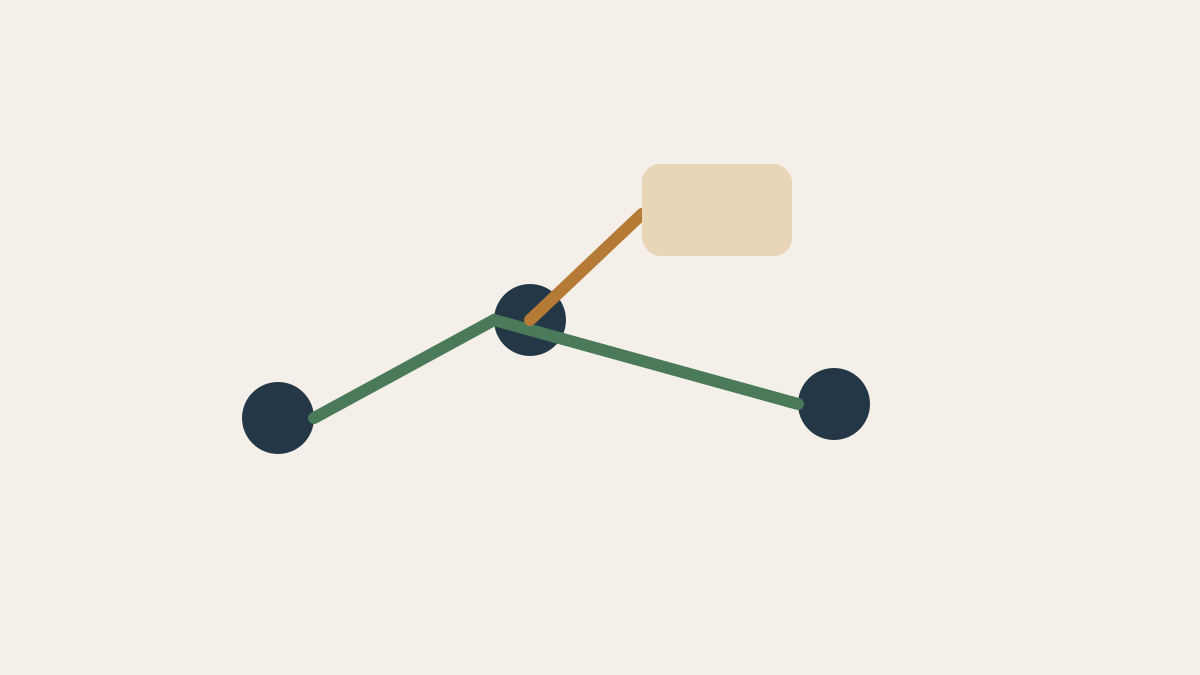
Collapse does not erase structure evenly. Some corridors remain usable, some depots still hold stock, some local elites retain legitimacy, and some technical standards keep parts of the old infrastructure interoperable. The post-collapse reassembly model starts from those leftovers.
Its main question is not how the old order failed, but which surviving fragments can seed a successor order. That makes reassembly a structural problem of selective continuity rather than a purely narrative restart.
| Axis | Question | Signal |
|---|---|---|
| Corridor residue | Which routes still connect enough value or movement to matter? | Usable rail trunk, defended river chain, old military road, surviving port ladder |
| Institutional residue | What habits or offices still coordinate behavior? | Tax memory, municipal councils, clergy networks, guild standards, courier routines |
| Reserve fragments | What stock or capacity can stabilize the first successor nodes? | Fuel yards, granaries, workshops, local militias, hospital stock, machine parts |
| Scope narrowing | What smaller geography can now be governed coherently? | Regional core, basin state, coastal strip, enclave chain, fortified corridor belt |
Successor orders do not all rebuild the same way. They depend on what kind of residue remains strongest after collapse.
A few surviving hubs use reserve fragments and legitimacy residue to reconnect their nearest corridors first.
Successor order rarely returns everywhere at once because residue is unevenly distributed. One corridor still works, one town still holds reserves, one clergy or civic office still coordinates behavior, while neighboring areas remain too broken to reconnect immediately. The model is valuable because it treats that unevenness as the normal starting condition rather than as a messy exception after collapse.
This also explains why many restoration attempts fail. Actors confuse memory of old scale with actual surviving capacity. They try to restore a large footprint before corridor residue, reserve fragments, and legitimacy depth can support it. The model redirects attention toward the smaller geography that can reproduce order first.
The key boundary question is scale. A successor order usually fails when it tries to restore the lost system's full footprint before its surviving residue can support it. Reassembly works better when the first core is narrower, the reserve logic is explicit, and the restored corridor system matches what can actually be repaired and defended.
The fastest diagnostic is to ask which residue class is strongest right now: routes, institutions, reserves, or narrowed geography. That answer usually predicts the early shape of the successor order. If no residue class is strong enough to reproduce ordinary coordination, the world is still in fragmentation. If one class clearly dominates, the first stable core is already beginning to appear.
Shows what survives from the old order strongly enough to seed new coordination.
Cascading Failure TopologyExplains which parts of the old network were lost and which remained as usable residue after the cascade.
Synthetic Post-Imperial Rail ContinentApplies the model to transport-led reassembly after imperial rail fragmentation.
The reusable lesson is that successor orders emerge from selective survivals. Use this model when a world needs to explain how coherence returns after fragmentation without pretending that the old system vanished cleanly or that the new one begins from nothing.
Read what should come before it, what relation role matters next, and where this page should hand you off after the local graph is clear.
Start with Institutional Residue Map and then return here once the surrounding concept stack is clear.
These entries clarify the footing underneath the current node before you move outward again. Start with Historical Transformation Framework when you want the clearest next role.
Return to broader lenses when this model is too specific for the question you are asking.
5 handoff nodes stay inside Evolution And Breakdown. 4 handoff nodes share Cross Scale.
Detail pages now expose the branch and scale of their surrounding graph before showing raw prerequisite and relation shelves, so continuation can stay taxonomy-led instead of adjacency-led.
Explain transition, disturbance, collapse, recovery, and reassembly across eras and stress cycles.
Start with transformation and failure models, trace residue and recovery paths, compare a collapse or successor-order study, then run a failure-mode review.
Explain how legitimacy, coercion, administrative reach, frontier bargaining, and elite control are structured.
Start with the pressure map, locate legitimacy and capture mechanisms, validate against a frontier or state case, then run a governance stress test.
Use this scale when the strongest explanation depends on several levels staying visible together.
Use this scale when routes, relays, buffers, and linked nodes matter more than territorial bulk.
Use prerequisites when you want the shortest path into the assumptions this page depends on.
A model for tracing which roads, archives, forts, cadasters, cults, and legal habits survive from earlier eras and continue to structure the present.
A model for tracing whether disruption pushes a system toward repair, brittle stagnation, or self-amplifying collapse after reserves, coordination, and repair capacity are tested.
These groups explain why each neighboring node matters, whether it stabilizes the concept, operationalizes it, proves it, or pushes the lane further.
Use foundation relations when this node depends on a concept, term, or framing layer that should be explicit before you branch further.
A framework for reading long-run structural change through continuity, rupture, inheritance, infrastructure rewrite, and post-shock reassembly rather than through event chronology alone.
A model for tracing which roads, archives, forts, cadasters, cults, and legal habits survive from earlier eras and continue to structure the present.
Use applied relations when the next useful move is to see the current pattern survive inside a study or assembled world.
An advanced synthetic study of how a shattered continental rail system fragments, cascades, and then reassembles into a narrower successor order built on surviving trunks and depot residue.
These entries still matter, but they currently rely on generic adjacency instead of typed continuation semantics.
An advanced model for tracing how disruption propagates across tightly coupled routes, reserves, institutions, and infrastructures once local failure begins rewriting the wider network.
An advanced historical study of how administrative strain, corridor loss, reserve distortion, and regional autonomy turned imperial fragmentation into a network failure rather than one sudden fall.
Models formalize behavior. Use them when you need a concrete chain, loop, stress scenario, or layered mechanism that can be tested and reused.
A model should explain how something behaves over time or under pressure, not just identify a broad topic area.
When a setting feels plausible at rest but still behaves vaguely, models provide the explicit structure needed to test it.
A strong workflow often moves from broad lens to formal model to applied case reading.
Keep these collapsed until you want to turn the page into an active reading exercise.
What mechanism is this model making explicit?
Where does this model break or become most interesting under stress?
Which study would verify whether this model survives in a complete setting?
These routes are tuned to the kind of entry you are currently reading, so you can leave this page with one deliberate next move.
Return to broader lenses when this model is too specific for the question you are asking.
Cross-layer moveMove through the systems module when you want to navigate models by design intent.
Cross-layer moveVerify the model inside applied cases where multiple structures interact at once.