Preparing the current spcent route.
The page shell is online. Shared content and route data are still being assembled.
The amount of material, people, information, or force that can pass through a route, system, or institution within a given time without breakdown.
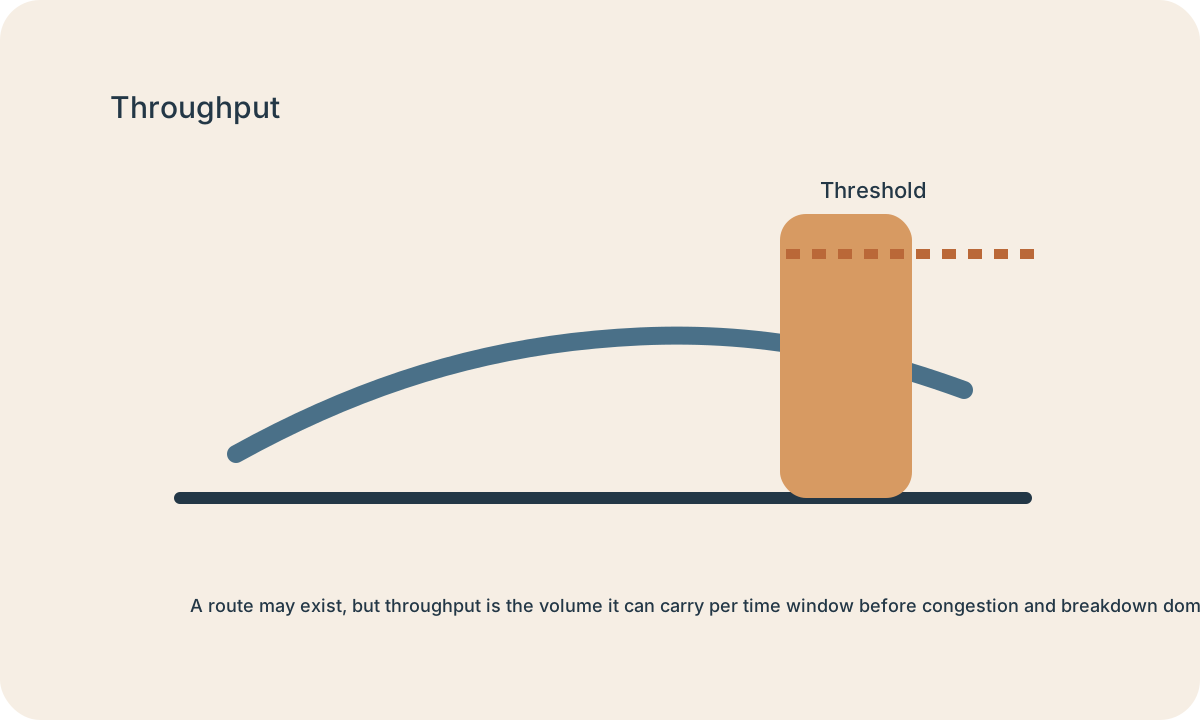
Throughput is the rate at which a system can move or process something before congestion, delay, waste, or collapse becomes significant.
It matters because a route may exist on the map, but still be unable to support the volume required by war, trade, migration, or governance.
| Axis | Question | Signal |
|---|---|---|
| Route | How much can a road, river, or lane carry per time window? | Convoy density, barge count, passage delay, escort need |
| Node | How much can a port, gate, or depot receive and release? | Berth turnover, gate queue, warehouse intake, customs drag |
| Institution | How much can a governing system process coherently? | Tax filings, dispatch volume, ration tickets, court backlog |
| Transformation | How much material can actually be converted or redistributed? | Mill rate, foundry capacity, repair queue, packing speed |
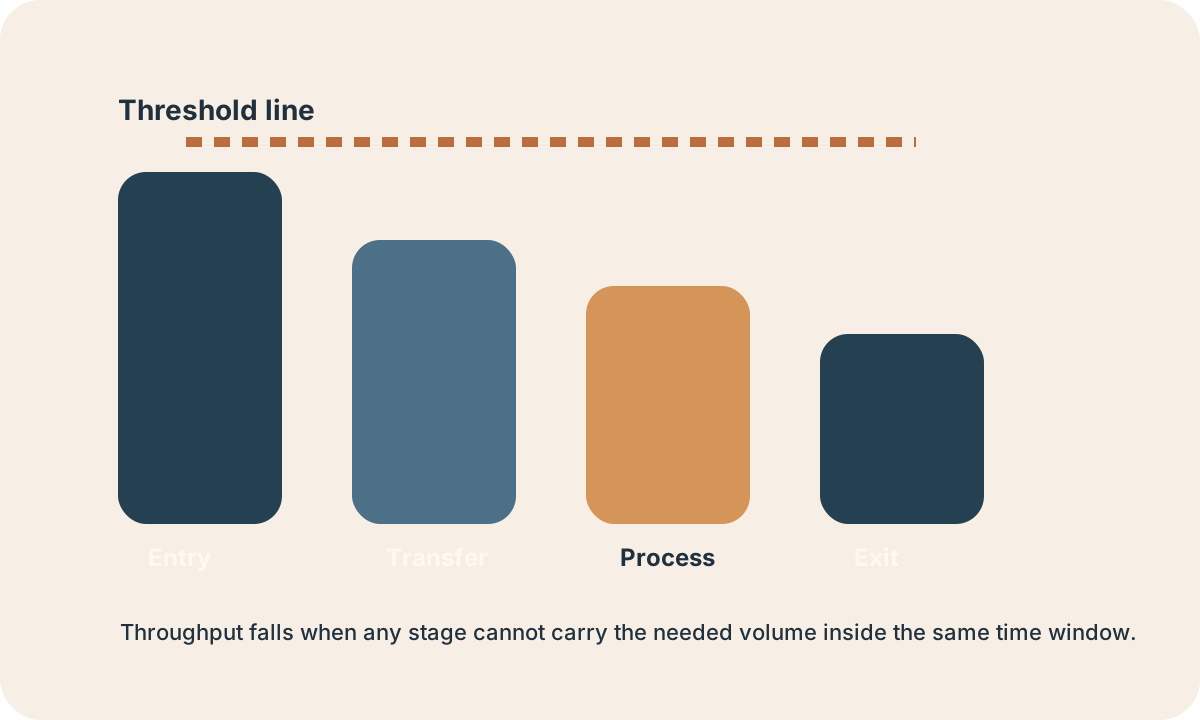
Throughput is the concept that prevents route maps from being mistaken for functioning systems. A corridor may connect two places perfectly well in principle while still failing under the volume demanded by campaign supply, urban provisioning, or mass migration.
It also explains why bottlenecks appear in surprising places. Sometimes the weak point is not the road itself but the customs gate, repair yard, granary mouth, or unloading labor that caps the wider flow. Throughput forces you to look at the whole chain.
Throughput is not identical to width, speed, or nominal capacity. A broad road with poor unloading discipline may have worse throughput than a narrower but better-buffered corridor. A fast signal network may still have low institutional throughput if decisions cannot be processed or authorized in time. The term always implies sustained flow under real operating conditions, not optimistic maximums.
If demand doubles tomorrow, what stage jams first? The answer usually reveals the real throughput limit faster than raw map description does.
Queues, waiting time, backlog, and forced priority choices are usually the clearest signs that throughput is the real problem. If goods, people, or instructions keep arriving but cannot clear the next stage smoothly, the system is already telling you where its limit sits.
Read what should come before it, what relation role matters next, and where this page should hand you off after the local graph is clear.
Start with Corridor and then return here once the surrounding concept stack is clear.
These entries clarify the footing underneath the current node before you move outward again. Start with Route Hierarchy when you want the clearest next role.
Many glossary abstractions become richer when viewed inside the spatial module.
2 handoff nodes stay inside Flow And Logistics. 4 handoff nodes share Network.
Detail pages now expose the branch and scale of their surrounding graph before showing raw prerequisite and relation shelves, so continuation can stay taxonomy-led instead of adjacency-led.
Explain how resources, goods, labor, information, and force circulate, stall, buffer, and break.
Start from the resource-flow loop, trace storage and throughput models, compare one logistics study, then run a flow audit worksheet.
Explain how topology, region graphs, corridors, map abstraction, and scale determine movement and leverage.
Start in Spatial, reduce the map into region graph and corridor logic, test topology under disruption, then return through a spatial design guide.
Use this scale when routes, relays, buffers, and linked nodes matter more than territorial bulk.
Use prerequisites when you want the shortest path into the assumptions this page depends on.
A durable movement spine where terrain, settlement, exchange, and repeated transit align strongly enough to guide long-run circulation.
The ranked structure by which some routes function as primary spines while others act as feeder, secondary, seasonal, or fallback paths.
These groups explain why each neighboring node matters, whether it stabilizes the concept, operationalizes it, proves it, or pushes the lane further.
Use foundation relations when this node depends on a concept, term, or framing layer that should be explicit before you branch further.
The ranked structure by which some routes function as primary spines while others act as feeder, secondary, seasonal, or fallback paths.
Use operationalizing relations when you want the current abstraction rendered as a cleaner model, loop, or structural device.
A model for rating how exposed an economy is to route loss, storage failure, timing delays, and concentration at a few decisive movement nodes.
A model for how extraction, transport, storage, transformation, and redistribution create stability or fragility in a world system.
Glossary entries define Spcent's shared vocabulary. They are conceptual anchors designed to stabilize how an abstraction is used across pages and modules.
A glossary term should lock down what a phrase means so later reading is not burdened by ambiguity.
When you know the concept but not yet the best framework or model, start here and then move outward through related nodes.
A useful definition points toward the frameworks, models, and studies that actually use the term in context.
Keep these collapsed until you want to turn the page into an active reading exercise.
What question becomes easier once this term is precisely defined?
Which entries in the graph are using this abstraction operationally rather than only naming it?
Do I need a framework, model, or study next to see this concept in action?
These routes are tuned to the kind of entry you are currently reading, so you can leave this page with one deliberate next move.
Many glossary abstractions become richer when viewed inside the spatial module.
Cross-layer moveMove into frameworks when you want a planning lens built on top of the term.
Cross-layer moveSearch across the graph to find every place the concept currently appears.