Preparing the current spcent route.
The page shell is online. Shared content and route data are still being assembled.
An advanced model for tracing how disruption propagates across tightly coupled routes, reserves, institutions, and infrastructures once local failure begins rewriting the wider network.
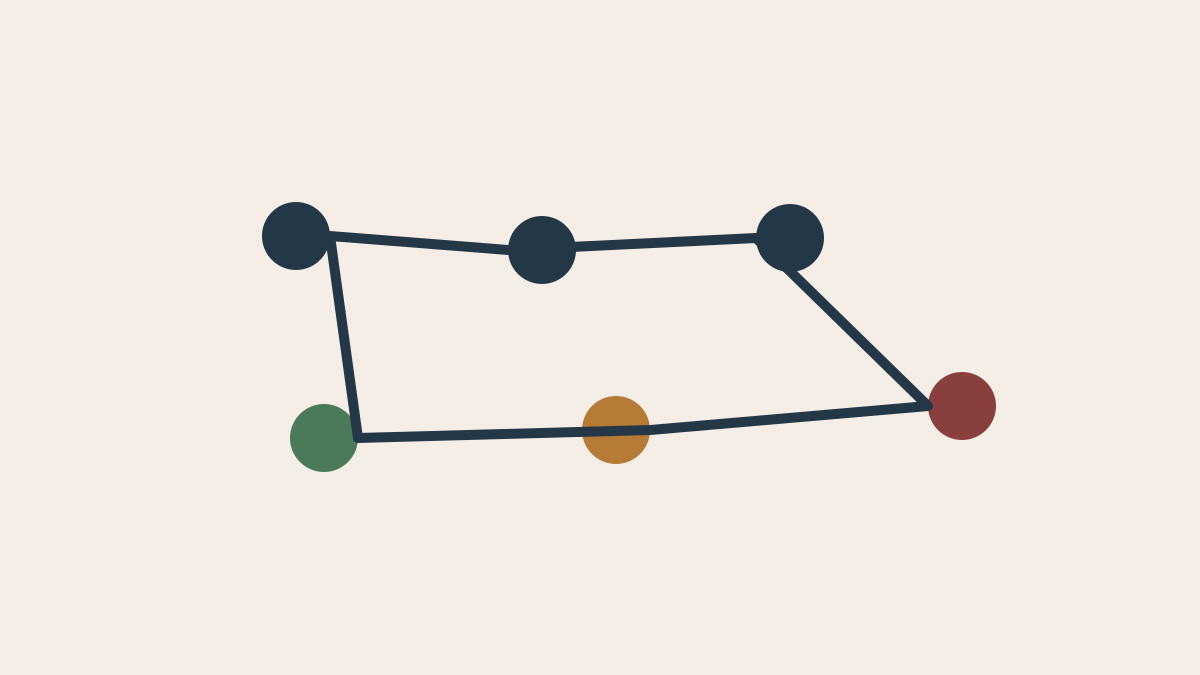
Topology stress tests show whether disruption matters. Cascading failure topology asks how it spreads once it matters. The model tracks how one broken edge, reserve drain, administrative delay, or confidence loss propagates across the larger network and transforms the operating conditions of nodes that were not initially damaged.
This is what makes the model advanced. It does not stop at closure and rerouting. It follows second-order overload, reserve exhaustion, governance drift, and the loss of substitute capacity itself.
Start with one route loss, infrastructure outage, reserve delay, legitimacy fracture, or corridor seizure.
Identify which fallback nodes, depots, and corridors now inherit traffic or burden they were never built to carry.
Watch when the substitute paths themselves begin failing through queue growth, reserve depletion, or governance delay.
Ask whether the network has merely degraded or whether it has entered a new stable but narrower structural shape.
| Axis | Question | Signal |
|---|---|---|
| Coupling | Which systems are using the same corridor, reserve, or authority surface simultaneously? | Freight and armies on one road, power and signaling on one grid, tax and relief through one depot chain |
| Substitute overload | What backup path fails once it absorbs the displaced burden? | Queue spiral, depot exhaustion, repair backlog, ferry overload, customs saturation |
| Recovery mismatch | Can repair arrive before the substitutes degrade too far? | Delayed crews, missing spare parts, exhausted escorts, reserve drawdown, administrative confusion |
| Topology rewrite | What new network shape remains after the cascade passes? | Regional isolation, narrowed core, abandoned branches, hardened enclaves, new gateway hierarchy |
The same disruption may remain local, spread systemically, or produce a new stable but diminished network depending on how tightly the system is coupled.
Redundancy and reserves prevent overload from escaping the original failure zone.
The model turns advanced once it stops treating backups as safety by default. Substitute corridors, reserve depots, and alternate authorities can fail precisely because they inherit load they were never designed to absorb. This is why cascades often look surprising from the outside: the original damage may be local, but the real crisis appears where compensation effort begins overloading the network's own fallback geometry.
Provides the first-order route disruption that cascade analysis extends into multi-stage propagation.
Recovery-Collapse LoopAdds the temporal logic for whether repairs, reserves, and response can interrupt the cascade.
Synthetic Post-Imperial Rail ContinentApplies the model to transport fragmentation and reassembly after imperial network loss.
Use this model when a system appears to have redundancy yet still produces widening crisis. The decisive question is whether the backups share the same hidden bottleneck. If they do, the network is not truly redundant. It is merely distributing failure across a slightly longer sequence.
Ask which substitute path would be stressed first if the primary node vanished today. If the answer relies on the same reserve source, same repair crews, or same command delay as the original path, the topology is more tightly coupled than it appears. That is usually the earliest sign that local disruption can become systemic rewrite.
The reusable lesson is that advanced failure analysis is about changed network shape, not only bigger damage. Use this model when you need to explain how tightly coupled systems spread disruption through their own substitutes and emerge structurally different on the other side. In revision terms, the key payoff is that recovery no longer means "everything returns," but "a different map stabilizes after the cascade."
Read what should come before it, what relation role matters next, and where this page should hand you off after the local graph is clear.
Start with Topology Stress Test and then return here once the surrounding concept stack is clear.
These entries clarify the footing underneath the current node before you move outward again. Start with Topology Stress Test when you want the clearest next role.
Return to broader lenses when this model is too specific for the question you are asking.
4 handoff nodes stay inside Evolution And Breakdown. 1 handoff nodes share Network.
Detail pages now expose the branch and scale of their surrounding graph before showing raw prerequisite and relation shelves, so continuation can stay taxonomy-led instead of adjacency-led.
Explain transition, disturbance, collapse, recovery, and reassembly across eras and stress cycles.
Start with transformation and failure models, trace residue and recovery paths, compare a collapse or successor-order study, then run a failure-mode review.
Explain how topology, region graphs, corridors, map abstraction, and scale determine movement and leverage.
Start in Spatial, reduce the map into region graph and corridor logic, test topology under disruption, then return through a spatial design guide.
Use this scale when the strongest explanation depends on several levels staying visible together.
Use this scale when routes, relays, buffers, and linked nodes matter more than territorial bulk.
Use prerequisites when you want the shortest path into the assumptions this page depends on.
A model for testing how a spatial layout behaves under congestion, disruption, seasonal shifts, and asymmetric pressure.
A model for tracing whether disruption pushes a system toward repair, brittle stagnation, or self-amplifying collapse after reserves, coordination, and repair capacity are tested.
These groups explain why each neighboring node matters, whether it stabilizes the concept, operationalizes it, proves it, or pushes the lane further.
Use foundation relations when this node depends on a concept, term, or framing layer that should be explicit before you branch further.
A model for testing how a spatial layout behaves under congestion, disruption, seasonal shifts, and asymmetric pressure.
A model for tracing whether disruption pushes a system toward repair, brittle stagnation, or self-amplifying collapse after reserves, coordination, and repair capacity are tested.
Use applied relations when the next useful move is to see the current pattern survive inside a study or assembled world.
An advanced synthetic study of how a shattered continental rail system fragments, cascades, and then reassembles into a narrower successor order built on surviving trunks and depot residue.
These entries still matter, but they currently rely on generic adjacency instead of typed continuation semantics.
A framework for reading long-run structural change through continuity, rupture, inheritance, infrastructure rewrite, and post-shock reassembly rather than through event chronology alone.
An advanced historical study of how administrative strain, corridor loss, reserve distortion, and regional autonomy turned imperial fragmentation into a network failure rather than one sudden fall.
Models formalize behavior. Use them when you need a concrete chain, loop, stress scenario, or layered mechanism that can be tested and reused.
A model should explain how something behaves over time or under pressure, not just identify a broad topic area.
When a setting feels plausible at rest but still behaves vaguely, models provide the explicit structure needed to test it.
A strong workflow often moves from broad lens to formal model to applied case reading.
Keep these collapsed until you want to turn the page into an active reading exercise.
What mechanism is this model making explicit?
Where does this model break or become most interesting under stress?
Which study would verify whether this model survives in a complete setting?
These routes are tuned to the kind of entry you are currently reading, so you can leave this page with one deliberate next move.
Return to broader lenses when this model is too specific for the question you are asking.
Cross-layer moveMove through the systems module when you want to navigate models by design intent.
Cross-layer moveVerify the model inside applied cases where multiple structures interact at once.