Preparing the current spcent route.
The page shell is online. Shared content and route data are still being assembled.
A synthetic study of how monsoon timing, distributary routes, migration corridors, and node hierarchy combine into a dense delta polity with uneven but durable leverage.
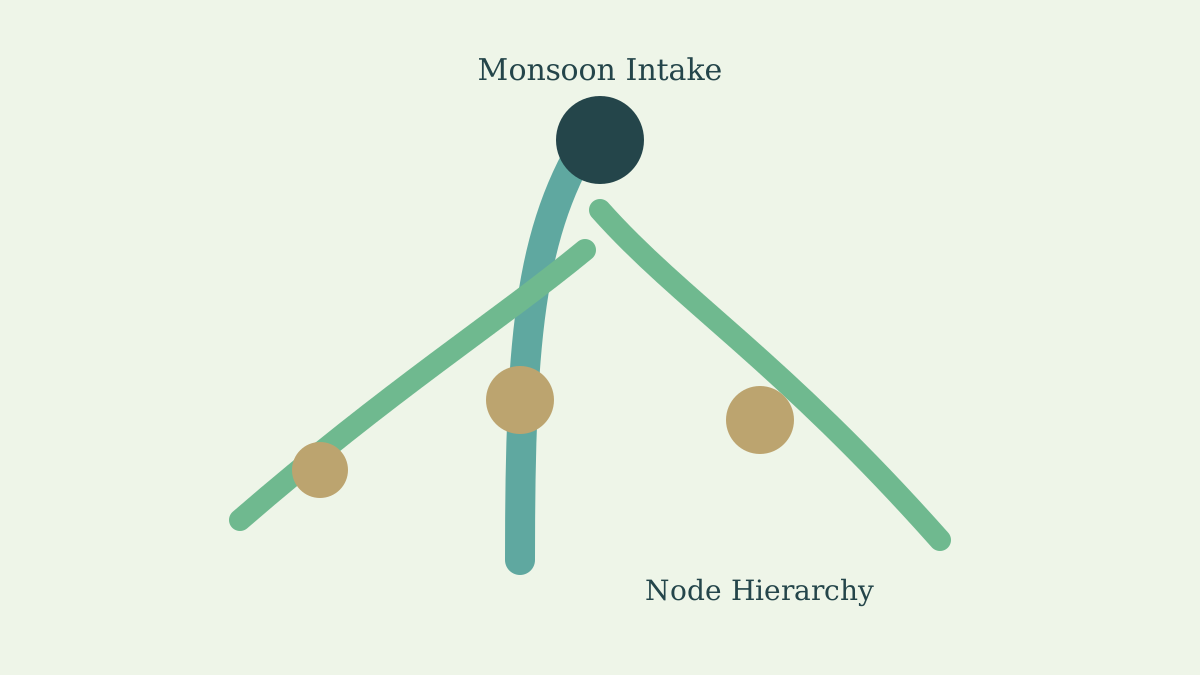
This synthetic delta commonwealth begins with a repeating monsoon rhythm that floods transport channels, feeds fertile silt belts, and periodically forces storage and labor into synchronized cycles. Those same cycles attract seasonal migrants, merchants, and political claimants toward a narrow set of distributary corridors.
The result is a polity whose strength comes from concentrated movement and layered urban nodes, but whose legitimacy remains under constant pressure because incoming labor, old agrarian cores, and port elites do not all benefit from the same timing in the same way.
Explains why labor, shipping, and storage all follow the same seasonal pulse instead of moving evenly year-round.
Migration Corridor ModelShows why incoming labor and frontier settlers reuse the same distributary routes and intake nodes repeatedly.
Legitimacy-Capture CouplingClarifies why a rich delta still has to keep redistribution and order visibly linked if it wants compliance to survive.
The commonwealth stabilizes because three systems reinforce one another. Climate rhythm creates predictable production and shipping windows. Migration corridors feed labor and military settlers into the same route network. Urban node hierarchy lets core ports, warehouse cities, and inland relay towns specialize instead of competing as duplicates.
But the same concentration produces political strain. Port elites benefit from timing arbitrage, frontier districts feel overexposed to disruption, and agrarian cores demand visible redistribution when the monsoon cycle goes unevenly.
| Axis | Question | Signal |
|---|---|---|
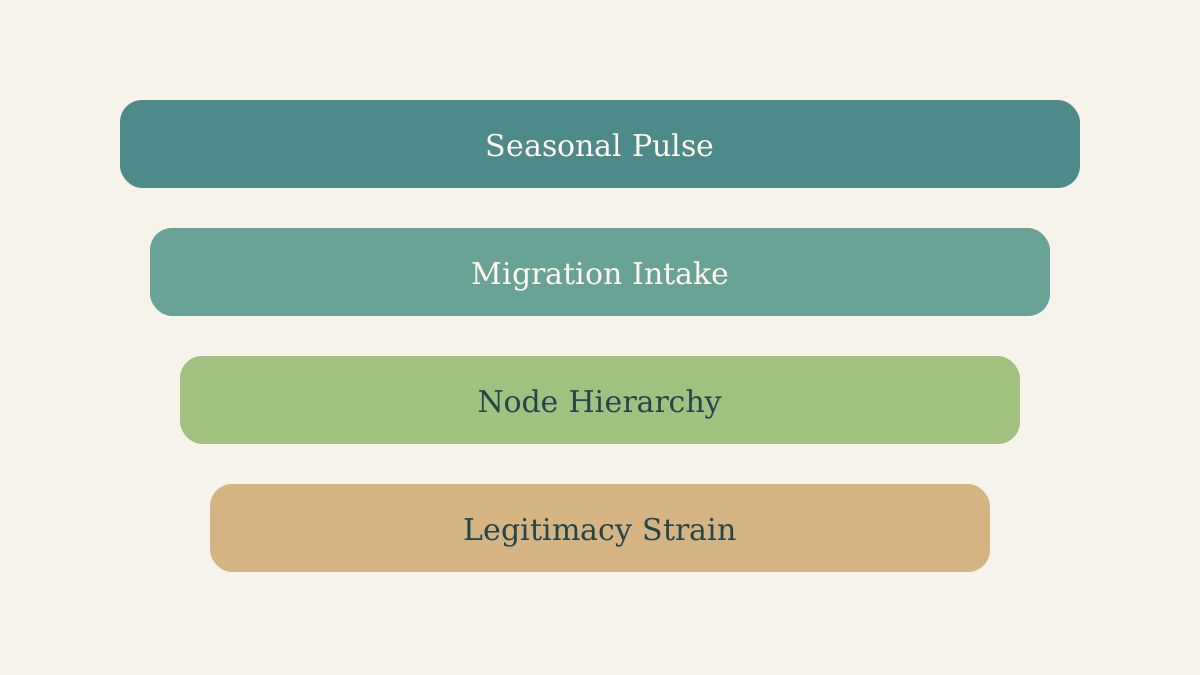
| Seasonal pulse | What makes the system rich but timing-sensitive? | Monsoon intake, flood retreat, canal depth, harvest compression, storage rush |
| Migration intake | Why does incoming labor keep thickening the same route belts? | River branches, protected embankments, market hiring, frontier grants, escort familiarity |
| Node hierarchy | How is urban work differentiated across the delta? | Core ports, depot cities, inland relays, customs crossings, ceremonial capitals |
| Legitimacy strain | What keeps prosperity from translating automatically into stable rule? | Redistribution disputes, flood relief burden, tariff resentment, elite hoarding, regional grievance |
Use the timeline to see how the same rich corridor system can shift from confidence to bargaining crisis.
Monsoon timing, shipping windows, and storage turnover stay close enough that both merchants and agrarian cores feel the system is paying out visibly.
The reusable lesson is that dense deltas are powerful because climate rhythm, migration, and node hierarchy keep selecting the same belts of movement and storage. They become politically brittle when legitimacy cannot keep pace with how unevenly those belts distribute security and reward.
Read what should come before it, what relation role matters next, and where this page should hand you off after the local graph is clear.
Start with Climate Rhythm Model and then return here once the surrounding concept stack is clear.
These entries clarify the footing underneath the current node before you move outward again. Start with Climate Rhythm Model when you want the clearest next role.
Use Guides when the study should feed into a worksheet or structured revision sequence.
1 handoff nodes stay inside Flow And Logistics. 1 handoff nodes share Regional.
Detail pages now expose the branch and scale of their surrounding graph before showing raw prerequisite and relation shelves, so continuation can stay taxonomy-led instead of adjacency-led.
Explain what the world is materially built from before politics, balance, or style are discussed.
Start in Worlds, read the anchor framework, open one regional model, validate with a complete study, then finish with a world assembly guide pass.
Explain how resources, goods, labor, information, and force circulate, stall, buffer, and break.
Start from the resource-flow loop, trace storage and throughput models, compare one logistics study, then run a flow audit worksheet.
Explain how legitimacy, coercion, administrative reach, frontier bargaining, and elite control are structured.
Start with the pressure map, locate legitimacy and capture mechanisms, validate against a frontier or state case, then run a governance stress test.
Use this scale when the strongest explanation depends on several levels staying visible together.
Use this scale when routes, relays, buffers, and linked nodes matter more than territorial bulk.
Use this scale when the region is the main leverage unit for settlement, extraction, governance, or conflict.
Use this scale when city-scale transfer, concentration, or control is doing the main structural work.
Use prerequisites when you want the shortest path into the assumptions this page depends on.
A model for how repeating weather and seasonal windows structure labor, harvest timing, travel reliability, and crisis pacing across a world.
A model for how relay settlements, market towns, ports, capitals, and depot cities differentiate by throughput, storage, administration, and coordination load.
These groups explain why each neighboring node matters, whether it stabilizes the concept, operationalizes it, proves it, or pushes the lane further.
Use foundation relations when this node depends on a concept, term, or framing layer that should be explicit before you branch further.
A model for how repeating weather and seasonal windows structure labor, harvest timing, travel reliability, and crisis pacing across a world.
A model for how repeated displacement, opportunity seeking, and frontier movement consolidate into durable corridors that reshape identity, labor, and political load.
Use operationalizing relations when you want the current abstraction rendered as a cleaner model, loop, or structural device.
A model for how relay settlements, market towns, ports, capitals, and depot cities differentiate by throughput, storage, administration, and coordination load.
A model for how material capture becomes durable rule only when extraction, justification, and visible order remain coupled strongly enough to be tolerated.
These entries still matter, but they currently rely on generic adjacency instead of typed continuation semantics.
An assembled example world showing how convoy seasons, relay ports, warehouse islands, and distributed sovereignty create a maritime commonwealth that is connective but fragile.
Studies apply Spcent's lenses to complete cases. Read them to see whether geography, surplus, corridors, and pressure patterns still make sense when placed inside one setting.
The goal is not to retain setting trivia. The goal is to extract reusable patterns and structural habits you can reapply elsewhere.
Studies are strongest when you already know the frameworks and models underneath them, so you can recognize the structural moves being made.
After reading a study, identify which layer of your own draft needs work and go back there with one concrete change in mind.
Keep these collapsed until you want to turn the page into an active reading exercise.
What are the decisive regions, corridors, or chokepoints in this case?
What keeps the studied world stable, and what makes it brittle?
Which model or framework do I need next if I want to reproduce this pattern in my own project?
These routes are tuned to the kind of entry you are currently reading, so you can leave this page with one deliberate next move.
Use Guides when the study should feed into a worksheet or structured revision sequence.
Cross-layer moveReturn to the worlds module when the case highlights a weak worldbuilding layer in your own draft.
Cross-layer moveOpen models when the case reveals a mechanism you want to isolate and reuse directly.