Preparing the current spcent route.
The page shell is online. Shared content and route data are still being assembled.
A model for how corridors, ports, barracks, migration pulses, and immunity mismatch turn movement systems into repeating health pressure.
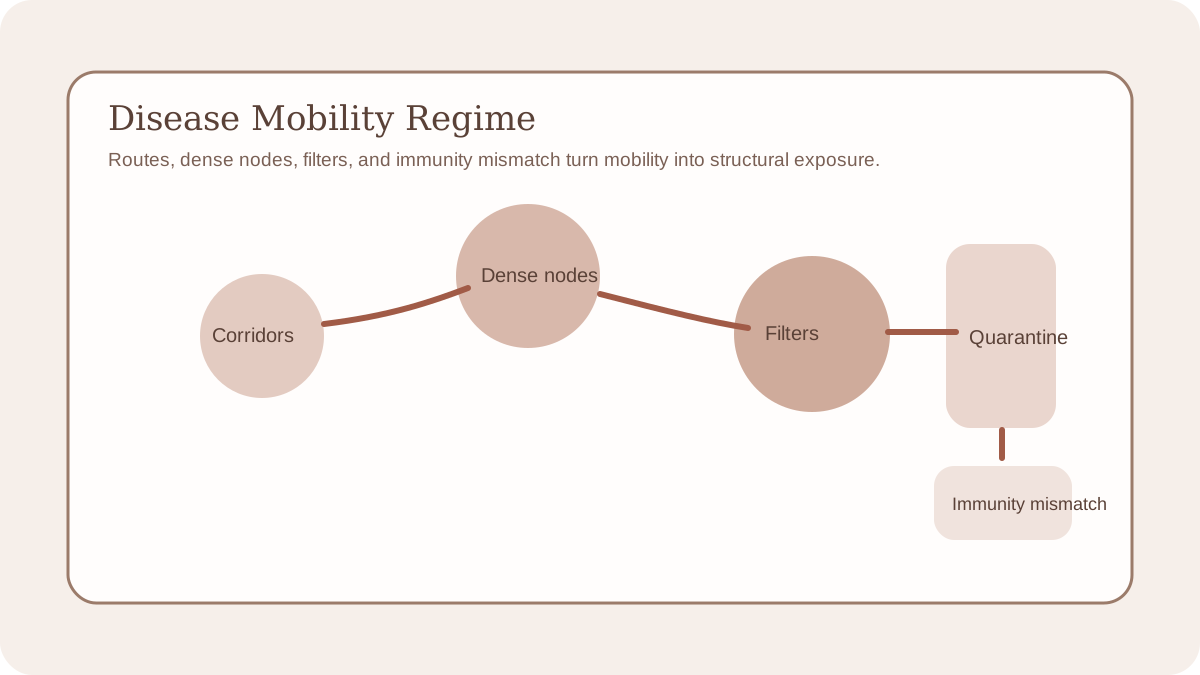
Disease becomes structural when mobility keeps reintroducing exposure faster than communities can absorb it. A disease mobility regime explains why some routes remain productive despite health risk, why others trigger seasonal shutdowns, and why dense nodes carry recurring administrative and labor pressure.
This model does not require modern epidemiology. It only requires that the world take exposure seriously as a consequence of corridor design, port turnover, enclosure, migration, and immunity mismatch across populations.
| Axis | Question | Signal |
|---|---|---|
| Corridor exposure | Which recurring routes bring bodies, animals, cargo, and water sources into sustained contact? | Caravan relays, pilgrim roads, port chains, river crews, military roads, refugee trails |
| Dense node amplification | Where does concentration convert passing exposure into lasting spread? | Markets, barracks, ports, mining camps, monasteries, winter housing clusters |
| Filter and delay | What institutions slow transmission without stopping movement entirely? | Quarantine islands, inspection depots, cordons, ritual cleansing, convoy spacing, closed seasons |
| Immunity mismatch | Which encounters create disproportionate mortality because exposure histories differ? | Frontier settlement, maritime exchange, conquest routes, slave traffic, new wetlands, thaw camps |
If one epidemic cycle begins, which part of the movement system is forced to change first: port turnover, military concentration, market timing, migration flow, or religious travel? A convincing answer should identify an exposed corridor and a bottlenecked institution, not only a death count.
Monsoon Archipelago Commonwealth is useful because maritime density, seasonal timing, and island bottlenecks make filtering movement as important as moving it. Frostpunk Thermal Governance System is the opposite case: enclosure, crowding, and scarcity intensify exposure when populations cannot disperse. Frontier settings can also use this model to explain why conquest or migration reorganizes labor and legitimacy long before it changes formal borders.
The reusable lesson is that disease pressure should be tied to movement architecture. Once corridors, nodes, filters, and immunity mismatch are explicit, quarantine, ritual, barracks policy, and seasonal travel restrictions become structural parts of the world instead of ad hoc plot devices.
Read what should come before it, what relation role matters next, and where this page should hand you off after the local graph is clear.
Start with Migration Corridor Model and then return here once the surrounding concept stack is clear.
These entries clarify the footing underneath the current node before you move outward again. Start with Material Continuity Framework when you want the clearest next role.
Return to broader lenses when this model is too specific for the question you are asking.
No handoff nodes currently stay inside Evolution And Breakdown. 1 handoff nodes share Network.
Detail pages now expose the branch and scale of their surrounding graph before showing raw prerequisite and relation shelves, so continuation can stay taxonomy-led instead of adjacency-led.
Explain what the world is materially built from before politics, balance, or style are discussed.
Start in Worlds, read the anchor framework, open one regional model, validate with a complete study, then finish with a world assembly guide pass.
Explain how legitimacy, coercion, administrative reach, frontier bargaining, and elite control are structured.
Start with the pressure map, locate legitimacy and capture mechanisms, validate against a frontier or state case, then run a governance stress test.
Explain how technology, magic, infrastructure, communication, and transformation capacity rewrite baseline constraints.
Start with the operating regime, price the capability through diffusion or monopoly models, compare a regime-rewrite case, then run a capability sanity check.
Use this scale when the region is the main leverage unit for settlement, extraction, governance, or conflict.
Use this scale when the strongest explanation depends on several levels staying visible together.
Use this scale when routes, relays, buffers, and linked nodes matter more than territorial bulk.
Use this scale when city-scale transfer, concentration, or control is doing the main structural work.
Use prerequisites when you want the shortest path into the assumptions this page depends on.
A model for how repeated displacement, opportunity seeking, and frontier movement consolidate into durable corridors that reshape identity, labor, and political load.
A model for mapping how water, temperature, soil renewal, shelter, and disturbance tolerance create uneven ecological carrying capacity across a world.
These groups explain why each neighboring node matters, whether it stabilizes the concept, operationalizes it, proves it, or pushes the lane further.
Use foundation relations when this node depends on a concept, term, or framing layer that should be explicit before you branch further.
A framework for reading how food, water, health, and maintenance cycles must keep reproducing beneath settlement, surplus, and political order.
Use applied relations when the next useful move is to see the current pattern survive inside a study or assembled world.
An assembled example world showing how convoy seasons, relay ports, warehouse islands, and distributed sovereignty create a maritime commonwealth that is connective but fragile.
Use extension relations when the next move is not prerequisite or proof, but a deeper neighboring step in the same graph lane.
A model for how repeated displacement, opportunity seeking, and frontier movement consolidate into durable corridors that reshape identity, labor, and political load.
These entries still matter, but they currently rely on generic adjacency instead of typed continuation semantics.
A broad transition band where direct control, corridor security, settlement density, and competing claims remain structurally unstable.
The practical distance and depth over which an actor can reliably enforce compliance through force, threat, escort, or punitive response.
A game study of how heat radius, labor sacrifice, storage timing, and moral policy turn Frostpunk into a compact model of survival governance under extreme climatic pressure.
Models formalize behavior. Use them when you need a concrete chain, loop, stress scenario, or layered mechanism that can be tested and reused.
A model should explain how something behaves over time or under pressure, not just identify a broad topic area.
When a setting feels plausible at rest but still behaves vaguely, models provide the explicit structure needed to test it.
A strong workflow often moves from broad lens to formal model to applied case reading.
Keep these collapsed until you want to turn the page into an active reading exercise.
What mechanism is this model making explicit?
Where does this model break or become most interesting under stress?
Which study would verify whether this model survives in a complete setting?
These routes are tuned to the kind of entry you are currently reading, so you can leave this page with one deliberate next move.
Return to broader lenses when this model is too specific for the question you are asking.
Cross-layer moveMove through the systems module when you want to navigate models by design intent.
Cross-layer moveVerify the model inside applied cases where multiple structures interact at once.