Preparing the current spcent route.
The page shell is online. Shared content and route data are still being assembled.
A structural study of how harbor clearance, district specialization, and regional servicing tied Hong Kong to a much larger hinterland than the city itself could physically contain.
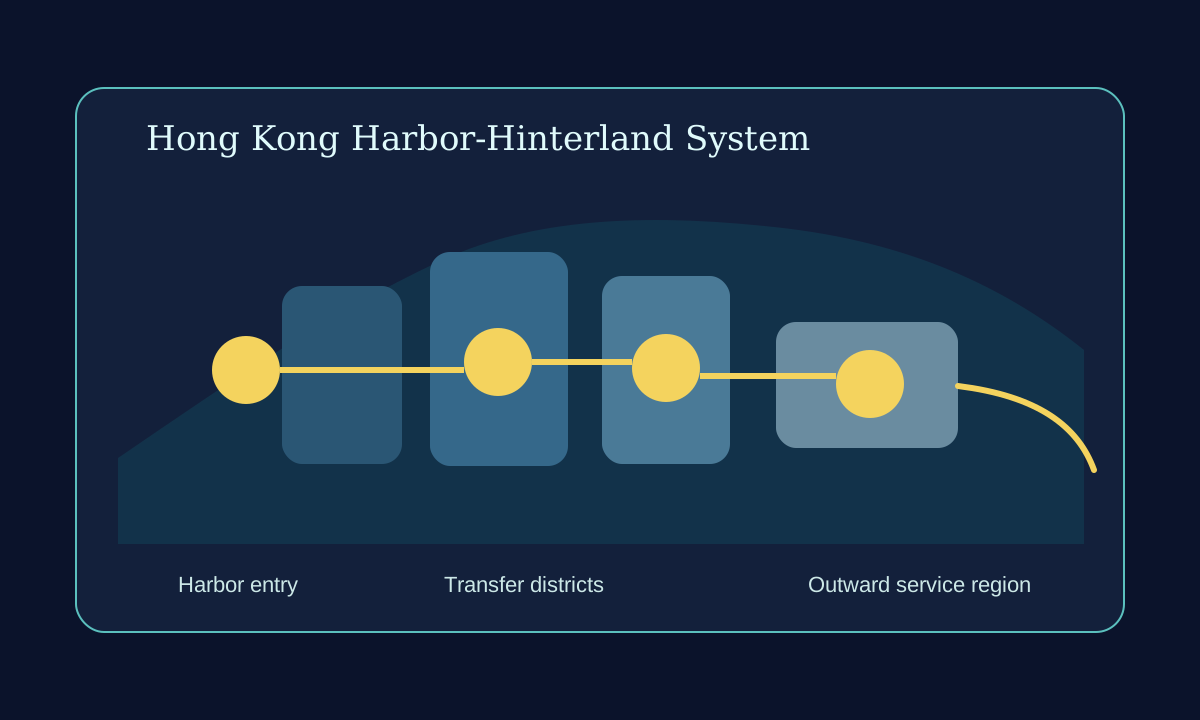
Hong Kong is best read as a harbor-hinterland system rather than only as a dense coastal city. The useful structural question is how a relatively compressed urban surface could clear large volumes of movement and then stay tightly coupled to a much broader manufacturing, labor, and service region.
That makes Hong Kong a strong city-scale case. The harbor edge, transfer districts, and outward service channels all mattered together. Without fast internal clearance and regional recoupling, the harbor alone would not explain the city's leverage.
Shows why the city had to clear large volumes through a compact internal surface instead of assuming the harbor itself solved throughput.
Hinterland Service RadiusClarifies that the real system extends as far as the city can still service, finance, and coordinate surrounding production.
City-Region Coupling ModelExplains the two-way dependence between urban clearance, labor concentration, and outward service to the wider region.
Unlike a classic canal empire or one protected lagoon gateway, Hong Kong shows how a compressed harbor surface can remain powerful by moving quickly between arrival, sorting, finance, warehousing, and outward service. The city does not need to absorb every productive step locally so long as it keeps the region tightly coupled through fast recirculation.
| Axis | Question | Signal |
|---|---|---|
| Compressed entry edge | Why could the city receive large flows without vast territorial depth? | Deep harbor access, rapid unloading, dense quays, fast broker transfer, layered maritime entry |
| District specialization | How did the city sort finance, warehousing, labor intake, and onward dispatch internally? | Dock districts, bonded yards, market towers, storage belts, ferry transfer corridors |
| Regional recoupling | Why did the harbor stay tied to a wider productive region instead of becoming a detached enclave? | Factory servicing, credit loops, commuter movement, feeder barges, truck clearance, supplier access |
| Selective permeability | Where did regulation and urban hierarchy create unequal friction? | Customs filtering, checkpoint regimes, property intensity, labor bottlenecks, priority lanes, black-market bypass |
Use the toggle to see why Hong Kong stays powerful only when clearance, district sorting, and outward service remain coupled.
Arrival clears quickly into specialized districts and then back outward into finance, labor, and supplier networks, so the harbor remains a compact but decisive regional machine.
The key lesson is that regional power does not require the city to contain every productive step physically. It requires the city to clear, sort, finance, and recouple enough flow that the wider region keeps treating it as the decisive interface. Hong Kong's compactness is therefore not a contradiction to its importance. It is part of the case, because the city proves how much leverage can be concentrated in a small but highly efficient harbor surface.
That also explains why district specialization matters so much. If arrivals jam at the edge or cannot be recoupled into labor, supplier, and financing networks quickly, the harbor becomes only a busy waterfront. The city becomes structurally important only when internal sorting and outward service remain synchronized.
The system usually weakens first through clearance drag or regional uncoupling rather than through the simple disappearance of ships. The edge can remain active while the wider service machine starts fraying. That distinction is useful because it separates visible throughput from actual city-region power. A busy harbor is not automatically a strong harbor-hinterland regime.
The reusable lesson is that harbor cities scale through clearance and recoupling, not by harbor position alone. Hong Kong is useful because it shows how a dense city can remain structurally decisive when throughput, district specialization, and hinterland service keep reinforcing one another.
Read what should come before it, what relation role matters next, and where this page should hand you off after the local graph is clear.
Start with Urban Throughput Surface and then return here once the surrounding concept stack is clear.
These entries clarify the footing underneath the current node before you move outward again. Start with Urban Throughput Surface when you want the clearest next role.
Use Guides when the study should feed into a worksheet or structured revision sequence.
4 handoff nodes stay inside Urban And Regional Coupling. 3 handoff nodes share Cross Scale.
Detail pages now expose the branch and scale of their surrounding graph before showing raw prerequisite and relation shelves, so continuation can stay taxonomy-led instead of adjacency-led.
Explain how cities work as filters, gateways, relays, conversion surfaces, and regional control machines.
Start with the urban logistics surface, step into gateway and throughput models, compare a port or capital study, then run a city-region worksheet.
Explain how resources, goods, labor, information, and force circulate, stall, buffer, and break.
Start from the resource-flow loop, trace storage and throughput models, compare one logistics study, then run a flow audit worksheet.
Explain how topology, region graphs, corridors, map abstraction, and scale determine movement and leverage.
Start in Spatial, reduce the map into region graph and corridor logic, test topology under disruption, then return through a spatial design guide.
Use this scale when the strongest explanation depends on several levels staying visible together.
Use this scale when city-scale transfer, concentration, or control is doing the main structural work.
Use this scale when routes, relays, buffers, and linked nodes matter more than territorial bulk.
Use prerequisites when you want the shortest path into the assumptions this page depends on.
A model for reading the city as a capacity surface where streets, quays, depots, crossings, and clearance routines set the real ceiling on urban flow.
A model for measuring how far a city can actually market, tax, repair, relieve, or police surrounding production before service quality and control degrade.
These groups explain why each neighboring node matters, whether it stabilizes the concept, operationalizes it, proves it, or pushes the lane further.
Use foundation relations when this node depends on a concept, term, or framing layer that should be explicit before you branch further.
A model for reading the city as a capacity surface where streets, quays, depots, crossings, and clearance routines set the real ceiling on urban flow.
A framework for reading movement as stacked road, river, sea, border, and administrative layers whose overlaps decide gateway leverage, rerouting options, and operating reach.
Use operationalizing relations when you want the current abstraction rendered as a cleaner model, loop, or structural device.
A model for tracing the two-way dependence between a city and its surrounding production, service, labor, and reserve network instead of treating the city as a self-contained center.
Use contrast relations when the difference between two nodes is more useful than simple adjacency or agreement.
A historical study of how canal transport, grain reserves, courier timing, and administrative corridors helped hold a large imperial system together unevenly.
These entries still matter, but they currently rely on generic adjacency instead of typed continuation semantics.
A model for measuring how far a city can actually market, tax, repair, relieve, or police surrounding production before service quality and control degrade.
A city whose importance comes from coordinating transfers between several movement layers rather than from local size alone.
Studies apply Spcent's lenses to complete cases. Read them to see whether geography, surplus, corridors, and pressure patterns still make sense when placed inside one setting.
The goal is not to retain setting trivia. The goal is to extract reusable patterns and structural habits you can reapply elsewhere.
Studies are strongest when you already know the frameworks and models underneath them, so you can recognize the structural moves being made.
After reading a study, identify which layer of your own draft needs work and go back there with one concrete change in mind.
Keep these collapsed until you want to turn the page into an active reading exercise.
What are the decisive regions, corridors, or chokepoints in this case?
What keeps the studied world stable, and what makes it brittle?
Which model or framework do I need next if I want to reproduce this pattern in my own project?
These routes are tuned to the kind of entry you are currently reading, so you can leave this page with one deliberate next move.
Use Guides when the study should feed into a worksheet or structured revision sequence.
Cross-layer moveReturn to the worlds module when the case highlights a weak worldbuilding layer in your own draft.
Cross-layer moveOpen models when the case reveals a mechanism you want to isolate and reuse directly.