Preparing the current spcent route.
The page shell is online. Shared content and route data are still being assembled.
A model for reading the city as a capacity surface where streets, quays, depots, crossings, and clearance routines set the real ceiling on urban flow.
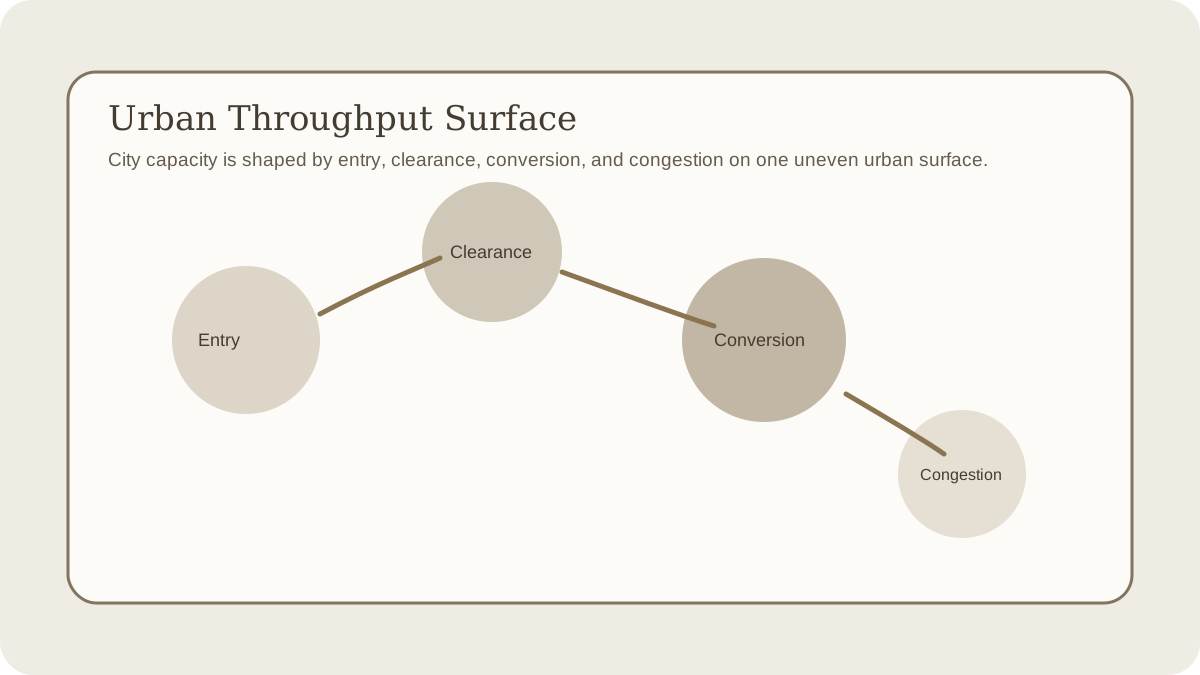
Regional flow does not enter a city at full speed and leave unchanged. It crosses an urban throughput surface where docks, streets, canal basins, bridges, depots, and inspection routines all add capacity limits. That surface determines whether a city behaves like a high-volume gateway or a chronic bottleneck.
This model matters because worlds often overestimate what a city can absorb simply by naming it a port, market, or capital. The real question is how much flow can actually clear the urban surface per cycle once loading, delay, congestion, and routing conflicts are counted.
| Axis | Question | Signal |
|---|---|---|
| Entry capacity | How much can physically arrive at the city edge in one cycle? | Dock slots, bridge width, quay cranes, barge stairs, road approaches, gate width |
| Internal clearance | How quickly can arrivals be sorted and moved beyond the first edge? | Cart lanes, canal branches, porter labor, bonded delay, tally routines, yard turnover |
| Buffer conversion | Where does throughput become storage, processing, or onward dispatch? | Warehouse rows, mill districts, transfer depots, craft quarters, reserve yards |
| Congestion spill | Where does overload start rerouting, delaying, or politically stressing the city? | Blocked quays, bridge queues, price spikes, tax delay, escort backlog, black-market bypass |
When demand rises, which surface saturates first: entry capacity, internal clearance, buffer conversion, or congestion spill? That first limit usually matters more than nominal regional abundance because it decides whether the city scales or clogs.
Ming Canal Logistics System is useful because the most important question is not only canal reach but where urban and administrative surfaces clear or delay massive grain throughput. Synthetic Desert Port Relay Empire is the stronger frontier comparison when a thin urban surface makes one relay city decisive for a much wider corridor.
The reusable lesson is that city power depends on internal throughput, not only on external position. Once the urban surface is explicit, congestion, reserve timing, and district specialization become operational rather than decorative.
Read what should come before it, what relation role matters next, and where this page should hand you off after the local graph is clear.
Start with Gateway District Stack and then return here once the surrounding concept stack is clear.
These entries clarify the footing underneath the current node before you move outward again. Start with Urban Logistics Surface Framework when you want the clearest next role.
Return to broader lenses when this model is too specific for the question you are asking.
2 handoff nodes stay inside Urban And Regional Coupling. 1 handoff nodes share Urban.
Detail pages now expose the branch and scale of their surrounding graph before showing raw prerequisite and relation shelves, so continuation can stay taxonomy-led instead of adjacency-led.
Explain how resources, goods, labor, information, and force circulate, stall, buffer, and break.
Start from the resource-flow loop, trace storage and throughput models, compare one logistics study, then run a flow audit worksheet.
Explain how cities work as filters, gateways, relays, conversion surfaces, and regional control machines.
Start with the urban logistics surface, step into gateway and throughput models, compare a port or capital study, then run a city-region worksheet.
Explain how technology, magic, infrastructure, communication, and transformation capacity rewrite baseline constraints.
Start with the operating regime, price the capability through diffusion or monopoly models, compare a regime-rewrite case, then run a capability sanity check.
Use this scale when routes, relays, buffers, and linked nodes matter more than territorial bulk.
Use this scale when internal city geometry or gateway-district filtering is the level that matters most.
Use this scale when city-scale transfer, concentration, or control is doing the main structural work.
Use prerequisites when you want the shortest path into the assumptions this page depends on.
A model for reading how quays, market courts, bonded yards, depot belts, and gate corridors stack inside a gateway city instead of collapsing into one abstract urban node.
The amount of material, people, information, or force that can pass through a route, system, or institution within a given time without breakdown.
These groups explain why each neighboring node matters, whether it stabilizes the concept, operationalizes it, proves it, or pushes the lane further.
Use foundation relations when this node depends on a concept, term, or framing layer that should be explicit before you branch further.
A framework for reading cities as transfer surfaces where gateways, districts, depots, servicing radius, and hinterland demand converge into one operational field.
Use applied relations when the next useful move is to see the current pattern survive inside a study or assembled world.
A historical study of how canal transport, grain reserves, courier timing, and administrative corridors helped hold a large imperial system together unevenly.
Use extension relations when the next move is not prerequisite or proof, but a deeper neighboring step in the same graph lane.
A model for reading how quays, market courts, bonded yards, depot belts, and gate corridors stack inside a gateway city instead of collapsing into one abstract urban node.
These entries still matter, but they currently rely on generic adjacency instead of typed continuation semantics.
A model for tracing how raw inputs become processed components, standardized output, and scalable capability through conversion bottlenecks rather than simple extraction.
The amount of material, people, information, or force that can pass through a route, system, or institution within a given time without breakdown.
A synthetic study of a route-control empire where licensed desert crossings, port relays, and selective border openness turn movement into administrative leverage.
Models formalize behavior. Use them when you need a concrete chain, loop, stress scenario, or layered mechanism that can be tested and reused.
A model should explain how something behaves over time or under pressure, not just identify a broad topic area.
When a setting feels plausible at rest but still behaves vaguely, models provide the explicit structure needed to test it.
A strong workflow often moves from broad lens to formal model to applied case reading.
Keep these collapsed until you want to turn the page into an active reading exercise.
What mechanism is this model making explicit?
Where does this model break or become most interesting under stress?
Which study would verify whether this model survives in a complete setting?
These routes are tuned to the kind of entry you are currently reading, so you can leave this page with one deliberate next move.
Return to broader lenses when this model is too specific for the question you are asking.
Cross-layer moveMove through the systems module when you want to navigate models by design intent.
Cross-layer moveVerify the model inside applied cases where multiple structures interact at once.