Preparing the current spcent route.
The page shell is online. Shared content and route data are still being assembled.
A model for tracing the two-way dependence between a city and its surrounding production, service, labor, and reserve network instead of treating the city as a self-contained center.
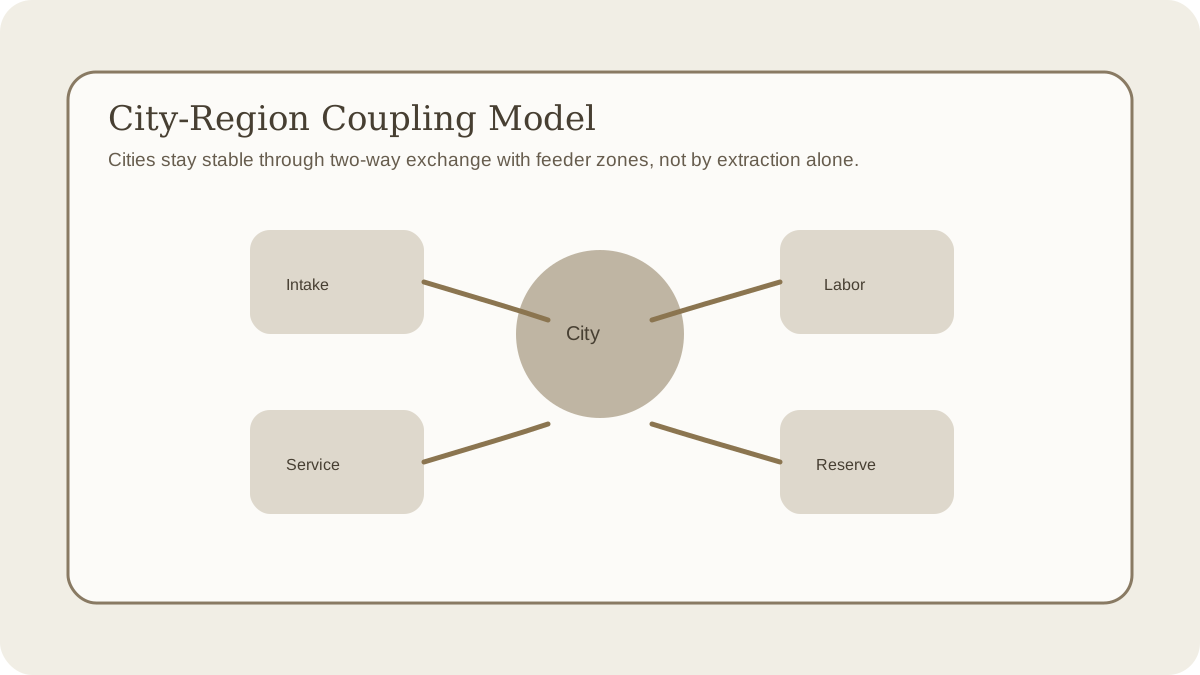
A city does not simply sit on top of a region and consume it. It remains stable through repeated two-way exchange with surrounding zones: food and raw material come inward, while markets, repairs, reserves, labor opportunities, and coercive response move back outward. The city-region coupling model keeps both directions visible.
This model matters when a city looks economically dominant but the wider region still behaves as if nothing depends on it, or when a city appears self-sufficient despite obvious dependence on feeder belts. Coupling is what distinguishes a true city-region system from a wealthy node floating above a decorative map.
| Axis | Question | Signal |
|---|---|---|
| Inward intake | What production and labor does the region send into the city repeatedly? | Staples, fuel, craft inputs, migrants, tax grain, toll revenue, draft animals |
| Outward service | What does the city return that keeps the region tied to it instead of drifting away? | Markets, repair, law, storage, credit, ritual, escorting, engineering crews |
| Reserve recursion | How do city buffers and regional shocks feed back into one another? | Granary drawdown, flood relief, price smoothing, reserve dispatch, famine migration |
| Differentiation pressure | How does coupling make zones specialize rather than remain uniform? | Feeder towns, craft belts, peri-urban farms, transport corridors, service satellites |
If the city extracts one step more than usual, what must increase outward to keep the coupling stable: repair, reserve release, escort, market access, or wages? If nothing must increase, the city-region relationship is probably under-modeled.
Synthetic Delta Trade Commonwealth is a strong example because node hierarchy and redistribution visibly couple rich ports to flood-exposed agrarian belts. River Port Polity is the tighter city-centered case where storage, coercion, and transport make the city's dependence on the surrounding corridor explicit.
The reusable lesson is that urbanization should be read as a coupling problem, not only a concentration problem. Once the channels are explicit, regional inequality, feeder specialization, and urban political strain become easier to diagnose.
Read what should come before it, what relation role matters next, and where this page should hand you off after the local graph is clear.
Start with Regional Systems Matrix and then return here once the surrounding concept stack is clear.
These entries clarify the footing underneath the current node before you move outward again. Start with Hinterland Service Radius when you want the clearest next role.
Return to broader lenses when this model is too specific for the question you are asking.
2 handoff nodes stay inside Urban And Regional Coupling. 1 handoff nodes share Cross Scale.
Detail pages now expose the branch and scale of their surrounding graph before showing raw prerequisite and relation shelves, so continuation can stay taxonomy-led instead of adjacency-led.
Explain how resources, goods, labor, information, and force circulate, stall, buffer, and break.
Start from the resource-flow loop, trace storage and throughput models, compare one logistics study, then run a flow audit worksheet.
Explain how cities work as filters, gateways, relays, conversion surfaces, and regional control machines.
Start with the urban logistics surface, step into gateway and throughput models, compare a port or capital study, then run a city-region worksheet.
Explain what the world is materially built from before politics, balance, or style are discussed.
Start in Worlds, read the anchor framework, open one regional model, validate with a complete study, then finish with a world assembly guide pass.
Use this scale when the region is the main leverage unit for settlement, extraction, governance, or conflict.
Use this scale when the strongest explanation depends on several levels staying visible together.
Use this scale when routes, relays, buffers, and linked nodes matter more than territorial bulk.
Use this scale when city-scale transfer, concentration, or control is doing the main structural work.
Use prerequisites when you want the shortest path into the assumptions this page depends on.
A planning frame for mapping how geography, settlement, resources, and transit form a region's structural identity.
A model for measuring how far a city can actually market, tax, repair, relieve, or police surrounding production before service quality and control degrade.
These groups explain why each neighboring node matters, whether it stabilizes the concept, operationalizes it, proves it, or pushes the lane further.
Use foundation relations when this node depends on a concept, term, or framing layer that should be explicit before you branch further.
A model for measuring how far a city can actually market, tax, repair, relieve, or police surrounding production before service quality and control degrade.
Use operationalizing relations when you want the current abstraction rendered as a cleaner model, loop, or structural device.
A model for how extraction, transport, storage, transformation, and redistribution create stability or fragility in a world system.
Use applied relations when the next useful move is to see the current pattern survive inside a study or assembled world.
A synthetic study of how monsoon timing, distributary routes, migration corridors, and node hierarchy combine into a dense delta polity with uneven but durable leverage.
Use extension relations when the next move is not prerequisite or proof, but a deeper neighboring step in the same graph lane.
A framework for reading cities as transfer surfaces where gateways, districts, depots, servicing radius, and hinterland demand converge into one operational field.
These entries still matter, but they currently rely on generic adjacency instead of typed continuation semantics.
A planning frame for mapping how geography, settlement, resources, and transit form a region's structural identity.
A systems study of how estuaries, port warehousing, and toll control create a state that is wealthy, connective, and strategically exposed.
Models formalize behavior. Use them when you need a concrete chain, loop, stress scenario, or layered mechanism that can be tested and reused.
A model should explain how something behaves over time or under pressure, not just identify a broad topic area.
When a setting feels plausible at rest but still behaves vaguely, models provide the explicit structure needed to test it.
A strong workflow often moves from broad lens to formal model to applied case reading.
Keep these collapsed until you want to turn the page into an active reading exercise.
What mechanism is this model making explicit?
Where does this model break or become most interesting under stress?
Which study would verify whether this model survives in a complete setting?
These routes are tuned to the kind of entry you are currently reading, so you can leave this page with one deliberate next move.
Return to broader lenses when this model is too specific for the question you are asking.
Cross-layer moveMove through the systems module when you want to navigate models by design intent.
Cross-layer moveVerify the model inside applied cases where multiple structures interact at once.