Preparing the current spcent route.
The page shell is online. Shared content and route data are still being assembled.
A city whose importance comes from coordinating transfers between several movement layers rather than from local size alone.
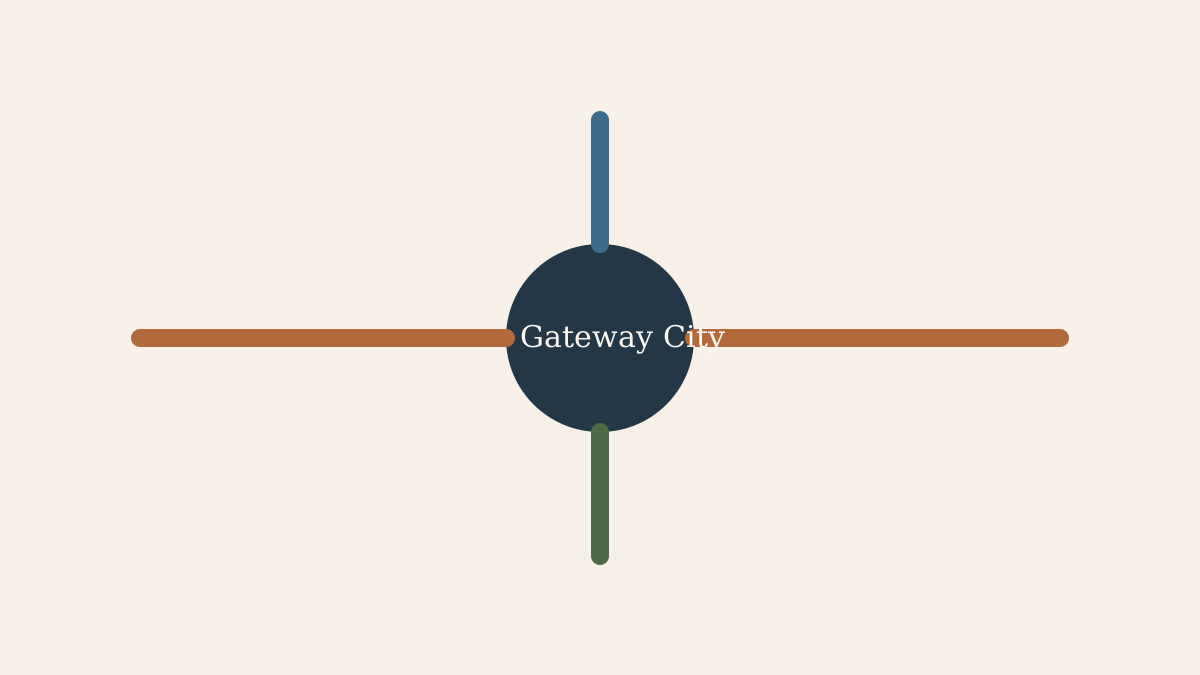
A gateway city is a transfer node where several movement layers meet and must be coordinated. Its power comes less from local population alone than from controlling how cargo, people, authority, or information change modes across the wider network.
Gateway cities concentrate leverage because delay, taxation, escorting, warehousing, and inspection all become easier to stage where transfer is unavoidable. They often sit at river mouths, pass exits, strait harbors, rail breaks, or major customs thresholds.
A gateway city is not just a large city, a capital, or a prosperous port. Its defining feature is transfer dependency. If the wider network can bypass it cheaply, the city may be important without actually functioning as a gateway.
If removing one city would force several separate route layers to reroute, fragment, or lose visibility at once, you are likely looking at a gateway city rather than an ordinary market center. Customs concentration, warehousing depth, multimodal queues, and escort coordination are common signals.
A river-mouth city where inland barges unload to sea convoys and customs officers process both flows is acting as a gateway city because route conversion happens there, not just local trade. The city matters because several movement systems have to acknowledge it. That dependence is what gives the node durable leverage.
The city's size may grow later, but the gateway role comes first. Transfer necessity is what lets population, warehousing, and taxation accumulate around it so persistently. Its later urban weight is usually the consequence of that earlier routing role. The city becomes indispensable because movement cannot stay layered without passing through it. Its leverage is therefore operational before it is demographic.
Places the city inside a stack of road, river, sea, border, and administrative layers.
Urban Node HierarchyShows why some cities coordinate several roles at once while others remain feeder settlements.
The Expanse Belt-Core Dependency SystemApplies the idea to orbital gateways and transfer dependence across a core-periphery system.
Read what should come before it, what relation role matters next, and where this page should hand you off after the local graph is clear.
No prerequisite chain is currently required, which makes this page a valid graph entry point for the current topic.
Use Multi-Layer Mobility Framework or the linked nodes below when you want to compare this page against neighboring parts of the graph.
Many glossary abstractions become richer when viewed inside the spatial module.
1 handoff nodes stay inside Urban And Regional Coupling. 1 handoff nodes share Urban.
Detail pages now expose the branch and scale of their surrounding graph before showing raw prerequisite and relation shelves, so continuation can stay taxonomy-led instead of adjacency-led.
Explain how resources, goods, labor, information, and force circulate, stall, buffer, and break.
Start from the resource-flow loop, trace storage and throughput models, compare one logistics study, then run a flow audit worksheet.
Explain how topology, region graphs, corridors, map abstraction, and scale determine movement and leverage.
Start in Spatial, reduce the map into region graph and corridor logic, test topology under disruption, then return through a spatial design guide.
Explain how cities work as filters, gateways, relays, conversion surfaces, and regional control machines.
Start with the urban logistics surface, step into gateway and throughput models, compare a port or capital study, then run a city-region worksheet.
Use this scale when the strongest explanation depends on several levels staying visible together.
Use this scale when routes, relays, buffers, and linked nodes matter more than territorial bulk.
Use this scale when city-scale transfer, concentration, or control is doing the main structural work.
No prerequisite chain is currently required, so you can continue from here into relation paths or cross-layer handoff.
This page has no prerequisite chain yet. Treat it as a start node, then branch outward through typed relation paths or cross-layer handoff below.
This entry still relies on generic related links. That works as a fallback, but typed relation roles would make continuation clearer.
A framework for reading movement as stacked road, river, sea, border, and administrative layers whose overlaps decide gateway leverage, rerouting options, and operating reach.
A model for how relay settlements, market towns, ports, capitals, and depot cities differentiate by throughput, storage, administration, and coordination load.
A model for reading straits, island chains, convoy arcs, and port ladders as one network where sea-lane leverage depends on sequencing as much as on any single port.
Glossary entries define Spcent's shared vocabulary. They are conceptual anchors designed to stabilize how an abstraction is used across pages and modules.
A glossary term should lock down what a phrase means so later reading is not burdened by ambiguity.
When you know the concept but not yet the best framework or model, start here and then move outward through related nodes.
A useful definition points toward the frameworks, models, and studies that actually use the term in context.
Keep these collapsed until you want to turn the page into an active reading exercise.
What question becomes easier once this term is precisely defined?
Which entries in the graph are using this abstraction operationally rather than only naming it?
Do I need a framework, model, or study next to see this concept in action?
These routes are tuned to the kind of entry you are currently reading, so you can leave this page with one deliberate next move.
Many glossary abstractions become richer when viewed inside the spatial module.
Cross-layer moveMove into frameworks when you want a planning lens built on top of the term.
Cross-layer moveSearch across the graph to find every place the concept currently appears.