Preparing the current spcent route.
The page shell is online. Shared content and route data are still being assembled.
A model for measuring how far a city can actually market, tax, repair, relieve, or police surrounding production before service quality and control degrade.
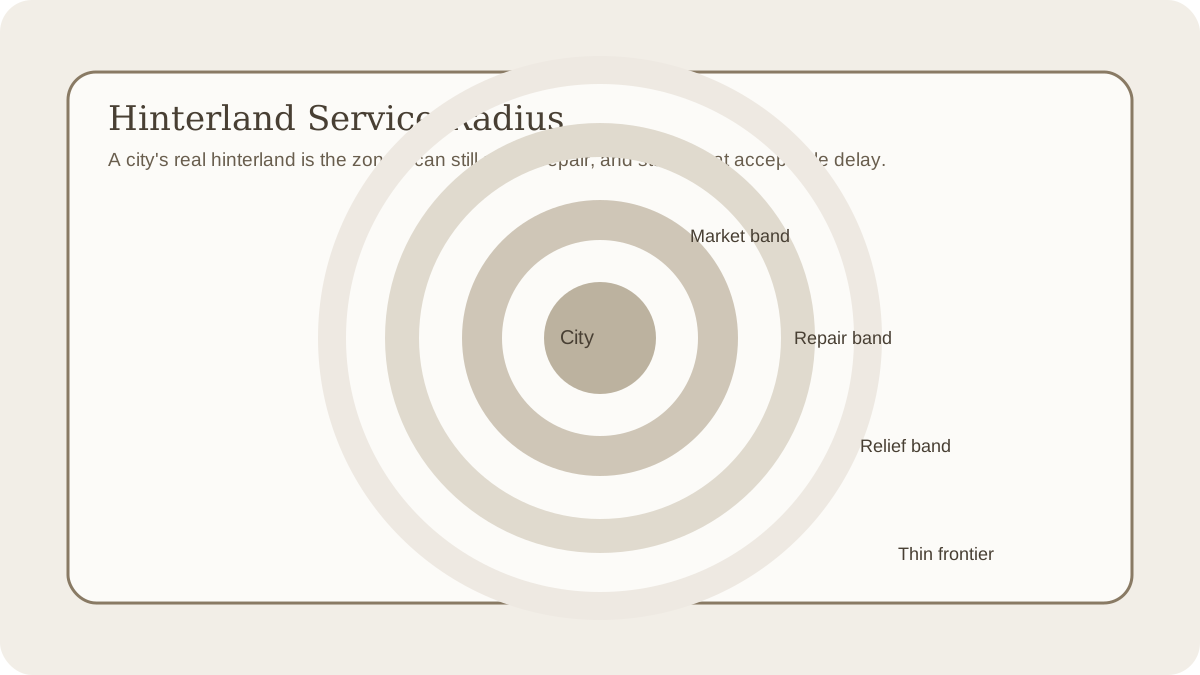
A city's hinterland is not only the land that produces for it. It is the zone the city can actually serve with markets, repairs, storage, relief, tax collection, and coercive response at acceptable delay and cost. The hinterland service radius turns that relationship into a measurable field rather than a vague colored region.
This model matters because worlds often assign enormous hinterlands to major cities without showing how service quality changes with distance, terrain, or route reliability. A city that can buy grain from far away may still be unable to police, repair, or relieve that same zone effectively.
| Axis | Question | Signal |
|---|---|---|
| Core market band | Where does exchange remain fast and routine enough to shape everyday production choices? | Day market reach, feeder cart routes, regular river trips, price integration, crop timing alignment |
| Repair and maintenance band | How far can tools, depots, crews, and replacements be dispatched without chronic lag? | Workshop service roads, canal maintenance loops, escortable depots, seasonal repair circuits |
| Relief and reserve band | Where can the city still stabilize shock before scarcity becomes local crisis? | Granary release, emergency tow, reserve wagons, flood relief reach, requisition timing |
| Thin frontier band | Where does service still exist on paper but become too slow, expensive, or intermittent to bind the zone tightly? | Delayed response, toll inflation, weak inspections, irregular markets, dependence on local brokers |
If one peripheral zone suffers crop loss, flood damage, or route disruption, does the city still reach it with repairs and reserves in time to matter? The answer shows the real service radius better than nominal tax or map claims.
Nile Flood Basin State is useful because river timing and hydraulic maintenance make service reach highly seasonal but still structurally legible. Mountain Basin Civilization is the contrast case where enclosure strengthens the core but causes service reach to thin rapidly once routes leave the basin.
The reusable lesson is that city-region coupling should be measured through service quality, not only extraction. Once service radius is explicit, core zones, neglected peripheries, and relief politics become much easier to justify.
Read what should come before it, what relation role matters next, and where this page should hand you off after the local graph is clear.
Start with Urban Node Hierarchy and then return here once the surrounding concept stack is clear.
These entries make the current idea more explicit and more reusable. Start with Communication Latency Regime when you want the clearest next role.
Return to broader lenses when this model is too specific for the question you are asking.
2 handoff nodes stay inside Urban And Regional Coupling. No handoff nodes currently share Cross Scale.
Detail pages now expose the branch and scale of their surrounding graph before showing raw prerequisite and relation shelves, so continuation can stay taxonomy-led instead of adjacency-led.
Explain what the world is materially built from before politics, balance, or style are discussed.
Start in Worlds, read the anchor framework, open one regional model, validate with a complete study, then finish with a world assembly guide pass.
Explain how cities work as filters, gateways, relays, conversion surfaces, and regional control machines.
Start with the urban logistics surface, step into gateway and throughput models, compare a port or capital study, then run a city-region worksheet.
Explain how technology, magic, infrastructure, communication, and transformation capacity rewrite baseline constraints.
Start with the operating regime, price the capability through diffusion or monopoly models, compare a regime-rewrite case, then run a capability sanity check.
Use this scale when the region is the main leverage unit for settlement, extraction, governance, or conflict.
Use this scale when routes, relays, buffers, and linked nodes matter more than territorial bulk.
Use this scale when city-scale transfer, concentration, or control is doing the main structural work.
Use prerequisites when you want the shortest path into the assumptions this page depends on.
A model for how relay settlements, market towns, ports, capitals, and depot cities differentiate by throughput, storage, administration, and coordination load.
A route whose main importance lies in keeping orders, permits, reserves, and repair capacity moving reliably enough for governance to hold.
These groups explain why each neighboring node matters, whether it stabilizes the concept, operationalizes it, proves it, or pushes the lane further.
Use operationalizing relations when you want the current abstraction rendered as a cleaner model, loop, or structural device.
A model for explaining how courier time, relay density, verification delay, and command visibility reshape coordination, legitimacy, and operational response.
Use applied relations when the next useful move is to see the current pattern survive inside a study or assembled world.
A historical study of how flood timing, basin irrigation, grain storage, and hydraulic maintenance let a river civilization turn annual renewal into durable state capacity.
Use extension relations when the next move is not prerequisite or proof, but a deeper neighboring step in the same graph lane.
A framework for reading cities as transfer surfaces where gateways, districts, depots, servicing radius, and hinterland demand converge into one operational field.
These entries still matter, but they currently rely on generic adjacency instead of typed continuation semantics.
A model for tracing how staples, fuel, fodder, labor conversion, and storage create the recurring intake that makes density and surplus possible.
A route whose main importance lies in keeping orders, permits, reserves, and repair capacity moving reliably enough for governance to hold.
A sample systems study showing how basin agriculture, defensive ridges, and narrow passes produce a dense but brittle civilization pattern.
Models formalize behavior. Use them when you need a concrete chain, loop, stress scenario, or layered mechanism that can be tested and reused.
A model should explain how something behaves over time or under pressure, not just identify a broad topic area.
When a setting feels plausible at rest but still behaves vaguely, models provide the explicit structure needed to test it.
A strong workflow often moves from broad lens to formal model to applied case reading.
Keep these collapsed until you want to turn the page into an active reading exercise.
What mechanism is this model making explicit?
Where does this model break or become most interesting under stress?
Which study would verify whether this model survives in a complete setting?
These routes are tuned to the kind of entry you are currently reading, so you can leave this page with one deliberate next move.
Return to broader lenses when this model is too specific for the question you are asking.
Cross-layer moveMove through the systems module when you want to navigate models by design intent.
Cross-layer moveVerify the model inside applied cases where multiple structures interact at once.