Preparing the current spcent route.
The page shell is online. Shared content and route data are still being assembled.
A model for how repeated displacement, opportunity seeking, and frontier movement consolidate into durable corridors that reshape identity, labor, and political load.
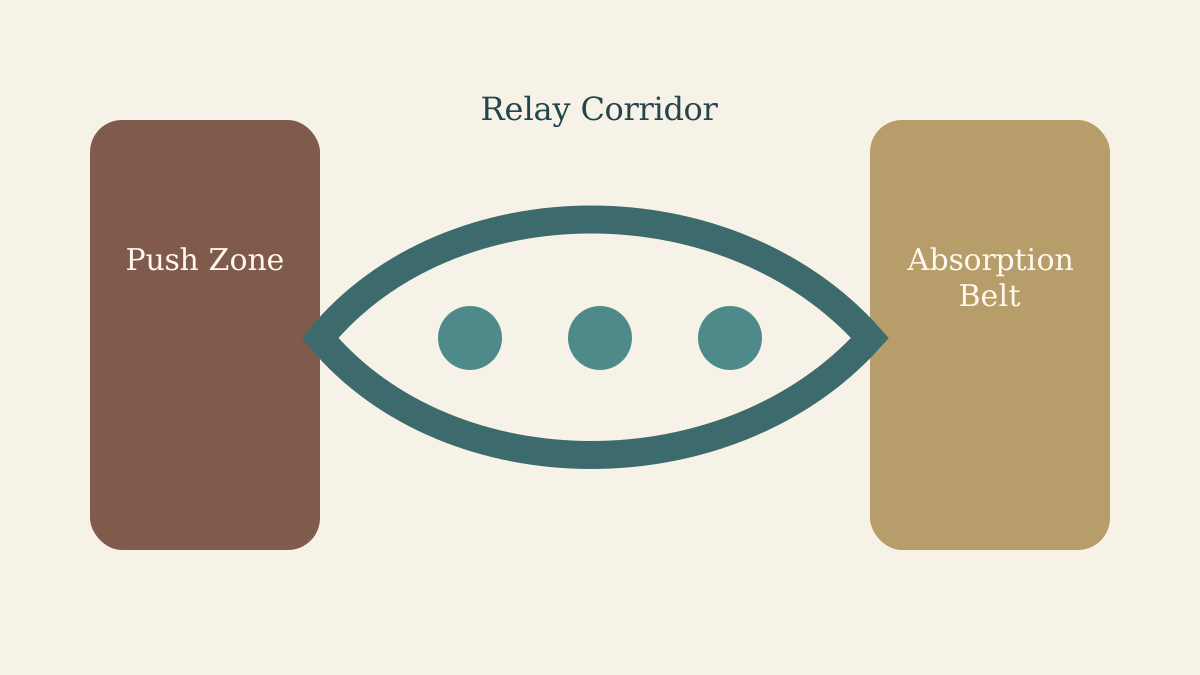
Migration is rarely a uniform wave. It usually resolves into corridors where pressure, safety, labor demand, and route familiarity align often enough to make repeated movement legible. Those corridors then begin reshaping border density, urban hierarchy, military concern, and identity politics.
The model is useful when a world needs to explain why certain routes become demographic arteries while others stay incidental. A migration corridor is not only a path; it is a repeated social and logistical pattern.
| Axis | Question | Signal |
|---|---|---|
| Push pressure | What repeatedly makes departure rational or necessary? | Climate stress, enclosure, taxation, war, labor eviction, grazing collapse |
| Route familiarity | Why does movement keep reusing the same path instead of diffusing randomly? | Relay kinship, ford knowledge, caravan routines, escort markets, border gaps |
| Absorption threshold | Where can incoming movement actually settle, work, or buffer? | Harvest labor zones, port belts, military colonies, market towns, frontier farms |
| Political load | How does repeated movement alter taxation, defense, and identity management? | Settlement rights, customs drag, policing belts, garrison growth, elite bargaining |
Migration corridors become especially useful when a setting needs to explain why frontier pressure and urban change arrive through the same route repeatedly. A closed pass, stricter customs regime, or new river crossing rarely stops movement entirely; it redirects where settlement stress appears first.
Use this when the main question is where movement keeps thickening into exposed contact zones.
Urban Node HierarchyUse this when repeated migration starts reorganizing towns, depots, and capitals unevenly along the route.
Steppe Granary MarchesUse this as an applied case for movement, storage, and frontier absorption pressure interacting across one route system.
The reusable lesson is that migration becomes world-shaping when it keeps selecting the same corridor. Once that corridor is visible, settlement change, military anxiety, elite bargaining, and identity friction all become easier to place and sequence.
Read what should come before it, what relation role matters next, and where this page should hand you off after the local graph is clear.
Start with Corridor and then return here once the surrounding concept stack is clear.
These entries clarify the footing underneath the current node before you move outward again. Start with Corridor when you want the clearest next role.
Return to broader lenses when this model is too specific for the question you are asking.
No handoff nodes currently stay inside Flow And Logistics. 2 handoff nodes share Network.
Detail pages now expose the branch and scale of their surrounding graph before showing raw prerequisite and relation shelves, so continuation can stay taxonomy-led instead of adjacency-led.
Explain how legitimacy, coercion, administrative reach, frontier bargaining, and elite control are structured.
Start with the pressure map, locate legitimacy and capture mechanisms, validate against a frontier or state case, then run a governance stress test.
Explain how topology, region graphs, corridors, map abstraction, and scale determine movement and leverage.
Start in Spatial, reduce the map into region graph and corridor logic, test topology under disruption, then return through a spatial design guide.
Explain what the world is materially built from before politics, balance, or style are discussed.
Start in Worlds, read the anchor framework, open one regional model, validate with a complete study, then finish with a world assembly guide pass.
Use this scale when the region is the main leverage unit for settlement, extraction, governance, or conflict.
Use this scale when routes, relays, buffers, and linked nodes matter more than territorial bulk.
Use this scale when the whole world model or planetary constraint pattern should stay visible at once.
Use prerequisites when you want the shortest path into the assumptions this page depends on.
A durable movement spine where terrain, settlement, exchange, and repeated transit align strongly enough to guide long-run circulation.
A broad transition band where direct control, corridor security, settlement density, and competing claims remain structurally unstable.
These groups explain why each neighboring node matters, whether it stabilizes the concept, operationalizes it, proves it, or pushes the lane further.
Use foundation relations when this node depends on a concept, term, or framing layer that should be explicit before you branch further.
A durable movement spine where terrain, settlement, exchange, and repeated transit align strongly enough to guide long-run circulation.
Use operationalizing relations when you want the current abstraction rendered as a cleaner model, loop, or structural device.
A layered model for understanding how roads, rivers, passes, and market towns align into durable spatial corridors.
Use applied relations when the next useful move is to see the current pattern survive inside a study or assembled world.
An assembled example world showing how irrigated granary cores, horse-frontier mobility, and fortified corridor towns create a political field of repeated expansion and recoil.
These entries still matter, but they currently rely on generic adjacency instead of typed continuation semantics.
A framework for reading a world from climate rhythm, terrain friction, habitability, circulation, and settlement thresholds before higher-order institutions are added.
A broad transition band where direct control, corridor security, settlement density, and competing claims remain structurally unstable.
The ranked structure by which some routes function as primary spines while others act as feeder, secondary, seasonal, or fallback paths.
Models formalize behavior. Use them when you need a concrete chain, loop, stress scenario, or layered mechanism that can be tested and reused.
A model should explain how something behaves over time or under pressure, not just identify a broad topic area.
When a setting feels plausible at rest but still behaves vaguely, models provide the explicit structure needed to test it.
A strong workflow often moves from broad lens to formal model to applied case reading.
Keep these collapsed until you want to turn the page into an active reading exercise.
What mechanism is this model making explicit?
Where does this model break or become most interesting under stress?
Which study would verify whether this model survives in a complete setting?
These routes are tuned to the kind of entry you are currently reading, so you can leave this page with one deliberate next move.
Return to broader lenses when this model is too specific for the question you are asking.
Cross-layer moveMove through the systems module when you want to navigate models by design intent.
Cross-layer moveVerify the model inside applied cases where multiple structures interact at once.