Preparing the current spcent route.
The page shell is online. Shared content and route data are still being assembled.
A model for how local crop shortfall escalates into price stress, labor reallocation, migration, reserve drawdown, and wider political crisis.
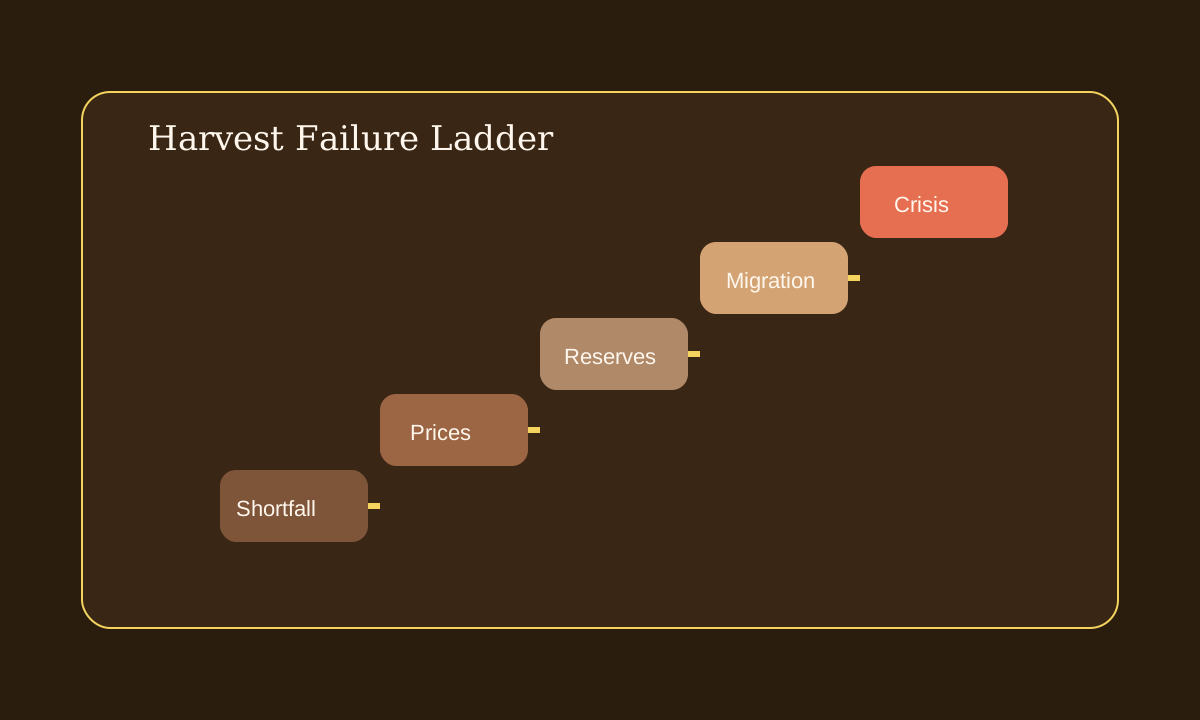
A failed harvest does not become famine in one jump. It usually climbs a ladder. Local shortfall raises prices, changes labor and fodder allocation, drains reserves, alters migration behavior, and only then begins to threaten wider political stability. The harvest failure ladder keeps those steps visible.
This model matters because worlds often move directly from poor weather to social collapse without showing the intervening stages. A believable harvest crisis changes storage decisions, trade routes, debt, movement restrictions, and who is forced to move first.
| Axis | Question | Signal |
|---|---|---|
| Local shortfall | Where does production first underperform relative to ordinary expectation? | Crop loss, pasture weakness, irrigation miss, blight, late rains, seed damage |
| Price and ration stress | How does scarcity first show up in ordinary exchange? | Market spikes, fodder diversion, ration cuts, debt pressure, storage hoarding |
| Reserve drawdown | When does the system begin spending stored stability to prevent wider damage? | Granary release, tax deferral, herd slaughter, emergency imports, seed reserve use |
| Migration and labor shift | Who moves or changes work first when reserves no longer stabilize the local zone? | Seasonal flight, wage drift, farm abandonment, relief camps, caravan labor, urban inflow |
| Political crisis | What becomes harder to govern once harvest failure leaves the agricultural layer? | Relief overload, legitimacy strain, riot risk, tax collapse, border leakage, coercive overreach |
At which rung does the system stop absorbing the shock locally and begin exporting it through price, migration, or coercion? That threshold explains whether a harvest failure remains painful but ordinary or becomes system-defining.
Dust Bowl Migration Ecology makes the ladder clear because crop loss becomes debt, abandonment, migration, and regional labor reshaping rather than one simple famine event. The model also works for drought basins, blight-prone monocrops, and frontier grain belts where reserves and credit matter as much as rainfall.
The reusable lesson is that harvest failure should be modeled as an escalation path. Once the ladder is explicit, famine, migration, reserve politics, and coercive response stop feeling arbitrary.
Read what should come before it, what relation role matters next, and where this page should hand you off after the local graph is clear.
Start with Food Energy Base Model and then return here once the surrounding concept stack is clear.
These entries clarify the footing underneath the current node before you move outward again. Start with Food Energy Base Model when you want the clearest next role.
Return to broader lenses when this model is too specific for the question you are asking.
3 handoff nodes stay inside Evolution And Breakdown. 3 handoff nodes share Regional.
Detail pages now expose the branch and scale of their surrounding graph before showing raw prerequisite and relation shelves, so continuation can stay taxonomy-led instead of adjacency-led.
Explain transition, disturbance, collapse, recovery, and reassembly across eras and stress cycles.
Start with transformation and failure models, trace residue and recovery paths, compare a collapse or successor-order study, then run a failure-mode review.
Explain how resources, goods, labor, information, and force circulate, stall, buffer, and break.
Start from the resource-flow loop, trace storage and throughput models, compare one logistics study, then run a flow audit worksheet.
Explain what the world is materially built from before politics, balance, or style are discussed.
Start in Worlds, read the anchor framework, open one regional model, validate with a complete study, then finish with a world assembly guide pass.
Use this scale when the region is the main leverage unit for settlement, extraction, governance, or conflict.
Use this scale when routes, relays, buffers, and linked nodes matter more than territorial bulk.
Use this scale when the strongest explanation depends on several levels staying visible together.
Use prerequisites when you want the shortest path into the assumptions this page depends on.
A model for tracing how staples, fuel, fodder, labor conversion, and storage create the recurring intake that makes density and surplus possible.
A model for locating where reserves are stored, who can release them, and how fast they can stabilize the wider system under delay, shock, or surge.
These groups explain why each neighboring node matters, whether it stabilizes the concept, operationalizes it, proves it, or pushes the lane further.
Use foundation relations when this node depends on a concept, term, or framing layer that should be explicit before you branch further.
A model for tracing how staples, fuel, fodder, labor conversion, and storage create the recurring intake that makes density and surplus possible.
Use operationalizing relations when you want the current abstraction rendered as a cleaner model, loop, or structural device.
A model for how fires, floods, storms, pest waves, and disease pulses repeatedly reset ecological and settlement stability before recovery rebuilds density.
Use applied relations when the next useful move is to see the current pattern survive inside a study or assembled world.
A historical study of how soil loss, harvest collapse, debt pressure, and migration turned ecological disturbance into a long recovery problem rather than one bad season.
Use extension relations when the next move is not prerequisite or proof, but a deeper neighboring step in the same graph lane.
A model for locating where reserves are stored, who can release them, and how fast they can stabilize the wider system under delay, shock, or surge.
These entries still matter, but they currently rely on generic adjacency instead of typed continuation semantics.
A model for how raw surplus becomes taxable, storable, and politically controllable through successive layers of capture.
A model for how corridors, ports, barracks, migration pulses, and immunity mismatch turn movement systems into repeating health pressure.
Models formalize behavior. Use them when you need a concrete chain, loop, stress scenario, or layered mechanism that can be tested and reused.
A model should explain how something behaves over time or under pressure, not just identify a broad topic area.
When a setting feels plausible at rest but still behaves vaguely, models provide the explicit structure needed to test it.
A strong workflow often moves from broad lens to formal model to applied case reading.
Keep these collapsed until you want to turn the page into an active reading exercise.
What mechanism is this model making explicit?
Where does this model break or become most interesting under stress?
Which study would verify whether this model survives in a complete setting?
These routes are tuned to the kind of entry you are currently reading, so you can leave this page with one deliberate next move.
Return to broader lenses when this model is too specific for the question you are asking.
Cross-layer moveMove through the systems module when you want to navigate models by design intent.
Cross-layer moveVerify the model inside applied cases where multiple structures interact at once.