Preparing the current spcent route.
The page shell is online. Shared content and route data are still being assembled.
A model for how repeating weather and seasonal windows structure labor, harvest timing, travel reliability, and crisis pacing across a world.
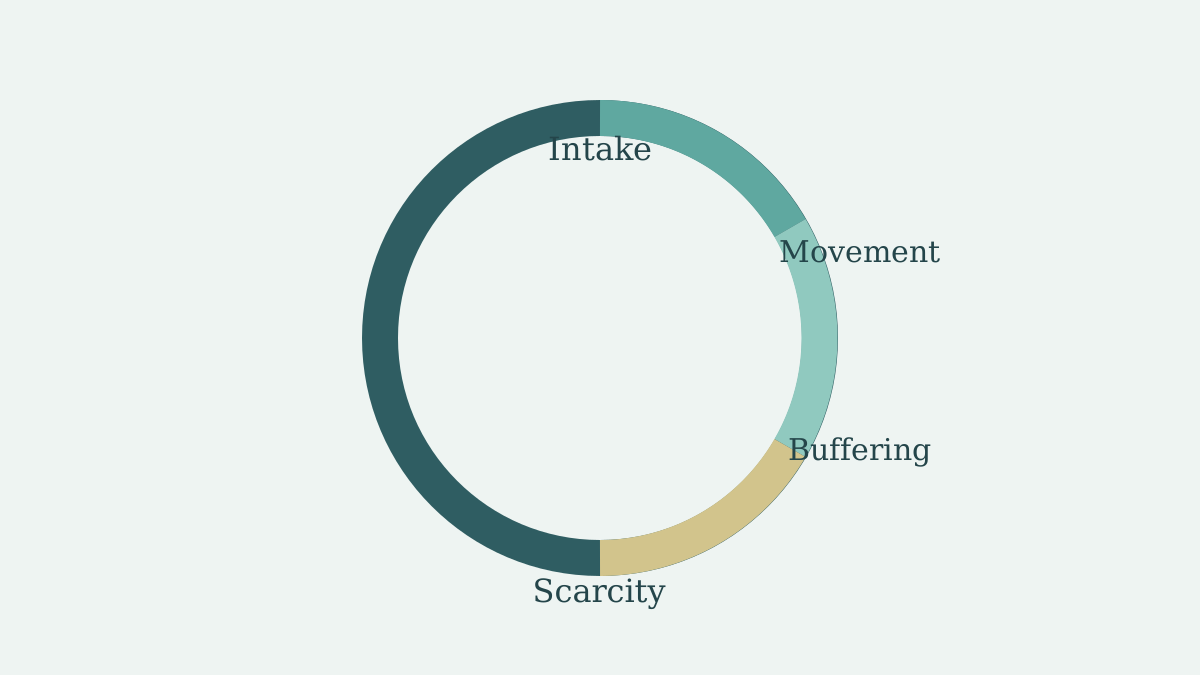
Climate becomes structurally important when it repeats. A single flood, freeze, or dry season is an event. A repeating flood, freeze, or dry season is a rhythm that reorganizes labor, travel, storage, and political anxiety every cycle.
The model turns climate into a timing system. Instead of asking whether a world is warm, cold, wet, or dry in the abstract, ask when movement is cheap, when harvest is possible, when reserves are drawn down, and when delayed pressure becomes visible.
Identify the period when water, heat, labor, or pollination make primary production possible.
Mark when roads, rivers, sea lanes, or passes become reliable enough for redistribution and exchange.
Show when societies store, ration, or hedge against the coming hostile part of the cycle.
Name the part of the year when shortages, disease, labor drag, or isolation become most visible.
| Axis | Question | Signal |
|---|---|---|
| Production window | When can the world produce surplus at all? | Planting season, thaw, flood retreat, monsoon arrival, storm lull |
| Transit window | When can routes move at low enough cost to matter systemically? | Dry roads, navigable channels, calm seas, open passes, caravan season |
| Storage window | When must reserves be built, rotated, or defended? | Granary fill, fuel stacking, salting, cistern refill, depot consolidation |
| Scarcity window | When does delayed pressure become politically visible? | Hunger months, winter exhaustion, disease bloom, transit lock, fodder gap |
Worlds usually misuse climate in one of two ways: either the cycle never affects labor and movement at all, or it produces spectacle without altering the timing of storage and authority. The diagnostic question is simple: if a climate window vanished for one cycle, who would feel it first and where?
The reusable lesson is that climate should create a recurring schedule of opportunity and exposure. Once the cycle is explicit, harvest timing, convoy movement, levy readiness, and frontier vulnerability stop feeling arbitrary.
Read what should come before it, what relation role matters next, and where this page should hand you off after the local graph is clear.
Start with Habitat Carrying Gradient and then return here once the surrounding concept stack is clear.
These entries clarify the footing underneath the current node before you move outward again. Start with World Constraint Stack when you want the clearest next role.
Return to broader lenses when this model is too specific for the question you are asking.
4 handoff nodes stay inside World Foundations. 1 handoff nodes share World.
Detail pages now expose the branch and scale of their surrounding graph before showing raw prerequisite and relation shelves, so continuation can stay taxonomy-led instead of adjacency-led.
Explain what the world is materially built from before politics, balance, or style are discussed.
Start in Worlds, read the anchor framework, open one regional model, validate with a complete study, then finish with a world assembly guide pass.
Explain how technology, magic, infrastructure, communication, and transformation capacity rewrite baseline constraints.
Start with the operating regime, price the capability through diffusion or monopoly models, compare a regime-rewrite case, then run a capability sanity check.
Use this scale when the region is the main leverage unit for settlement, extraction, governance, or conflict.
Use this scale when routes, relays, buffers, and linked nodes matter more than territorial bulk.
Use this scale when city-scale transfer, concentration, or control is doing the main structural work.
Use this scale when the whole world model or planetary constraint pattern should stay visible at once.
Use prerequisites when you want the shortest path into the assumptions this page depends on.
A model for mapping how water, temperature, soil renewal, shelter, and disturbance tolerance create uneven ecological carrying capacity across a world.
These groups explain why each neighboring node matters, whether it stabilizes the concept, operationalizes it, proves it, or pushes the lane further.
Use foundation relations when this node depends on a concept, term, or framing layer that should be explicit before you branch further.
A framework for reading a world from climate rhythm, terrain friction, habitability, circulation, and settlement thresholds before higher-order institutions are added.
Use operationalizing relations when you want the current abstraction rendered as a cleaner model, loop, or structural device.
A framework for reading how terrain friction and access gradients shape where settlement density can sustainably accumulate.
Use applied relations when the next useful move is to see the current pattern survive inside a study or assembled world.
A game study of how heat radius, labor sacrifice, storage timing, and moral policy turn Frostpunk into a compact model of survival governance under extreme climatic pressure.
These entries still matter, but they currently rely on generic adjacency instead of typed continuation semantics.
A model for mapping how water, temperature, soil renewal, shelter, and disturbance tolerance create uneven ecological carrying capacity across a world.
A model for tracing how food chains, pollination, disease buffering, draft power, and freshwater renewal link species and human settlement into one interdependent living system.
Models formalize behavior. Use them when you need a concrete chain, loop, stress scenario, or layered mechanism that can be tested and reused.
A model should explain how something behaves over time or under pressure, not just identify a broad topic area.
When a setting feels plausible at rest but still behaves vaguely, models provide the explicit structure needed to test it.
A strong workflow often moves from broad lens to formal model to applied case reading.
Keep these collapsed until you want to turn the page into an active reading exercise.
What mechanism is this model making explicit?
Where does this model break or become most interesting under stress?
Which study would verify whether this model survives in a complete setting?
These routes are tuned to the kind of entry you are currently reading, so you can leave this page with one deliberate next move.
Return to broader lenses when this model is too specific for the question you are asking.
Cross-layer moveMove through the systems module when you want to navigate models by design intent.
Cross-layer moveVerify the model inside applied cases where multiple structures interact at once.