Preparing the current spcent route.
The page shell is online. Shared content and route data are still being assembled.
A model for how potable water, irrigation, flood control, drainage, and navigability bind settlement density to water management burden.
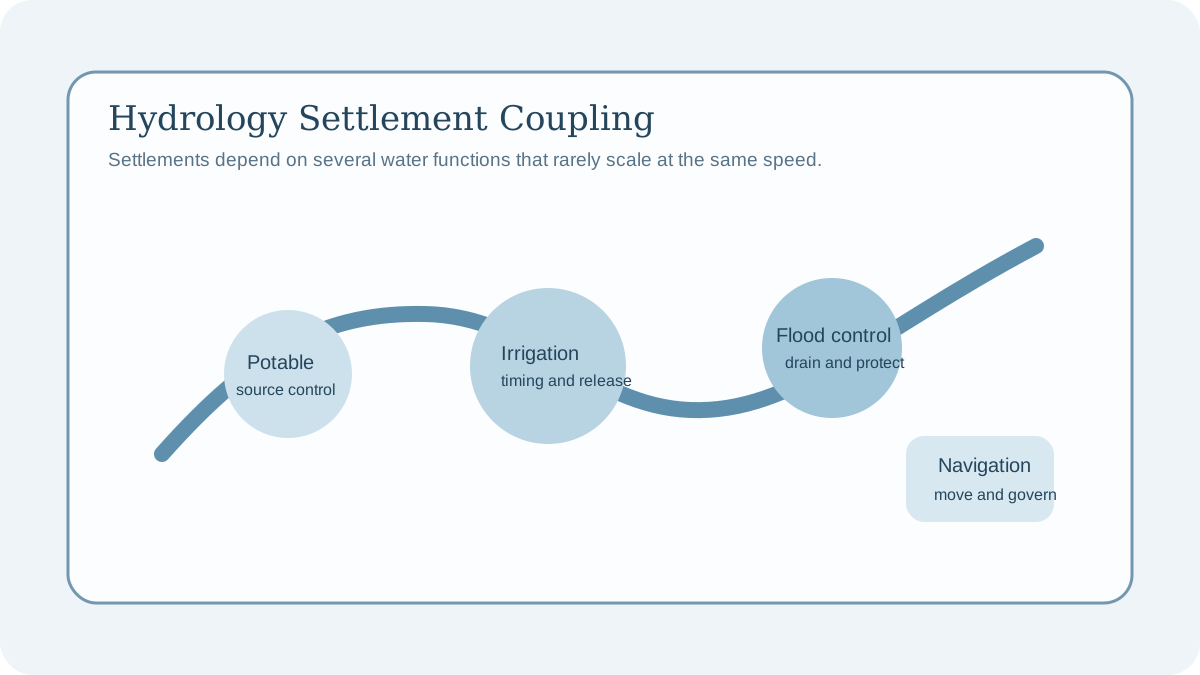
Settlements gather around water, but they also become dependent on different water functions that do not always align. Drinking water, crop water, drainage, flood control, and navigation can reinforce one another in one region and conflict sharply in another.
Hydrology settlement coupling turns water from background scenery into a structural bargain. Dense settlement becomes plausible only when a place can manage the water benefits it concentrates and the water risks it amplifies.
| Axis | Question | Signal |
|---|---|---|
| Potable supply | How does ordinary drinking water remain clean and accessible as density rises? | Springs, cisterns, aquifers, upland catchment, filtration, source protection |
| Productive water | How do crops, mills, fisheries, or pasture draw usable water without exhausting the base? | Irrigation timing, flood retreat farming, reservoir release, canal scheduling, wetland use |
| Protective control | What prevents flood, salinity, stagnation, or erosion from turning concentration into fragility? | Dikes, drainage channels, sluices, sediment clearing, embankments, marsh buffers |
| Navigable movement | How does water become a corridor for transport and administration rather than only a local input? | River ports, tow paths, lock chains, ferry crossings, canal depots, seasonal draft depth |
Which water function fails first when the region scales up or suffers disruption: drinking safety, irrigation timing, drainage, flood control, or navigation? That first failure usually tells you whether the setting is really a river civilization, a floodplain gamble, or an aquifer society pretending to be more stable than it is.
In River Port Polity, river access is not enough on its own; port hierarchy depends on storage, dredging, and flood behavior staying aligned. In Rift Aquifer Theocracy, hidden water security changes both legitimacy and settlement pattern because the aquifer is more politically decisive than surface geography alone. Ming Canal Logistics System is the other useful comparison when hydraulic maintenance and administrative coordination scale together.
The reusable lesson is that settlement around water should be modeled as a coupling between benefits and maintenance, not as free fertility. Once the water functions are separated, deltas, canal belts, oasis systems, and marsh cities become structurally distinct rather than cosmetically different.
Read what should come before it, what relation role matters next, and where this page should hand you off after the local graph is clear.
Start with Climate Rhythm Model and then return here once the surrounding concept stack is clear.
These entries clarify the footing underneath the current node before you move outward again. Start with Material Continuity Framework when you want the clearest next role.
Return to broader lenses when this model is too specific for the question you are asking.
3 handoff nodes stay inside World Foundations. 3 handoff nodes share Regional.
Detail pages now expose the branch and scale of their surrounding graph before showing raw prerequisite and relation shelves, so continuation can stay taxonomy-led instead of adjacency-led.
Explain how resources, goods, labor, information, and force circulate, stall, buffer, and break.
Start from the resource-flow loop, trace storage and throughput models, compare one logistics study, then run a flow audit worksheet.
Explain what the world is materially built from before politics, balance, or style are discussed.
Start in Worlds, read the anchor framework, open one regional model, validate with a complete study, then finish with a world assembly guide pass.
Explain how legitimacy, coercion, administrative reach, frontier bargaining, and elite control are structured.
Start with the pressure map, locate legitimacy and capture mechanisms, validate against a frontier or state case, then run a governance stress test.
Use this scale when the region is the main leverage unit for settlement, extraction, governance, or conflict.
Use this scale when routes, relays, buffers, and linked nodes matter more than territorial bulk.
Use this scale when the strongest explanation depends on several levels staying visible together.
Use this scale when the whole world model or planetary constraint pattern should stay visible at once.
Use prerequisites when you want the shortest path into the assumptions this page depends on.
A model for how repeating weather and seasonal windows structure labor, harvest timing, travel reliability, and crisis pacing across a world.
A planning frame for mapping how geography, settlement, resources, and transit form a region's structural identity.
These groups explain why each neighboring node matters, whether it stabilizes the concept, operationalizes it, proves it, or pushes the lane further.
Use foundation relations when this node depends on a concept, term, or framing layer that should be explicit before you branch further.
A framework for reading how food, water, health, and maintenance cycles must keep reproducing beneath settlement, surplus, and political order.
Use applied relations when the next useful move is to see the current pattern survive inside a study or assembled world.
A systems study of how estuaries, port warehousing, and toll control create a state that is wealthy, connective, and strategically exposed.
Use extension relations when the next move is not prerequisite or proof, but a deeper neighboring step in the same graph lane.
A model for how repeating weather and seasonal windows structure labor, harvest timing, travel reliability, and crisis pacing across a world.
These entries still matter, but they currently rely on generic adjacency instead of typed continuation semantics.
An assembled example world showing how deep water access, ritual infrastructure, and magical monopoly can produce a theocratic basin state that is rich in control but brittle at its hidden sources.
A historical study of how canal transport, grain reserves, courier timing, and administrative corridors helped hold a large imperial system together unevenly.
A location where flow is buffered, accumulated, protected, measured, or redirected strongly enough to change who can control the wider system.
Models formalize behavior. Use them when you need a concrete chain, loop, stress scenario, or layered mechanism that can be tested and reused.
A model should explain how something behaves over time or under pressure, not just identify a broad topic area.
When a setting feels plausible at rest but still behaves vaguely, models provide the explicit structure needed to test it.
A strong workflow often moves from broad lens to formal model to applied case reading.
Keep these collapsed until you want to turn the page into an active reading exercise.
What mechanism is this model making explicit?
Where does this model break or become most interesting under stress?
Which study would verify whether this model survives in a complete setting?
These routes are tuned to the kind of entry you are currently reading, so you can leave this page with one deliberate next move.
Return to broader lenses when this model is too specific for the question you are asking.
Cross-layer moveMove through the systems module when you want to navigate models by design intent.
Cross-layer moveVerify the model inside applied cases where multiple structures interact at once.