Preparing the current spcent route.
The page shell is online. Shared content and route data are still being assembled.
A systems study of how estuaries, port warehousing, and toll control create a state that is wealthy, connective, and strategically exposed.
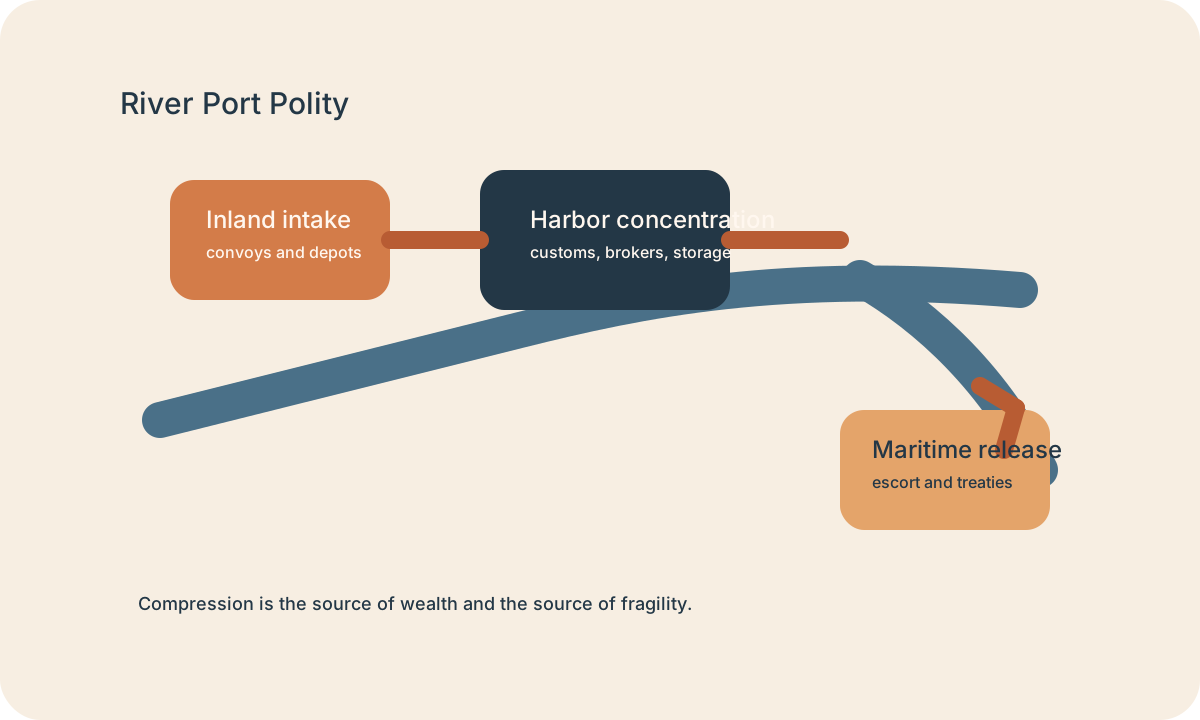
This polity sits where a navigable river meets the sea. Grain, timber, ore, and manufactured goods all compress through the same estuary before leaving for distant markets.
The result is exceptional revenue concentration, but also strategic exposure. Weather, piracy, blockade, or inland unrest can all break the system from different directions.
Barges, depots, and convoy towns gather the river hinterland into the estuary chain.
Warehouses, brokers, customs officials, and insurers decide where value is buffered and priced.
Escort, treaties, and shipping capacity determine how much port wealth can leave safely for distant markets.
Provides the layered regional frame for understanding hinterland supply and estuary concentration.
Resource Flow LoopExplains how extraction and redistribution depend on uninterrupted movement through the port chain.
Frontier Chokepoint LedgerShows why piers, narrows, and customs mouths become leverage points rather than neutral infrastructure.
The polity becomes rich by charging for passage, storage, brokerage, and protection. It becomes vulnerable because wealth depends on narrow gateways and timed coordination.
| Axis | Question | Signal |
|---|---|---|
| Inland intake | How does value enter the estuary system? | River barges, convoy towns, warehouse chains, customs checkpoints |
| Harbor concentration | Where is value buffered and priced? | Docks, bonded storage, shipyards, insurance houses |
| Maritime release | How does the polity project value outward? | Convoys, naval escort, tariff privileges, merchant treaties |
The polity gains leverage because river and sea movement cannot stay separate at the estuary. Goods have to be counted, buffered, repriced, and insured before they can leave the inland system and enter the maritime one. That conversion lets the state earn tolls, brokerage, and strategic knowledge from the same narrow set of timed surfaces.
The state usually weakens first through disrupted sequence rather than through the disappearance of trade altogether. If inland intake remains strong but harbor concentration fails, value piles up without becoming governable wealth. If maritime release weakens, warehouses turn from assets into exposed static stock. The case is useful because it separates movement from successfully monetized compression.
That distinction helps explain why busy ports can still become politically anxious and fiscally brittle under relatively modest disruption.
Port states often look open and cosmopolitan on the surface, but structurally they are chokepoint regimes. Their prosperity comes from compression, and the same compression makes them acutely disruption-sensitive.
That is why estuary polities often spend so much effort on customs discipline, warehousing standards, convoy timing, and harbor security. Their openness is real, but it depends on keeping a narrow release sequence working with very little slack. A river port polity is therefore best understood as a conversion machine that monetizes transition between inland and maritime systems rather than as a generic trade city with a flag. That framing also explains why such states are often wealthy, nervous, and intensely procedural at the same time. They live by making every transfer legible, taxable, and reversible before value disappears into the open sea. Once that conversion order breaks, commerce can remain busy while the state itself becomes brittle. Throughput alone does not save the polity. Order at the hinge is what matters.
Read what should come before it, what relation role matters next, and where this page should hand you off after the local graph is clear.
Start with Regional Systems Matrix and then return here once the surrounding concept stack is clear.
Use Regional Systems Matrix or the linked nodes below when you want to compare this page against neighboring parts of the graph.
Use Guides when the study should feed into a worksheet or structured revision sequence.
1 handoff nodes stay inside Flow And Logistics. 2 handoff nodes share Regional.
Detail pages now expose the branch and scale of their surrounding graph before showing raw prerequisite and relation shelves, so continuation can stay taxonomy-led instead of adjacency-led.
Explain how resources, goods, labor, information, and force circulate, stall, buffer, and break.
Start from the resource-flow loop, trace storage and throughput models, compare one logistics study, then run a flow audit worksheet.
Explain how legitimacy, coercion, administrative reach, frontier bargaining, and elite control are structured.
Start with the pressure map, locate legitimacy and capture mechanisms, validate against a frontier or state case, then run a governance stress test.
Explain what the world is materially built from before politics, balance, or style are discussed.
Start in Worlds, read the anchor framework, open one regional model, validate with a complete study, then finish with a world assembly guide pass.
Use this scale when the region is the main leverage unit for settlement, extraction, governance, or conflict.
Use this scale when routes, relays, buffers, and linked nodes matter more than territorial bulk.
Use prerequisites when you want the shortest path into the assumptions this page depends on.
A planning frame for mapping how geography, settlement, resources, and transit form a region's structural identity.
A model for how extraction, transport, storage, transformation, and redistribution create stability or fragility in a world system.
This entry still relies on generic related links. That works as a fallback, but typed relation roles would make continuation clearer.
A planning frame for mapping how geography, settlement, resources, and transit form a region's structural identity.
A model for how extraction, transport, storage, transformation, and redistribution create stability or fragility in a world system.
A framework for tracking which passes, ports, narrows, and crossings decide political leverage at the edge of a system.
Studies apply Spcent's lenses to complete cases. Read them to see whether geography, surplus, corridors, and pressure patterns still make sense when placed inside one setting.
The goal is not to retain setting trivia. The goal is to extract reusable patterns and structural habits you can reapply elsewhere.
Studies are strongest when you already know the frameworks and models underneath them, so you can recognize the structural moves being made.
After reading a study, identify which layer of your own draft needs work and go back there with one concrete change in mind.
Keep these collapsed until you want to turn the page into an active reading exercise.
What are the decisive regions, corridors, or chokepoints in this case?
What keeps the studied world stable, and what makes it brittle?
Which model or framework do I need next if I want to reproduce this pattern in my own project?
These routes are tuned to the kind of entry you are currently reading, so you can leave this page with one deliberate next move.
Use Guides when the study should feed into a worksheet or structured revision sequence.
Cross-layer moveReturn to the worlds module when the case highlights a weak worldbuilding layer in your own draft.
Cross-layer moveOpen models when the case reveals a mechanism you want to isolate and reuse directly.