Preparing the current spcent route.
The page shell is online. Shared content and route data are still being assembled.
A model for reading how quays, market courts, bonded yards, depot belts, and gate corridors stack inside a gateway city instead of collapsing into one abstract urban node.
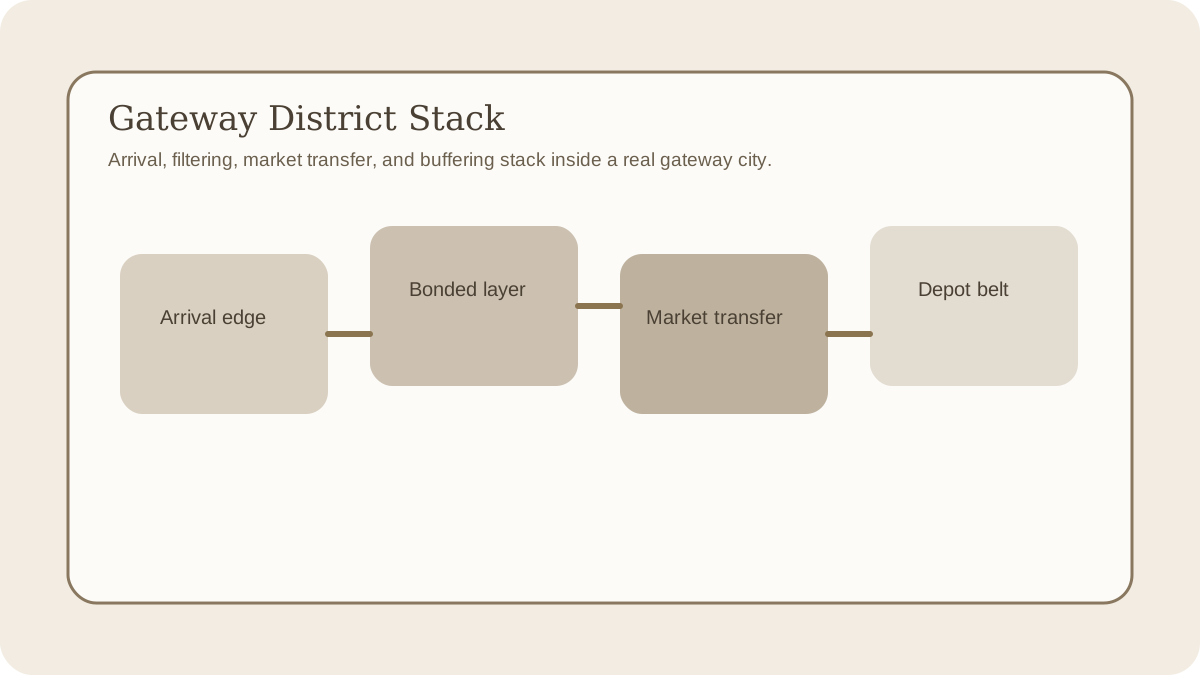
A gateway city is rarely one operational surface. Incoming cargo, people, permits, and escorts usually pass through several districts in sequence before they become usable regional leverage. The gateway district stack makes that sequence visible.
This model matters when a city is clearly important on the map but still acts like one abstract node. A real gateway usually has an arrival edge, an inspection or bonded layer, a market-transfer layer, and a deeper storage or redistribution belt. Those districts do different work and fail differently under stress.
| Axis | Question | Signal |
|---|---|---|
| Arrival edge | Where does outside movement first compress into the city? | Harbor face, river stairs, rail break, bridge gate, customs quay, pass mouth |
| Bonded or inspection layer | Where are cargo, people, and permits filtered or delayed before wider circulation? | Customs yards, bonded depots, quarantine docks, gatehouses, tally courts |
| Market-transfer layer | Where is flow sorted, priced, auctioned, or reassigned to other routes? | Market courts, caravan inns, exchange halls, canal basins, broker streets |
| Depot belt | Where does the city buffer reserve, maintenance, and onward dispatch? | Granaries, warehouse rows, arsenal yards, repair streets, escort mustering points |
If one incoming route surges or one gate closes, which district jams first: arrival edge, bonded layer, market-transfer layer, or depot belt? The answer reveals whether the city is a resilient transfer system or a thin gateway depending on one overburdened surface.
River Port Polity is the clearest existing example because port access, storage, and political coordination sit in different urban surfaces instead of one flat harbor icon. Venice Maritime Corridor System is the stronger maritime contrast when transfer sequence and protected storage make the city-system more decisive than any one pier.
The reusable lesson is that gateway cities should be modeled as district sequences. Once arrival, filtering, market transfer, and depot buffering are separated, congestion, taxation, and urban leverage become much easier to reason about.
Read what should come before it, what relation role matters next, and where this page should hand you off after the local graph is clear.
Start with Gateway City and then return here once the surrounding concept stack is clear.
These entries clarify the footing underneath the current node before you move outward again. Start with Urban Logistics Surface Framework when you want the clearest next role.
Return to broader lenses when this model is too specific for the question you are asking.
3 handoff nodes stay inside Urban And Regional Coupling. No handoff nodes currently share District.
Detail pages now expose the branch and scale of their surrounding graph before showing raw prerequisite and relation shelves, so continuation can stay taxonomy-led instead of adjacency-led.
Explain how cities work as filters, gateways, relays, conversion surfaces, and regional control machines.
Start with the urban logistics surface, step into gateway and throughput models, compare a port or capital study, then run a city-region worksheet.
Explain how resources, goods, labor, information, and force circulate, stall, buffer, and break.
Start from the resource-flow loop, trace storage and throughput models, compare one logistics study, then run a flow audit worksheet.
Explain how topology, region graphs, corridors, map abstraction, and scale determine movement and leverage.
Start in Spatial, reduce the map into region graph and corridor logic, test topology under disruption, then return through a spatial design guide.
Use this scale when city-scale transfer, concentration, or control is doing the main structural work.
Use this scale when the strongest explanation depends on several levels staying visible together.
Use this scale when routes, relays, buffers, and linked nodes matter more than territorial bulk.
Use this scale when the region is the main leverage unit for settlement, extraction, governance, or conflict.
Use prerequisites when you want the shortest path into the assumptions this page depends on.
A city whose importance comes from coordinating transfers between several movement layers rather than from local size alone.
A framework for reading cities as transfer surfaces where gateways, districts, depots, servicing radius, and hinterland demand converge into one operational field.
These groups explain why each neighboring node matters, whether it stabilizes the concept, operationalizes it, proves it, or pushes the lane further.
Use foundation relations when this node depends on a concept, term, or framing layer that should be explicit before you branch further.
A framework for reading cities as transfer surfaces where gateways, districts, depots, servicing radius, and hinterland demand converge into one operational field.
A city whose importance comes from coordinating transfers between several movement layers rather than from local size alone.
Use applied relations when the next useful move is to see the current pattern survive inside a study or assembled world.
A systems study of how estuaries, port warehousing, and toll control create a state that is wealthy, connective, and strategically exposed.
These entries still matter, but they currently rely on generic adjacency instead of typed continuation semantics.
A model for how relay settlements, market towns, ports, capitals, and depot cities differentiate by throughput, storage, administration, and coordination load.
A model for reducing a full map into a small graph of meaningful nodes, edges, weights, and transfer surfaces without losing the questions that matter operationally.
A structural study of how lagoon defense, convoy routes, warehouse depth, and gateway coordination turned Venice into a durable maritime corridor power.
Models formalize behavior. Use them when you need a concrete chain, loop, stress scenario, or layered mechanism that can be tested and reused.
A model should explain how something behaves over time or under pressure, not just identify a broad topic area.
When a setting feels plausible at rest but still behaves vaguely, models provide the explicit structure needed to test it.
A strong workflow often moves from broad lens to formal model to applied case reading.
Keep these collapsed until you want to turn the page into an active reading exercise.
What mechanism is this model making explicit?
Where does this model break or become most interesting under stress?
Which study would verify whether this model survives in a complete setting?
These routes are tuned to the kind of entry you are currently reading, so you can leave this page with one deliberate next move.
Return to broader lenses when this model is too specific for the question you are asking.
Cross-layer moveMove through the systems module when you want to navigate models by design intent.
Cross-layer moveVerify the model inside applied cases where multiple structures interact at once.