Preparing the current spcent route.
The page shell is online. Shared content and route data are still being assembled.
A model for how relay settlements, market towns, ports, capitals, and depot cities differentiate by throughput, storage, administration, and coordination load.
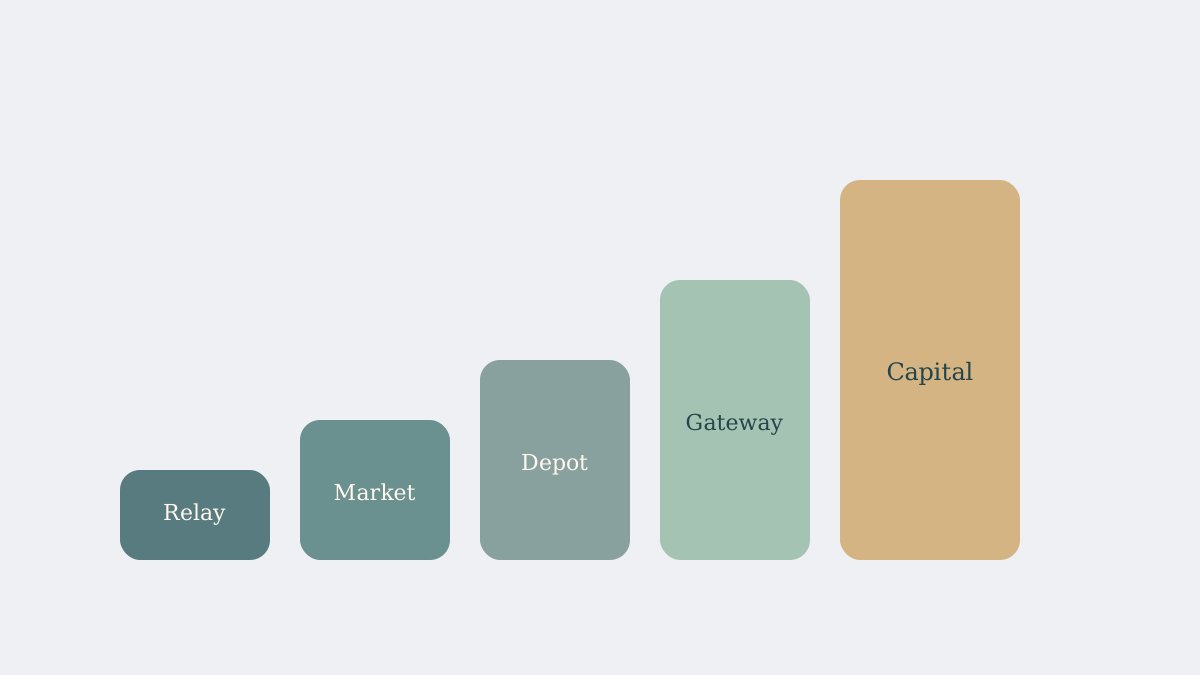
Urban hierarchy is not just size ranking. It is the uneven distribution of transport, storage, governance, and coordination roles across settlements. A relay settlement, depot city, port hub, and capital may all be large, but they do different structural work.
This model helps when a world has many named cities yet cannot explain why one is indispensable, why another is rich but politically weak, or why a third is administratively heavy but commercially thin.
Small but indispensable places that keep movement stitched together through storage, escorting, or crossing services.
Nodes that aggregate nearby production and translate local surplus into wider exchange.
Cities whose power comes from buffering, warehousing, and redistribution rather than ritual prestige alone.
Nodes that dominate because routes or transport layers convert there at unusual scale.
Cities that carry coordination, legitimacy, and administrative burden beyond their own immediate market footprint.
| Axis | Question | Signal |
|---|---|---|
| Relay settlement | What keeps movement alive here? | Crossing point, waystation, fodder market, caravan repair, garrison escort |
| Market town | What nearby production does this node aggregate? | Weekly exchange, rural intake, tax collection, craft conversion, merchant mediation |
| Depot city | How much reserve and redistribution load does it hold? | Granaries, warehouses, barracks, arsenals, fiscal offices |
| Gateway hub | Which route layers convert here? | River-sea transfer, pass mouth, canal lock, estuary customs, lift point |
| Capital | What coordination burden makes this node politically exceptional? | Court, archives, command chain, ceremonial legitimacy, administrative ministries |
One useful test is to remove a node and ask what disappears with it. If closing a port only delays trade slightly, it was never really a gateway hub. If losing a depot city immediately breaks military pacing and market confidence, that node was carrying far more than local population size suggests.
Urban hierarchy is not static. Relay towns can become gateway hubs when one border opens, capitals can weaken if coordination moves elsewhere, and depot cities can become politically decisive when reserve burden rises faster than ceremonial prestige. The model therefore helps explain not only what a city is now, but why its role changes under new transport, migration, or administrative conditions.
That makes hierarchy a moving systems question rather than a fixed population ranking. Cities rise or fall when the work they do for the wider network changes.
The reusable lesson is that city systems feel more believable when each important node has a structural job. Once the hierarchy is explicit, urban inequality, capital relocation, depot vulnerability, and migration stress all become easier to reason about.
The model also keeps revision work disciplined. Instead of making every large city do everything, it asks which node is paying for coordination, which one is buffering flow, and which one only looks important because of population scale. That usually produces cleaner maps and more believable urban rivalry. It also clarifies why certain cities fear losing rank.
Use this when repeated movement is thickening or destabilizing specific nodes along one corridor.
River Port PolityUse this as a case for gateway dominance, storage load, and political coordination concentrated inside one port-centered hierarchy.
Relay SettlementUse this when the first problem is distinguishing the smallest indispensable nodes from larger but less strategic towns.
Read what should come before it, what relation role matters next, and where this page should hand you off after the local graph is clear.
Start with Relay Settlement and then return here once the surrounding concept stack is clear.
These entries clarify the footing underneath the current node before you move outward again. Start with Relay Settlement when you want the clearest next role.
Return to broader lenses when this model is too specific for the question you are asking.
No handoff nodes currently stay inside Urban And Regional Coupling. No handoff nodes currently share Urban.
Detail pages now expose the branch and scale of their surrounding graph before showing raw prerequisite and relation shelves, so continuation can stay taxonomy-led instead of adjacency-led.
Explain how resources, goods, labor, information, and force circulate, stall, buffer, and break.
Start from the resource-flow loop, trace storage and throughput models, compare one logistics study, then run a flow audit worksheet.
Explain what the world is materially built from before politics, balance, or style are discussed.
Start in Worlds, read the anchor framework, open one regional model, validate with a complete study, then finish with a world assembly guide pass.
Use this scale when routes, relays, buffers, and linked nodes matter more than territorial bulk.
Use this scale when the region is the main leverage unit for settlement, extraction, governance, or conflict.
Use this scale when the whole world model or planetary constraint pattern should stay visible at once.
Use prerequisites when you want the shortest path into the assumptions this page depends on.
A settlement whose main structural role is to pass movement onward by offering storage, handoff, repair, taxation, escort, or communication continuity.
A location where flow is buffered, accumulated, protected, measured, or redirected strongly enough to change who can control the wider system.
These groups explain why each neighboring node matters, whether it stabilizes the concept, operationalizes it, proves it, or pushes the lane further.
Use foundation relations when this node depends on a concept, term, or framing layer that should be explicit before you branch further.
A settlement whose main structural role is to pass movement onward by offering storage, handoff, repair, taxation, escort, or communication continuity.
A location where flow is buffered, accumulated, protected, measured, or redirected strongly enough to change who can control the wider system.
Use applied relations when the next useful move is to see the current pattern survive inside a study or assembled world.
A systems study of how estuaries, port warehousing, and toll control create a state that is wealthy, connective, and strategically exposed.
These entries still matter, but they currently rely on generic adjacency instead of typed continuation semantics.
A framework for reading a world from climate rhythm, terrain friction, habitability, circulation, and settlement thresholds before higher-order institutions are added.
A planning frame for mapping how geography, settlement, resources, and transit form a region's structural identity.
A model for how repeated displacement, opportunity seeking, and frontier movement consolidate into durable corridors that reshape identity, labor, and political load.
Models formalize behavior. Use them when you need a concrete chain, loop, stress scenario, or layered mechanism that can be tested and reused.
A model should explain how something behaves over time or under pressure, not just identify a broad topic area.
When a setting feels plausible at rest but still behaves vaguely, models provide the explicit structure needed to test it.
A strong workflow often moves from broad lens to formal model to applied case reading.
Keep these collapsed until you want to turn the page into an active reading exercise.
What mechanism is this model making explicit?
Where does this model break or become most interesting under stress?
Which study would verify whether this model survives in a complete setting?
These routes are tuned to the kind of entry you are currently reading, so you can leave this page with one deliberate next move.
Return to broader lenses when this model is too specific for the question you are asking.
Cross-layer moveMove through the systems module when you want to navigate models by design intent.
Cross-layer moveVerify the model inside applied cases where multiple structures interact at once.