Preparing the current spcent route.
The page shell is online. Shared content and route data are still being assembled.
A model for how walls, canals, customs lines, policing regimes, class barriers, and street hierarchy make some urban districts easy to cross and others selectively closed.
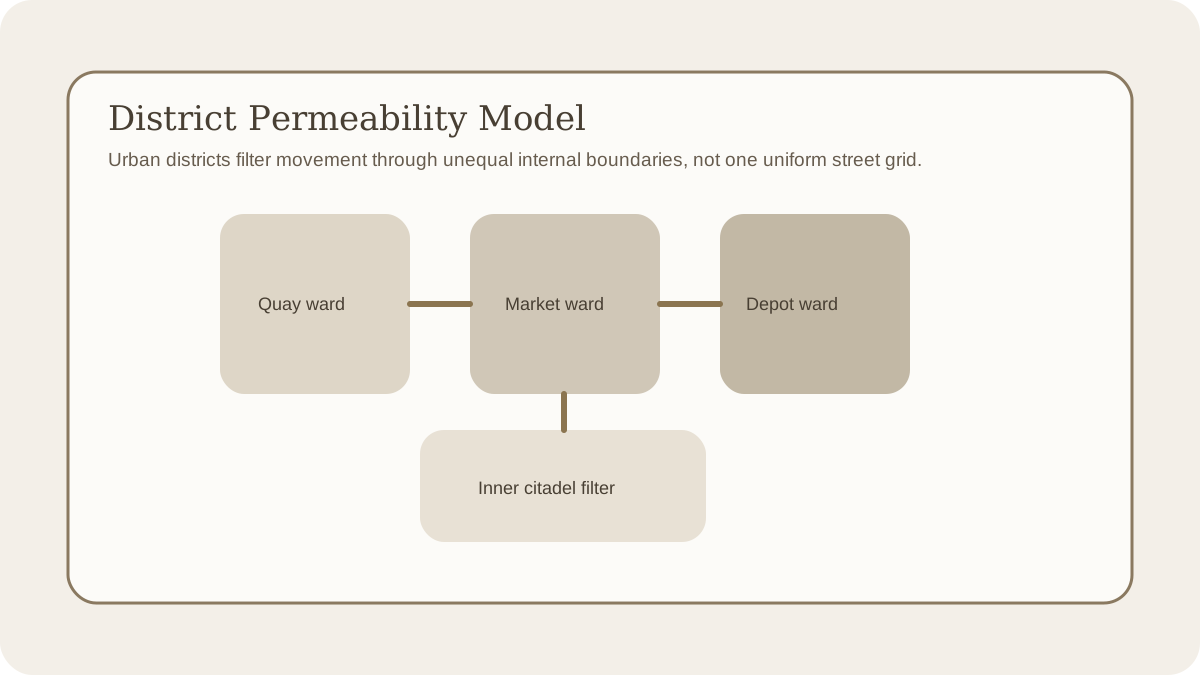
Cities often behave like miniature border systems. Streets, canals, gates, customs lines, class separation, and policing patterns make some districts easy to cross and others selectively closed. The district permeability model reads those internal differences as structural filters rather than as background atmosphere.
This matters because a city can look dense and connected on a map while still forcing different actors through very different movement regimes. Merchants may pass one canal district freely, laborers may be delayed at ward gates, and military movement may bypass busy markets altogether. Internal permeability changes urban leverage.
| Axis | Question | Signal |
|---|---|---|
| Physical filter | Which streets, canals, walls, and gates make crossing easier or harder by route alone? | Bridges, culverts, ward walls, dead-end lanes, tow canals, guarded causeways |
| Regulatory filter | Where do permits, customs, tallying, or inspections add selective friction? | Quarantine basins, customs posts, bonded streets, tax cordons, curfew gates |
| Social filter | Which groups can move, dwell, or trade across districts on unequal terms? | Guild enclaves, patrician wards, labor quarters, foreign districts, restricted docks |
| Crisis filter | How does permeability change under riot, epidemic, siege, or convoy surge? | Lockdowns, barricades, escort corridors, emergency closures, ration lines, patrol concentration |
If the city faces smuggling, epidemic, or military panic, which district becomes selectively closed first and which route stays open for priority traffic? That answer reveals the city's true internal hierarchy more clearly than peacetime street maps.
Venice Maritime Corridor System is a useful example because urban water routes, storage zones, and guarded transfer surfaces create unequal internal permeability despite a compact city form. River Port Polity offers the riverine contrast where customs, docks, and store belts filter movement differently even inside one port-centered city.
The reusable lesson is that cities should be modeled as internally uneven movement fields. Once district permeability is explicit, congestion, control, and social segregation stop feeling like separate urban topics and start reading as one operational structure.
Read what should come before it, what relation role matters next, and where this page should hand you off after the local graph is clear.
Start with Border Permeability Model and then return here once the surrounding concept stack is clear.
These entries clarify the footing underneath the current node before you move outward again. Start with Urban Logistics Surface Framework when you want the clearest next role.
Return to broader lenses when this model is too specific for the question you are asking.
2 handoff nodes stay inside Urban And Regional Coupling. 1 handoff nodes share District.
Detail pages now expose the branch and scale of their surrounding graph before showing raw prerequisite and relation shelves, so continuation can stay taxonomy-led instead of adjacency-led.
Explain how resources, goods, labor, information, and force circulate, stall, buffer, and break.
Start from the resource-flow loop, trace storage and throughput models, compare one logistics study, then run a flow audit worksheet.
Explain how cities work as filters, gateways, relays, conversion surfaces, and regional control machines.
Start with the urban logistics surface, step into gateway and throughput models, compare a port or capital study, then run a city-region worksheet.
Explain how technology, magic, infrastructure, communication, and transformation capacity rewrite baseline constraints.
Start with the operating regime, price the capability through diffusion or monopoly models, compare a regime-rewrite case, then run a capability sanity check.
Use this scale when routes, relays, buffers, and linked nodes matter more than territorial bulk.
Use this scale when the region is the main leverage unit for settlement, extraction, governance, or conflict.
Use this scale when internal city geometry or gateway-district filtering is the level that matters most.
Use this scale when city-scale transfer, concentration, or control is doing the main structural work.
Use prerequisites when you want the shortest path into the assumptions this page depends on.
A model for comparing how borders change crossing cost, asymmetry, inspection burden, and rerouting behavior for different actors and flows.
A model for reading how quays, market courts, bonded yards, depot belts, and gate corridors stack inside a gateway city instead of collapsing into one abstract urban node.
These groups explain why each neighboring node matters, whether it stabilizes the concept, operationalizes it, proves it, or pushes the lane further.
Use foundation relations when this node depends on a concept, term, or framing layer that should be explicit before you branch further.
A framework for reading cities as transfer surfaces where gateways, districts, depots, servicing radius, and hinterland demand converge into one operational field.
Use operationalizing relations when you want the current abstraction rendered as a cleaner model, loop, or structural device.
A model for reading how quays, market courts, bonded yards, depot belts, and gate corridors stack inside a gateway city instead of collapsing into one abstract urban node.
Use extension relations when the next move is not prerequisite or proof, but a deeper neighboring step in the same graph lane.
A model for comparing how borders change crossing cost, asymmetry, inspection burden, and rerouting behavior for different actors and flows.
These entries still matter, but they currently rely on generic adjacency instead of typed continuation semantics.
A model for explaining how courier time, relay density, verification delay, and command visibility reshape coordination, legitimacy, and operational response.
A structural study of how lagoon defense, convoy routes, warehouse depth, and gateway coordination turned Venice into a durable maritime corridor power.
A systems study of how estuaries, port warehousing, and toll control create a state that is wealthy, connective, and strategically exposed.
Models formalize behavior. Use them when you need a concrete chain, loop, stress scenario, or layered mechanism that can be tested and reused.
A model should explain how something behaves over time or under pressure, not just identify a broad topic area.
When a setting feels plausible at rest but still behaves vaguely, models provide the explicit structure needed to test it.
A strong workflow often moves from broad lens to formal model to applied case reading.
Keep these collapsed until you want to turn the page into an active reading exercise.
What mechanism is this model making explicit?
Where does this model break or become most interesting under stress?
Which study would verify whether this model survives in a complete setting?
These routes are tuned to the kind of entry you are currently reading, so you can leave this page with one deliberate next move.
Return to broader lenses when this model is too specific for the question you are asking.
Cross-layer moveMove through the systems module when you want to navigate models by design intent.
Cross-layer moveVerify the model inside applied cases where multiple structures interact at once.