Preparing the current spcent route.
The page shell is online. Shared content and route data are still being assembled.
A model for explaining how courier time, relay density, verification delay, and command visibility reshape coordination, legitimacy, and operational response.
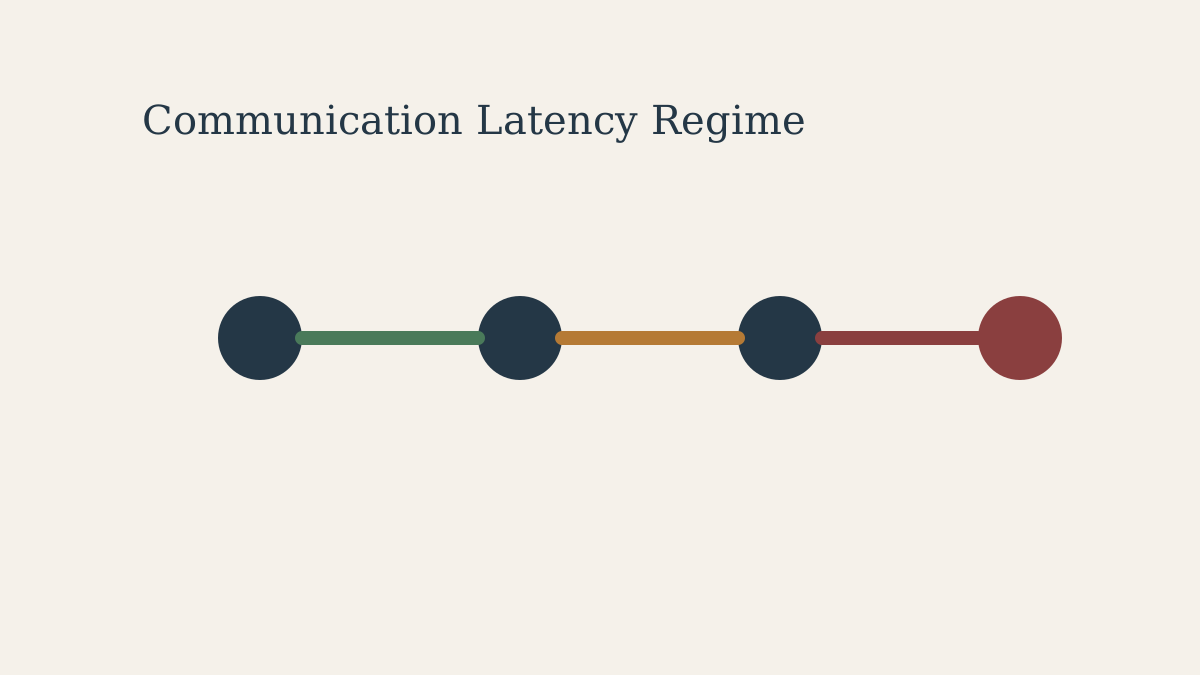
Systems rarely operate at the speed of the map. They operate at the speed of message movement, verification, and release authority. The communication latency regime makes those delays explicit.
This is useful because delayed communication changes more than convenience. It changes who can improvise, how much legitimacy a center retains, and whether reserves or repairs arrive in time to matter.
The regime becomes especially important when transport and command no longer share the same tempo. Supplies may still move, but if decisions lag behind them the system starts acting on stale pictures of itself.
| Axis | Question | Signal |
|---|---|---|
| Courier speed | How fast can orders and reports move between key nodes? | Relay horses, signal towers, packet routes, secure channels, jump-gate relays |
| Verification delay | How long until information is trusted enough to act on? | Double reporting, seals, bureaucracy review, sensor confirmation, witness lag |
| Release authority | Who can spend reserves or redirect force without waiting? | Delegated governors, local commanders, reserve keys, emergency mandates |
| Coordination drift | What mismatch appears while actors are waiting on the same event? | Duplicated effort, stale orders, delayed relief, rumor authority, local bargaining |
Use the model when a state, faction, or platform claims wide reach but seems strangely slow or brittle in practice. The fastest check is whether crisis pace is faster than message pace. If it is, local actors start governing by improvisation, stockpiles are released too late, and legitimacy becomes uneven.
Defines the routes that keep messages, permits, and reserve release governable at all.
Strategic Reserve NetworkShows why reserves fail when authorization and visibility arrive later than the disruption.
Ming Canal Logistics SystemApplies the model to a grain-and-command corridor where transport and information remain tightly coupled.
The reusable lesson is that control depends on response time, not only on territorial claim. Model communication latency whenever you need to explain why a large system governs unevenly, releases aid late, or fractures into local initiative under stress.
Read what should come before it, what relation role matters next, and where this page should hand you off after the local graph is clear.
Start with Administrative Load and then return here once the surrounding concept stack is clear.
These entries clarify the footing underneath the current node before you move outward again. Start with Administrative Corridor when you want the clearest next role.
Return to broader lenses when this model is too specific for the question you are asking.
No handoff nodes currently stay inside Capability Regimes. 3 handoff nodes share Network.
Detail pages now expose the branch and scale of their surrounding graph before showing raw prerequisite and relation shelves, so continuation can stay taxonomy-led instead of adjacency-led.
Explain how legitimacy, coercion, administrative reach, frontier bargaining, and elite control are structured.
Start with the pressure map, locate legitimacy and capture mechanisms, validate against a frontier or state case, then run a governance stress test.
Explain how resources, goods, labor, information, and force circulate, stall, buffer, and break.
Start from the resource-flow loop, trace storage and throughput models, compare one logistics study, then run a flow audit worksheet.
Use this scale when the strongest explanation depends on several levels staying visible together.
Use this scale when routes, relays, buffers, and linked nodes matter more than territorial bulk.
Use prerequisites when you want the shortest path into the assumptions this page depends on.
The cumulative burden of governing, coordinating, recording, supplying, and enforcing order across a territory or institution.
The practical distance and depth over which an actor can reliably enforce compliance through force, threat, escort, or punitive response.
These groups explain why each neighboring node matters, whether it stabilizes the concept, operationalizes it, proves it, or pushes the lane further.
Use foundation relations when this node depends on a concept, term, or framing layer that should be explicit before you branch further.
A route whose main importance lies in keeping orders, permits, reserves, and repair capacity moving reliably enough for governance to hold.
A framework for mapping how flow, capture, legitimacy, coalition strain, and force sustainment combine into one escalating system rather than separate mechanics.
Use applied relations when the next useful move is to see the current pattern survive inside a study or assembled world.
A historical study of how canal transport, grain reserves, courier timing, and administrative corridors helped hold a large imperial system together unevenly.
These entries still matter, but they currently rely on generic adjacency instead of typed continuation semantics.
A model for locating where reserves are stored, who can release them, and how fast they can stabilize the wider system under delay, shock, or surge.
Models formalize behavior. Use them when you need a concrete chain, loop, stress scenario, or layered mechanism that can be tested and reused.
A model should explain how something behaves over time or under pressure, not just identify a broad topic area.
When a setting feels plausible at rest but still behaves vaguely, models provide the explicit structure needed to test it.
A strong workflow often moves from broad lens to formal model to applied case reading.
Keep these collapsed until you want to turn the page into an active reading exercise.
What mechanism is this model making explicit?
Where does this model break or become most interesting under stress?
Which study would verify whether this model survives in a complete setting?
These routes are tuned to the kind of entry you are currently reading, so you can leave this page with one deliberate next move.
Return to broader lenses when this model is too specific for the question you are asking.
Cross-layer moveMove through the systems module when you want to navigate models by design intent.
Cross-layer moveVerify the model inside applied cases where multiple structures interact at once.